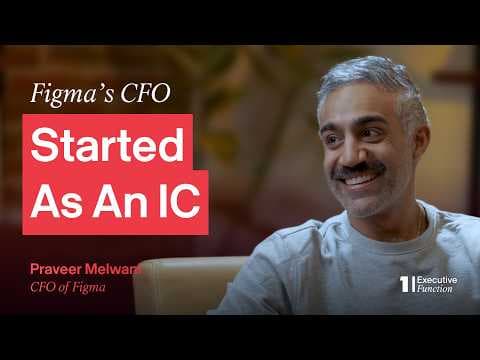
Figma’s CFO on going public, AI, and working alongside Dylan Field | Praveer Melwani
Audio Summary
AI Summary
The speaker discusses their career trajectory, starting in investment banking and moving through various finance roles at companies like Dropbox and NerdWallet before landing at Figma, where they ultimately became CFO. They attribute their success to a combination of luck, timing, and a proactive approach to learning and problem-solving.
Early in their career, the speaker joined Figma as an individual contributor, drawn to the early-stage company's potential and the opportunity to learn and contribute across various functions. They describe their initial responsibilities as primarily finance and accounting-focused, including managing outsourced bookkeeping, overseeing early monetization efforts, and collaborating with the product team on pricing and packaging. They also played a role in the company's Series B fundraising.
A significant turning point occurred when the COO left about a year into the speaker's tenure. This created a void in operational areas, including legal, security, compliance, and sales operations. The speaker eagerly stepped in, viewing it as an exciting opportunity to learn and build new functions from the ground up. This involved hiring key personnel, such as the General Counsel, and developing an understanding of what "great" looked like in these new domains. They emphasize the importance of asking the right questions and empowering new hires to succeed.
A core part of their growth involved learning to build alignment within the executive team. Initially, they relied heavily on data and spreadsheets, assuming others would grasp their reasoning. However, they quickly realized that influencing stakeholders required understanding their motivations and perspectives. This led to developing skills in communication and influence, which they consider crucial for their continued growth.
An example of this influence in action was navigating the transition from a purely subscription-based model to one that incorporated consumption-based pricing for Figma's products. This involved developing a shared understanding across the leadership team and the broader company about the new financial model, cost structures, user choices, and the creation of a new pricing currency. The process required presenting external market analysis, financial projections, and user behavior insights, while remaining open to feedback and iterative adjustments.
Reflecting on their past, the speaker notes a greater appreciation for end-users and community-led growth. Initially, they might have focused solely on the P&L implications, but now understand the interconnectedness of user engagement and business success. They also highlight the importance of balancing speed with creativity, particularly when developing pricing strategies, and being open to feedback from the product team.
The speaker's approach to learning new things involves seeking out experts, conducting thorough groundwork, and learning through experimentation. They are open to making progress on initiatives that are not "one-way doors," allowing for flexibility and quicker movement. They emphasize the importance of identifying decisions that are difficult to reverse and treating them with extra care.
When seeking advice from experts or peer CFOs, the speaker focuses on understanding the underlying problems and questions being addressed. They use these interactions as opportunities for thought partnership, providing additional context to foster a more productive exchange. This process helps them build a peer group and an internal board for idea riffing.
They believe there isn't a one-size-fits-all CFO role, as it varies significantly by industry and company context. For Figma, as a public company, the CFO role involves being a steward of the business, presenting well to investors, and ensuring long-term business durability. This includes creating guardrails for execution that allow for speed without being overly burdensome, maintaining high compliance standards, and fostering an operational and intellectually curious finance team. The role also encompasses Investor Relations (IR) and storytelling, an area they've developed over time to support the CEO. They aim to protect the CEO's time, allowing them to focus on product and business strategy. Navigating investor relationships, from venture capital to public market funds, requires adapting the level of detail and altitude of communication.
The difference between a good and a world-class CFO, in their view, lies in intellectual curiosity and the willingness to ask second and third-order questions. A good CFO might be a "traffic cop," but a world-class CFO acts as a strategic arm of the company, understanding unique business drivers and informing long-term investment decisions. They find joy in deep dives into business metrics and experiments, pushing for change and understanding root causes.
In the post-ChatGPT era, capital allocation and risk-taking have evolved. The speaker notes an "asymptotic" increase in software creation due to AI coding agents, presenting both opportunities and costs. The focus shifts to design, craft, and point of view as differentiators. Figma has relaxed some constraints, such as reducing gross margins to invest in AI products, recognizing the need to widen participation while thinking long-term. They also emphasize organizational effectiveness and efficiency through AI tools, aiming to augment existing staff output and remove manual toil. This allows for more aggressive investment strategies and a willingness to take on more bets, even those with a higher risk of failure, in pursuit of defining power-law opportunities.
The company has doubled its product portfolio and rapidly developed new tools like "Figma Make." The speaker believes that integrating and leveraging AI tools is crucial for staying relevant, and that the ability to refine, move quickly, and learn from failures is paramount. Traditional forecasting methodologies in spreadsheets are becoming legacy, with a preference for more dynamic, multi-methodological approaches.
The long-standing relationship with Figma's founder and CEO, Dylan, is highlighted as a significant benefit. This longevity has built deep trust, enabling the speaker to operate autonomously and understand when to involve the CEO. They assume good intent and operate from a shared context of wanting the best for the company. This relationship allows for candid feedback and a mutual understanding of each other's tendencies. While the business context and judgment gained over time are invaluable, the speaker evangelizes building strong relationships and gaining deep business understanding, regardless of tenure.
Within their own organization, the speaker aims for a shared context across the leadership team, allowing them to zoom in and out of details as needed. They value leaders who are first-principles thinkers, can live in the details, and prioritize team-first over individual success. They have a bias towards promoting from within but recognize the need to make difficult decisions when individuals aren't growing at the pace of the organization. Transparency in hiring is crucial to ensure long-term success.
The unique aspect of their executive team is the majority having a tenure of four-plus years, fostering a deep understanding and shared "scar tissue" from growing the organization together, both professionally and personally. This shared experience, often as first-time executives, allows for a "no priors" approach, learning and adapting without pre-conceived notions.
The company's strategy of acting like a public company before becoming one was initiated when an IPO felt like an inevitable outcome. This involved hiring key personnel like an IR leader and a controller, and establishing processes. The Adobe acquisition temporarily paused this, but the underlying thesis of Figma operating as a standalone business allowed them to continue preparing. Mock earnings calls, engagement with public market investors, and a larger secondary offering were part of this preparation. The speaker believes they did this at the appropriate time, avoiding undue process too early but completing the necessary groundwork efficiently. The benefits of being a public company include greater degrees of freedom, especially in total compensation and talent retention, even with a depressed stock price.
Finally, the speaker hopes that when they are not in the room, they are remembered for showing up prepared, asking good questions, not slowing others down, bridging perspectives, and for building a team that others are proud to be a part of.