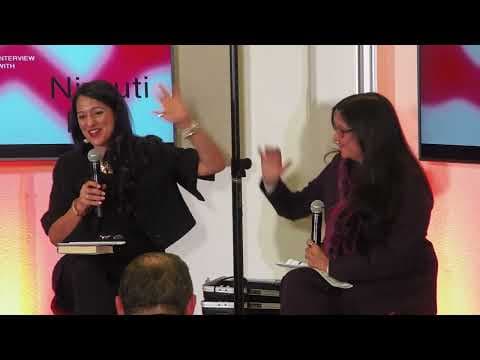
Overcoming Obstacles, Inspiring Change | Nivruti Rai | TEDxBerlin Salon
Audio Summary
AI Summary
The conversation features an interview with the CEO of Invest India, who shares her journey and insights on artificial intelligence. The interviewer begins by highlighting the CEO's path, noting that despite being born in India, she moved to the US for her bachelor's degree and initially faced challenges with its recognition, requiring two additional years of study. This leads to a discussion on the progress of women in leadership roles, contrasting the perceived limitations in the US with the more prominent presence of women in leadership positions in Asia.
The CEO recounts her 30-year career at Intel, with 15 years spent in the US and 15 in India. She shares a personal anecdote about her promotion within Intel. Despite being a "hardcore technologist," her American colleagues found it difficult to believe she had reached a Grade 10 level, a position equivalent to a principal engineer, simply due to her appearance or gender. This disbelief was not limited to men but also extended to women, and both Indians and non-Indians, illustrating a broader societal challenge in recognizing capabilities beyond superficial characteristics. Over time, however, she developed a resilience, stating that she has "toughened up so much" that difficulties no longer faze her. She illustrates this with Urdu couplets by Mirza Ghalib, which speak of becoming so accustomed to hardships that they cease to be perceived as difficult, a sentiment that she feels summarizes her own journey as a technologist and a woman who embraces her individuality.
The discussion then shifts to artificial intelligence (AI). The interviewer expresses concerns about the rapid adoption of AI, suggesting that society might be "sleepwalking" into a future where the negative impacts, such as job displacement, become apparent only after it's too late. She points out the current difficulty for university graduates to find employment and questions the focus on AI when there is a vast pool of human capital in India.
The CEO counters this by emphasizing the value AI can create, focusing on two key areas: precision and efficiency. She uses the example of orthopedic surgeries, where robotic precision significantly reduces recovery time compared to manual procedures. In terms of efficiency, she relates it to complex statistical methods like Monte Carlo simulations, which AI can perform at a much larger scale due to advancements in computing power and miniaturization of transistors, as seen in the semiconductor industry. She also notes the increasing availability of power, including renewable energy, which is crucial for AI's computational demands.
However, the CEO acknowledges the challenges related to decision-making and invention within AI, particularly concerning cultural nuances. She raises the point that AI developed predominantly in the US and China might not align with the cultural values of other regions like Europe, Asia, or Africa. This leads to the concept of "AI diplomacy," where cultural layers will be essential for AI to make decisions that are contextually appropriate. She illustrates this with the hypothetical scenario of an AI in a BMW prioritizing the lives of its passengers over children crossing the road, a decision that might differ based on cultural values.
She argues that AI, like human societies, will require regulatory and institutional frameworks. She believes that India, with its large population, will not lose jobs to AI but rather see a transformation of roles. She envisions India becoming a leader in creating "agentic software people" and agents, working collaboratively with other countries. This focus on building the creators and architects of AI systems, rather than just users, is how India will maintain its workforce.
Finally, the conversation touches upon the crucial aspect of values in AI. The CEO stresses the need for global standardization of ethical guidelines, similar to legal systems, to define what is right and wrong in AI. She acknowledges that while universal principles like "theft is wrong" exist, morality can be subjective and differ based on context, citing personal experiences during the COVID-19 pandemic. She believes that smart individuals worldwide will work together to establish these ethical frameworks, ensuring that AI is developed and deployed responsibly, with consideration for both human values and cultural diversity.