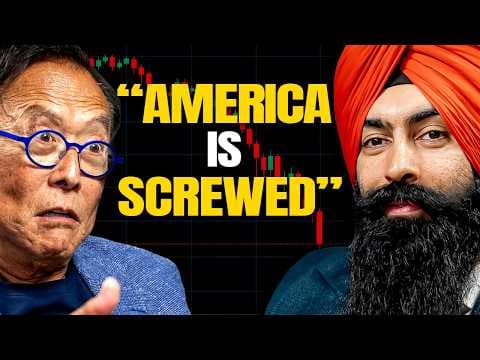
How To Make Millions In The Upcoming Market Crash | Robert Kiyosaki & Jaspreet Singh
Audio Summary
AI Summary
The speaker, Robert Kiyosaki, expresses strong concerns about the potential collapse of the American Empire, possibly by 2026, due to the nation's overwhelming debt. He argues that the US is past the point of no return regarding its financial situation and criticizes the government's monetary policies, particularly the decision in 1971 to take the dollar off the gold standard. This, he states, led to unchecked money printing, resulting in the current $39 trillion national debt and massive off-balance sheet liabilities, totaling potentially $260 trillion.
Kiyosaki believes that the current economic system is fundamentally flawed and that traditional retirement plans like 401(k)s, which are tied to the stock market, are unreliable and set up for failure, especially for the boomer generation. He draws parallels to historical events, such as the Weimar Republic's hyperinflation after World War I, to illustrate the potential consequences of excessive money printing and debt. He also references Thomas Jefferson's warning about the dangers of a central bank controlling the money supply.
A significant portion of the discussion revolves around the concept of "cash flow" and investing in what you understand. Kiyosaki shares his personal success with oil wells, emphasizing that he owns the production rather than just stocks, which he believes provides more direct and reliable income. He contrasts this with the volatility of the stock market and the uncertainty of 401(k)s. He also highlights the importance of understanding basic economic principles, likening them to kindergarten lessons, such as depreciation and amortization, which can be used for tax advantages.
The speaker is critical of the education system, which he deems "Marxist" and "criminal" for not teaching financial literacy. He believes this lack of education leaves people vulnerable and unable to protect themselves from economic downturns. He uses the example of a friend who became wealthy by reinvesting profits from selling eggs, illustrating that wealth can be built through simple, understandable businesses if one focuses and reinvests.
Artificial intelligence (AI) is another major topic. Kiyosaki predicts that AI will lead to massive job displacement, affecting professions like doctors, lawyers, and teachers, in addition to current jobs like Uber drivers. He uses the example of a woman pursuing her third master's degree while driving for Uber, highlighting the disconnect between advanced education and job security in the face of technological advancement. He believes that AI is already automating entry-level jobs and will continue to do so at an unprecedented pace.
Kiyosaki also touches upon the growing divide between the rich and the poor. He argues that attempts to "tax the rich" are misguided and lead to capital flight, citing California's experience. He asserts that the wealthy are financially educated and utilize the tax code as intended by the government to incentivize certain investments, such as real estate and oil drilling. He views these tax breaks not as loopholes but as mechanisms of capitalism that encourage economic activity.
Regarding personal finance, Kiyosaki advises individuals to invest in what they know and to be proactive in their financial education. He suggests that at age 30, people should assess their financial situation and question why they are not "rich" (defined as having passive income that covers expenses). He advocates for investing in assets that generate cash flow, such as apartment buildings and oil wells, rather than liabilities like a primary residence. He also expresses confidence in Bitcoin and Ethereum, seeing them as alternative forms of money alongside gold and silver, which he refers to as "God's money."
He dismisses the idea of the US returning to a gold standard, stating it's too late. He also expresses skepticism about US bonds, noting that countries like Japan and China are divesting from them. Kiyosaki's ultimate message is one of urgency and the need for financial education to navigate the complex and potentially catastrophic economic landscape. He believes that the current system is unsustainable and that individuals must take responsibility for their financial future by understanding how money works and investing wisely.
He concludes by reiterating that the core problem is the dollar's value, which is eroding due to constant money printing. He suggests that the end of the American Empire might be near, referencing historical parallels and even prophetic predictions for 2026. His final advice is to invest in tangible assets like gold, silver, Bitcoin, and to focus on understanding and generating cash flow. He also plugs his "Cashflow" board game as a tool for learning financial principles.