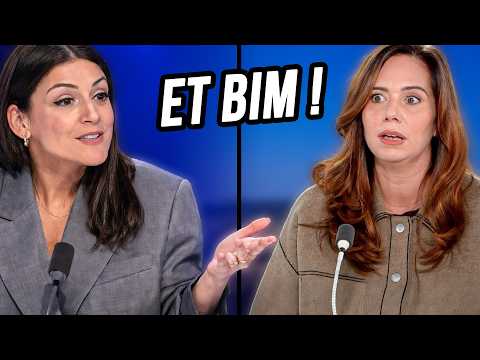
Knafo : la terreur des journalistes
AI Summary
The following summary analyzes the media strategies and televised interventions of Sarah Knafo, specifically focusing on her recent appearances during the municipal election period. According to the transcript, Knafo has become a figure whose television appearances are highly anticipated for their confrontational nature, often described as "croustillant" (juicy) segments that provide significant material for analysis.
### The Shift in Media Dynamics
The narrator observes that journalists adopt a fundamentally different posture when interviewing Knafo compared to centrist or traditional political figures like François Hollande or Nicolas Sarkozy. While journalists are usually confident and relaxed arbiters with "classic" politicians, they exhibit an unusual prudence or defensive aggression with Knafo. This is partly due to the high level of public distrust toward the media in France. Knafo understands this context and exploits the "failings" of the journalistic system. Her strategy, particularly on social media platforms like X, prioritizes sharing clips of journalistic "clashes" and duels over videos simply explaining her political program.
### The Psychology of the Interview
The transcript highlights that the traditional power balance—where the journalist maintains total control—is often fractured during Knafo’s interviews. Journalists, aware of her reputation for being combative, often start with shorter questions or more aggressive follow-ups to compensate for their own nervousness. In some cases, they adopt a cold, administrative posture. The narrator points out that the "control room" (la régie) behind the scenes is likely on edge during these segments because Knafo does not hesitate to challenge the neutrality and impartiality of public service media. She frequently cites Arcom (the French media regulator) decisions or alleged errors in polling data to put the journalists themselves on the defensive.
### Technique 1: The Power of Reframing (OQTF Example)
In one analyzed extract concerning the execution of deportation orders (OQTF), the journalist attempts to frame the data as a sign of progress, noting a rise in interpellations. Knafo immediately turns the tables by asking the journalist if she knows the actual execution rate. When the journalist hesitates, Knafo reveals it is less than 10%.
The narrator identifies this as a "reframing" tactic. Instead of accepting the journalist's narrative of "10% progress," Knafo labels it a "90% failure." She uses a private-sector analogy, arguing that any business owner with a 90% failure rate would be fired. This forced the journalist into a long, awkward silence—a "blanc"—where she had no immediate counter-argument. This technique transforms a "half-full glass" into a "completely broken glass," making the journalist's attempt to defend the policy appear absurd.
### Technique 2: Role Enforcement (The "Candidate" Trap)
During an interview regarding her program for Paris, a journalist repeatedly interrupted Knafo, attempting to drown out her arguments and create a "cacophony." This is described as a "tactique d'empêchement" (prevention tactic) often used against candidates from the political extremes to make their ideas inaudible.
Knafo’s response was not to lose her temper but to "snipe" the journalist by questioning his role. She asked if he was a candidate for the mayor of Paris. When he admitted he was not a candidate for anything, she effectively silenced his interruptions by reminding him that his role was to interview her, not to debate her as an opponent. The narrator notes that reminding an attacker of their professional role is far more effective than counter-arguing the specific points of an unfair attack.
### Technique 3: Reverse Interrogation and Fact-Checking (UNESCO and Costs)
Knafo frequently uses "reverse interrogation" to expose a journalist’s lack of preparation. When a journalist questioned the feasibility of her project for the banks of the Seine by citing UNESCO regulations, Knafo asked if he had actually read the UNESCO convention or knew the date the site was classified (1991). The journalist’s admission that he hadn't checked these details resulted in a "technical knockout."
Similarly, when a journalist used AI-generated estimates and figures from Knafo's political rivals to claim her project would cost billions—comparing it to the Millau Viaduct—Knafo corrected the data. She pointed out that the Millau Viaduct cost 350 million euros, not billions, and explained the technical differences between a heavy bridge and her proposed lightweight terraces. She accused the journalist of being "intoxicated" by the propaganda of her competitors, highlighting that a journalist's duty is to verify information rather than simply repeating claims from opposing camps.
### Conclusion: Blocking the Fight Before it Starts
The narrator concludes that Sarah Knafo’s primary strength lies in her refusal to engage in "hand-to-hand" combat over minor policy details. Instead of bickering or taking hits, she dismantles the journalist's credibility and position before the debate can even truly begin. By exposing their lack of homework or their departure from journalistic neutrality, she effectively "blocks" the attack. This strategy allows her to maintain the upper hand in high-pressure environments where other politicians might lose their calm. The analysis suggests that her success is rooted in being better prepared than those questioning her, allowing her to turn every interview into a critique of the media itself.