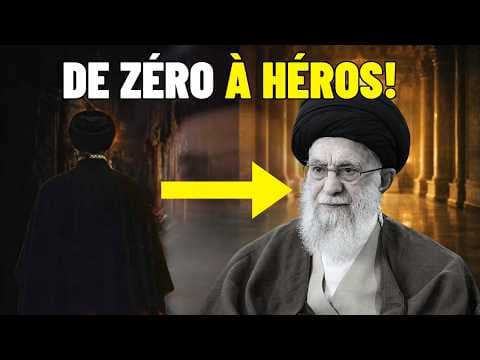
Khamenei - L'enfant pauvre qui a tenu tête à l'occident !
Audio Summary
AI Summary
Ali Khamenei, born on April 19, 1939, in Mashhad, Iran, grew up in stark poverty. His family lived in a 65 square meter, single-room house with a dark basement. His father, Javadi Khamenei, was a Mullah (spiritual guide) of Azeri origin, who had studied in prestigious seminaries in Najaf, Iraq, before settling in Mashhad as an Imam of an Azerbaijani mosque. His mother, Radij Mirdamadi, was a cultured woman passionate about literature and poetry. Ali was the second of eight children, three of whom also became religious figures. Khamenei himself described his childhood as one of deprivation, with meals often consisting only of bread and raisins. Privacy was non-existent in their small home, and the entire family would descend into the dark basement when visitors came to consult his father.
Despite the poverty, Khamenei’s childhood was deeply immersed in the sacred. At age four, he and his elder brother Mohammad attended a Maktab, a traditional Quranic school, where they learned the alphabet, the Quran, and the basics of Shiite theology. At 11, he entered the seminary of Mashhad and began wearing clerical attire, enduring mockery from his peers. However, Khamenei was not a typical seminarian. While his peers focused exclusively on Islamic jurisprudence, he spent hours at the Astan-e Quds Razavi library, one of Iran's largest book collections, attached to the Imam Reza shrine. He devoured Russian novels by Tolstoy, read Victor Hugo, Balzac, and Michel Zevaco, with *Les Misérables* being his favorite, a book he later called a "miracle" in novel writing. He wrote poems under the pseudonym "Amin" and participated in poetry competitions. He admired Jean-Paul Sartre and Bertrand Russell, revealing a youthful passion for Western philosophy. This detail is crucial, showing a man who understood and absorbed Western thought before consciously choosing to combat it.
In 1957, at 18, Khamenei traveled to Najaf, Iraq, following his father’s footsteps, attending lectures by prominent Shiite seminary masters. His father, however, recalled him to Iran. In 1958, Khamenei moved to Qom, a city that was the beating heart of clerical opposition to Mohammad Reza Pahlavi’s Shah regime. The Shah was forcefully modernizing Iran, promoting women's rights, agrarian reform, and rapprochement with the West, but his authoritarian methods crushed the Shiite clergy. In Qom, Khamenei met Ruhollah Khomeini, a man who galvanized students against the Shah. The encounter had an immediate and profound impact on Khamenei, who later declared himself a disciple of Khomeini in political, revolutionary thought, and Islamic jurisprudence.
From 1958 to 1964, Khamenei studied under Khomeini, as well as Ayatollah Boroujerdi and philosopher Allameh Tabatabai. His education was comprehensive—theological, legal, and philosophical—but the political component became dominant. He embraced Khomeini's revolutionary ideology, recruiting activists and carrying secret messages between clandestine cells. In 1963, Khomeini tasked him with delivering a secret message to religious leaders in Mashhad to organize resistance against the Shah. Khamenei was arrested for this, spending a night in prison and being forbidden to preach. He defied the order and was arrested again after the bloody June 1963 uprising, enduring ten days of severe imprisonment.
In 1964, at 25, Khamenei made a seemingly anodyne but deeply revealing choice: he left Qom, abandoning his advanced studies, to return to Mashhad and care for his father, who was losing his eyesight. He later attributed any success in his life to divine blessings for having cared for his parents. He did not abandon study entirely, continuing to teach jurisprudence to seminary students in Mashhad. He preached, recruited, and, crucially, interpreted the Quran in a radically political manner, teaching that Islam demanded a government based on its principles. His message was clear: the Shah must fall.
The Shah indeed fell. On February 11, 1979, the Islamic Revolution triumphed, and Khomeini returned from exile. Khamenei, who had spent years in the shadows, suddenly emerged into prominence. He was appointed to the Revolutionary Council and briefly oversaw the Revolutionary Guards, the paramilitary force that would become the regime's instrument of absolute control. In January 1980, Khomeini appointed him Imam of Friday Prayer in Tehran, a post of significant symbolic importance.
On June 27, 1981, an event transformed Khamenei into a living legend of the regime. After delivering a sermon at the Abu Dharr Mosque in Tehran, he sat to answer questions from congregants. A man placed a tape recorder on the table in front of him. After a minute, the device hissed and exploded. The bomb, hidden inside, ravaged Khamenei's right arm, lacerated his vocal cords, and perforated his lungs. His recovery took months, his right arm remained paralyzed for life, and his voice never fully recovered its original timbre. The attack was attributed to the Mujahedin-e Khalq, an armed opposition organization. A message found in the destroyed device declared it "a gift from the Forqan group to the Islamic Republic." Khomeini sent a message to Khamenei from his hospital bed, carefully choosing words that likened him to Imam Hossein, praising his service to Islam and the country as a faithful soldier and passionate teacher. Khamenei became a living martyr.
Three months later, he was elected President of the Islamic Republic with 95% of the vote at 42 years old. He served two terms, from 1981 to 1989, years marked by war with Iraq, internal repression, and his apprenticeship in power. However, no one at the time considered him a future Supreme Leader. John Limbert, an American diplomat held hostage in Tehran, met Khamenei during his captivity and later stated he never imagined discussing with a leading politician, having never even heard of him. Khamenei lacked Khomeini's charisma and religious erudition; he was not a Marja, a "source of imitation," the highest distinction in Shiite clergy required by the Constitution for the Supreme Leader.
Khomeini died on June 3, 1989. The next day, the Assembly of Experts convened urgently. Akbar Hashemi Rafsanjani, the speaker of parliament, orchestrated the debates, asserting, without verifiable proof, that Khomeini had privately designated Khamenei as his successor months earlier. The assembly voted 60 to 14 in favor, and Khamenei was elected Supreme Leader. He outwardly opposed it, reportedly stating, "We should shed tears of blood for having to propose my name for this position." But he accepted. To make the election constitutional, Article 109 was amended, removing the Marja requirement. Khamenei, an intermediate-rank cleric, became the second Supreme Leader, and the title of Ayatollah was subsequently bestowed upon him. Alex Vatanka of the Middle East Institute noted that Khamenei himself knew he lacked the prestige and stature to succeed the Republic's founder. This awareness of his own weakness, Vatanka argues, made him formidable.
While Khomeini ruled through charisma and religious stature, Khamenei would rule through institutional architecture. Methodically and without fanfare, over three decades, he rebuilt the power of the Supreme Leader from the ground up, not by imitating Khomeini but by transforming the office itself. He turned the Leader's office into a sophisticated bureaucratic nerve center, with intelligence, military, judiciary, and media all reporting to him. He acted not as a public dictator but as a power engineer, wiring every circuit to his office. The Islamic Revolutionary Guard Corps (IRGC) became the central pillar of this system. Under Khomeini, the Guards were one revolutionary militia among others; under Khamenei, they became an empire—military, economic, and industrial—controlling an estimated one-quarter to one-third of the national economy. Khamenei personally appointed IRGC commanders and intelligence chiefs, not the President or Parliament.
One by one, he sidelined those who had brought him to power. Rafsanjani, the "kingmaker" of 1989, gradually lost influence to Khamenei during his second presidential term and was eventually marginalized by conservatives installed by Khamenei. Mohammad Khatami, the reformist president elected in 1997, saw all his reforms blocked by the Guardian Council and institutions controlled by the Leader. Mir-Hossein Mousavi and Mehdi Karroubi, leaders of the 2009 Green Movement, were placed under house arrest without trial on Khamenei's direct order for years. The Assembly of Experts, theoretically tasked with supervising and even dismissing the Supreme Leader, became a ceremonial body whose candidates were filtered by the Guardian Council, half of whose members were appointed by the Leader. The system became self-contained, locked down at every level by the same man.
Reducing Khamenei to an internal autocrat, however, misses his strategic vision, whether judged cynical or lucid. He thought in terms of strategic depth, not just territory. Surrounded by American military bases in Iraq, Afghanistan, the Gulf, Qatar, and Bahrain, Iran lacked its adversaries' air force or advanced technology. Khamenei concluded that Iran could not defend itself in conventional combat against the U.S. or Israel, requiring an asymmetric deterrence. This deterrence took two forms: first, the ballistic and nuclear program, providing the capacity to strike anywhere in the region and the constant threat of crossing the nuclear threshold; second, the network of alliances, which the West calls proxies and Iran calls the "Axis of Resistance." This included Hezbollah in Lebanon, Hamas and Islamic Jihad in Gaza, Shiite militias in Iraq and Syria, and the Houthis in Yemen. Each actor had its local dynamic but offered Tehran power projection capabilities without deploying a single Iranian soldier abroad. Khamenei conceived this network as an "arc of deterrence" designed to make the cost of a direct attack on Iran so high that no power would risk it. This doctrine guided Iranian foreign policy for 30 years and, in the eyes of Israel and the U.S., made Iran the region's number one threat.
Then came the nuclear turning point, and with it, the failure that might seal the regime's fate. In 2015, after years of negotiation, Iran signed the Joint Comprehensive Plan of Action (JCPOA) with the five permanent members of the UN Security Council plus Germany. Iran agreed to drastically limit its nuclear program in exchange for sanctions relief. The International Atomic Energy Agency (IAEA) certified Iran's compliance ten times. For Khamenei, this was a risky gamble. He allowed President Rouhani to negotiate with the Americans against the advice of hardliners within his own camp, but he set limits: no concessions on ballistic missiles, no questioning of the political system.
On May 8, 2018, Donald Trump unilaterally withdrew the United States from the agreement, calling it a "horrible deal" and reimposing the most severe sanctions ever inflicted on Iran—the "maximum pressure" policy. This withdrawal occurred even as all inspections confirmed Iran's compliance. Emmanuel Macron had warned Trump that this decision could lead to war, while Israel and Saudi Arabia applauded. Khamenei reacted publicly with cold fury, stating, "We have always said not to trust the Americans. Here is the result." He then famously declared, "Mr. Trump, you will not be able to do anything against us." Privately, he drew a deeper conclusion, articulated in 2025: "Negotiating with the United States is neither wise, nor intelligent, nor honorable. The consequences are devastating."
The Iranian economy, which had begun to recover after sanctions were lifted, plunged again. Inflation exploded, the rial collapsed, and European companies like Peugeot, Total, and Siemens withdrew, terrified by secondary U.S. sanctions. Iran slowly began enriching uranium beyond permitted thresholds. The JCPOA was effectively dead long before its formal burial. For *Foreign Affairs* analysts, the American withdrawal validated exactly what the deal was supposed to weaken: the regime's hardliners, who had always maintained that Washington sought not an agreement but regime change. John Bolton, the National Security Advisor who pushed for the withdrawal, openly stated his intention to destroy the JCPOA to prepare the ground for direct confrontation. Iran, for its part, accelerated its pivot to the East, signing unprecedented commercial and military agreements with Russia and China, including a strategic trilateral pact in January 2026.
Meanwhile, inside Iran, the fracture between the regime and its population widened. 75% of Iran's 90 million people were born after the 1979 revolution. They did not know the Shah or the uprising against him. What they knew was unemployment, inflation, sanctions, and a regime that prevented them from living as they saw on their phone screens. In 2009, the Green Movement brought millions to protest Mahmoud Ahmadinejad's re-election, which Khamenei harshly repressed. In 2017 and 2019, revolts erupted in working-class cities against the high cost of living, again repressed by Khamenei. In 2022, after the death of Mahsa Amini, arrested by the morality police for improperly wearing her veil, Iran experienced its largest uprising since the revolution. The slogan "Woman, Life, Freedom" resonated across the country and worldwide. Khamenei again responded with repression, resulting in hundreds of deaths and thousands of arrests.
Khamenei did not understand these protests, or rather, he refused to understand them on their own terms. For him, every protest was a foreign plot, every social demand an Western infiltration. This inability to recognize the legitimacy of popular anger, even among those with no sympathy for the West, will likely be judged by history as his greatest political error.
In June 2025, after the failure of nuclear negotiations in Geneva, Israel launched massive strikes on Iran, targeting military installations, nuclear sites, and air defenses. This marked the beginning of the "12-day war." Iran retaliated with missile salvos on Israeli cities. The United States entered the conflict, striking nuclear facilities at Fordow, Natanz, and Isfahan. A ceasefire was obtained under American pressure, but nothing was resolved. Khamenei took refuge in a deep bunker beneath his Tehran residence, cutting all electronic communications and speaking only through a trusted aide. In an unprecedented move, he designated three senior clerics as potential successors and asked the Assembly of Experts to prepare for a rapid choice in case of his death. The man who controlled everything disappeared into darkness.
In December 2025 and January 2026, protests erupted in several Iranian cities, this time against the country's economic management, soaring cost of living, and the direct consequences of the war. The regime's legitimacy reached its lowest point. On February 28, 2026, the United States and Israel launched a joint military operation called "Epic Fury." The CIA had tracked Khamenei's movements for months and learned of a high-level meeting at his residence. Strikes were launched at that precise moment. Israeli planes dropped 30 bombs on the Supreme Leader's residential complex in Tehran. Iran immediately denied it, with the foreign ministry spokesperson declaring the Leader safe and sound, and Tasnim and Mehr news agencies asserting he was firm and unwavering, commanding from the field. Netanyahu and Trump claimed otherwise. Satellite images showed a razed building. That night, an Israeli official announced that the body had been found and identified. On March 1st, at dawn, Iran confirmed. IRIB announced that the Supreme Leader had achieved martyrdom. 40 days of national mourning and 7 days of public holiday were decreed. His daughter, Baraa, his granddaughter, Zahra, his son-in-law, and daughter-in-law also perished in the strikes.
In the streets of Iran, two countries coexisted simultaneously. Crowds gathered to mourn a man they considered the defender of Iranian sovereignty against foreign aggression. Others came out to celebrate the fall of a man they held responsible for decades of repression and impoverishment. In Syria, there were scenes of joy in the diaspora. In Shiite communities in Lebanon, Iraq, and Pakistan, there were calls for revenge. Iran was not a single people in a single mourning; it was a fractured country viewing the same death with radically different eyes.
Ali Khamenei was 86 years old, having held absolute power for 36 years. The little boy from Mashhad who ate bread and raisins in a dark basement became the architect of an unparalleled theocratic system, a network of armed alliances spanning four countries, and a nuclear and ballistic program that held the world in suspense for two decades. He survived an assassination attempt, eight years of war against Iraq, three hostile American presidents, unprecedented sanctions, and the anger of his own people. He defied the West, and the West ultimately killed him.
But the question his death poses is not what Washington or Tel Aviv would want to hear. The question is not "how was he eliminated?" The question is "what have 36 years of maximum pressure, sanctions, isolation, and ultimately bombing truly changed for the 90 million Iranians who remain?" He loved Victor Hugo's *Les Misérables*. He wrote poems under a pseudonym. He lost the use of his right hand in an attack and never stopped hiding it under his robe. The hidden hand. This is perhaps the best way to summarize Ali Khamenei: a concealed power, total control exercised in the shadows, and a lingering question. To whom did this hand truly belong? To a defender of Iranian sovereignty, or to a man who confiscated the future of an entire people in the name of a revolution that this people no longer wanted to live? The answer depends on who you are, and that is precisely what makes this story impossible to summarize in a single verdict. This is the true story of Ayatollah Ali Khamenei.