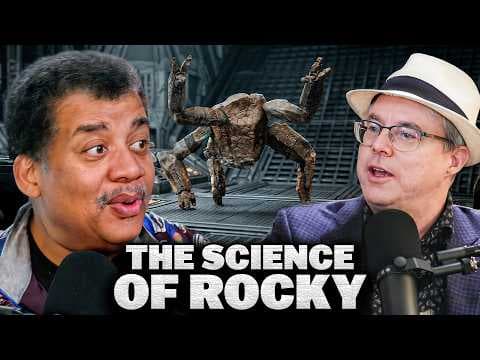
Neil deGrasse Tyson Confronts Andy Weir on the Science of Project Hail Mary
Audio Summary
AI Summary
Andy Weir, the acclaimed sci-fi novelist known for "The Martian," joined StarTalk to discuss his latest book, "Project Hail Mary," and delve into the scientific intricacies of his storytelling. Weir, who began his career as a software engineer, has seen two of his three books adapted into major films. "The Martian," his first book, was quickly followed by a movie starring Matt Damon, a process Weir described as "very fast." His second book, "Artemis," is the only one not yet made into a film, though Weir expressed his desire for it to be.
"Project Hail Mary," his third and most recent book, has also been adapted into a film starring Ryan Gosling (referred to as "Ken" due to his recent role). The discussion focused on the core plot of "Project Hail Mary," which revolves around an alien microbe named Astrophage. This microbe, which literally means "star-eater," lives on the surface of stars, absorbing energy and converting it into mass. It uses this mass for propulsion to travel to planets with carbon dioxide, where it gathers heavier elements for reproduction. The resulting "daughter cells" then return to a star, continuing the cycle.
The central conflict arises because Astrophage is growing exponentially on our sun, causing it to dim to a point where Earth will become uninhabitable. This problem is not unique to our solar system; other stars in our local cluster have also dimmed, with the exception of Taum Ceti. To discover why Taum Ceti is unaffected and find a solution, an interstellar spacecraft is built, fueled by Astrophage itself, which utilizes its mass conversion for propulsion.
Weir’s commitment to scientific accuracy in his fiction was highlighted, with Neil deGrasse Tyson quoting Weir's previous statement about being mindful of Tyson's potential critique when tempted to use "handwavy physics."
The conversation then shifted to the other alien species in "Project Hail Mary," a being that the protagonist befriends and names "Rocky" due to its rock-like appearance and crab-like movements. Weir explained his process for creating this alien, starting with the properties of its home exoplanet, 40 Eridani A. At the time of writing, this exoplanet was believed to be real, though it has since been disproven.
Weir based his alien's characteristics on the extreme conditions of this hypothetical planet. Being very close to its star, the planet would be incredibly hot, even hotter than Mercury. To allow for liquid water, essential for the pan-spermia-based life in his story, Weir theorized a planet with extremely high atmospheric pressure (29 atmospheres), preventing water from boiling even at over 200 degrees Celsius. To maintain such a thick atmosphere so close to a star, the planet would need a powerful magnetic field (25 times stronger than Earth's) and a rapid rotation (once every six hours).
Given the dense, hot, and ammonia-rich atmosphere, light would not reach the surface. This led Weir to conceive of an intelligent species, the Iridians, that evolved without eyes and relies entirely on echolocation. Their bodies are covered in "oracles" – nerve endings sensitive to sound – which provide a constant, 360-degree input of their 3D environment. Unlike humans, they do not possess the part of the brain that maintains a cognitive 3D model of their surroundings because they are constantly receiving real-time sensory data. If they suddenly lost auditory input, they would immediately lose all spatial information, a contrast to humans who retain a mental map even with closed eyes.
The alien, Rocky, communicates with the human protagonist, Ryland Grace, through a computer system that analyzes acoustic waveforms. They establish a shared vocabulary, starting with simple concepts like numbers, and gradually develop a functional language for exchanging knowledge.
A humorous detail revealed was the origin of the ship's name, "Hail Mary," and the protagonist's name, Dr. Ryland Grace, a subtle nod to the prayer, "Hail Mary, full of grace."
Weir discussed the theme of "alone in space" in his works, explaining that it serves as a convenient storytelling device to isolate the hero and emphasize their resourcefulness. Ryland Grace, the protagonist of "Project Hail Mary," is portrayed as a reluctant and somewhat selfish hero, initially unwilling to save the world. He is, in fact, drugged and forced into the mission due to his unique expertise as a xenobiologist and his integral role in the mission's planning. His eventual heroism is driven by his friendship with Rocky.
Weir also touched upon the challenges of adapting a book to film, mentioning one scene from the book that he and the screenwriter, Drew Goddard, regretfully had to cut due to runtime constraints. This scene involved humanity intentionally causing global warming by detonating nuclear devices in Antarctica to melt ice shelves and release methane. This drastic measure was a proactive attempt to retain more of the sun's heat as the Astrophage continued to dim it, creating a paradoxical situation where global warming was needed to counteract the sun's dimming.
Regarding the choice of a middle school chemistry teacher as the seemingly sole expert capable of saving humanity, Weir clarified that Ryland Grace was a former astrobiologist with a PhD who had published papers in the field. His continued involvement in the mission's planning made him the most knowledgeable candidate, and there was no time to train anyone else to his level of understanding across all aspects of the mission.
Weir concluded with three pieces of advice for aspiring writers: first, "you have to actually write," emphasizing that ideation and world-building are not writing; second, "resist the urge to tell your friends and family your story" to avoid sapping the will to write; and third, that "there's never been a better time in human history to self-publish," allowing writers to reach readers without traditional gatekeepers.