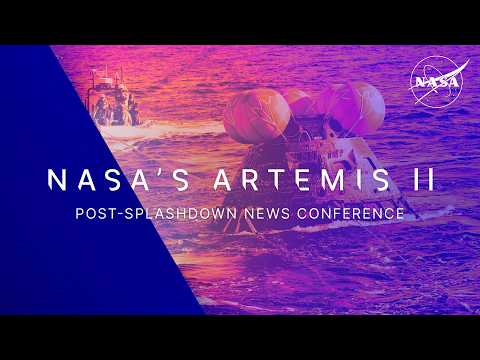
NASA's Artemis II Post-Splashdown News Conference (April 10, 2026)
Audio Summary
AI Summary
The Artemis 2 mission successfully completed its test flight, marking the first time humans were launched on the Orion space capsule. The mission, which took the astronauts around the Moon and back, landed safely in the Pacific Ocean at 7:07 p.m. Central time. This achievement is seen as the next crucial step in humanity's journey to Mars and a return to the Moon to establish a sustained presence.
During a post-landing press conference at NASA's Johnson Space Center in Houston, several leaders, including Ahmed Chhatria, Dr. Lori Glaze, Rick Henfling, Howard Hugh, and Sean Quinn, discussed the mission's success. Ahmed Chhatria emphasized that the mission's success was due to the dedication of thousands of engineers, technicians, and flight controllers across various locations, whose meticulous work ensured the vehicle's integrity. He highlighted the courage of the crew's families during the six-minute communication blackout upon re-entry and stressed that the path to the lunar surface is now open, with a commitment to "return to stay" and finish what previous missions started.
Dr. Lori Glaze celebrated the safe return of the four astronauts – Reed, Victor, Christina, and Jeremy – after more than 50 years since humans last journeyed to the Moon. She expressed pride in the team's ingenuity and effort, stating that ambitious goals are worth pursuing and can inspire the world. Glaze confirmed that this mission is just the beginning of many more to come, with teams ready to explore the lunar surface.
Rick Henfling provided key statistics, noting that the Integrity spacecraft and its crew flew 700,237 miles, reached a peak velocity of 24,664 miles per hour, hit its flight path angle target within 0.04%, and landed less than a mile from its target. He reiterated that the crew undertook the mission for all of humanity, and their safe return fulfilled that objective.
Howard Hugh, Orion program manager, acknowledged the tireless work of the entire Orion team, including NASA, industry partners, and the European team. He highlighted the mission's historical significance in demonstrating new capabilities for the Orion spacecraft, taking the crew farther than any previous lunar mission. Hugh emphasized that while the crew's safe return was paramount, the mission also served as a critical test flight, providing valuable data for future endeavors.
Sean Quinn, exploration ground systems program manager, expressed pride in the recovery operations, noting that the recovery teams were in the process of securing Orion back onto the USS Murtha. He recounted hearing from Commander Reed Wiseman, who confirmed all crew members were safe, affirming the mission's successful accomplishment.
During the Q&A session, questions arose regarding the astronauts' condition, future crew announcements, and lessons learned. Rick Henfling confirmed the crew was happy and healthy, with plans for them to return to Houston within 12 to 24 hours. Howard Hugh mentioned that a key lesson was related to a leakage discovered in the pressure control assembly, which would be thoroughly investigated.
The crew's role as "great communicators, almost poets" was praised, with Dr. Glaze highlighting their seamless teamwork and camaraderie as they represented a mission for all humanity. Rick Henfling addressed the re-entry blackout, explaining it was expected and dictated by the physics of the approach trajectory, confirming the spacecraft flew as predicted. He also clarified that some prop cautions during descent were likely due to overly tight limits, which were managed.
Regarding the future, Amit Chhatria stressed the importance of flight cadence and iteration for reliability and safety, stating that a higher cadence is mandatory for success in Artemis 3 and 4, and for building a Moon base. He reflected on the historical context, noting that the current program aims to achieve what the architects of Apollo initially envisioned: learning to live and work in space for extended periods, establishing a sustainable presence.
The team confirmed that the Orion docking system is ready and qualified for Artemis 3, with integration planned for later in the summer. They also noted ongoing test campaigns for landers from Blue Origin and SpaceX, crucial for future landing missions.
Personal reflections included Howard Hugh's emotional "wow moment" of seeing the main parachutes deploy, a sentiment echoed by other team members who found joy in the launch, the crew's safe report, and the prospect of reuniting with their friends. Dr. Glaze emphasized the profound impact of achieving this mission in her lifetime, contrasting it with her childhood memories of Apollo.
The successful demonstration of 4K video streaming with laser communications was highlighted as an incredible capability for future implementation. Initial assessments of the heat shield performance are underway, with data gathered from imagery and divers, to be analyzed in detail once the crew module is transported back to Kennedy Space Center.
The leaders encouraged industry to view the mission not just as an inspiration but as a challenge to accelerate production lines to meet the ambitious cadence of returning crews to space within a year and landing on the Moon twice by 2028. They expressed gratitude for taxpayer support, emphasizing that this program belongs to the people, reinforcing the pursuit of what's possible.