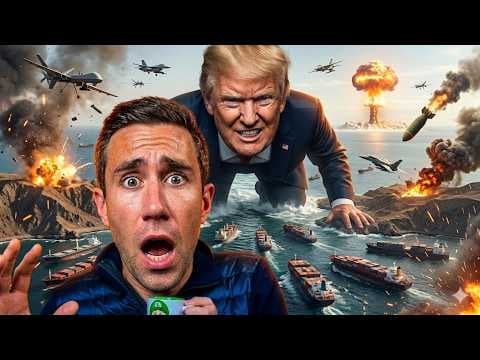
Blockade F**Ks the Strait of Hormuz | VERY BAD.
Audio Summary
AI Summary
Donald Trump is expected to impose a naval blockade on the Strait of Hormuz, with the US Navy initiating a process to blockade all ships entering or leaving the strait, as well as those that have paid a toll to Iran. This move comes after talks reportedly failed.
The Strait of Hormuz, a narrow waterway, presents significant challenges for a blockade. The speaker indicates that parking US tankers directly within the strait is ill-advised due to the risk of drone swarms from Iran, which manufactures drones deep inside Russia and can launch them from coastal mountains and ridges. These fiber optic drones have a range of up to 30 miles, making ships in the strait vulnerable. Instead, US ships are more likely to operate from the Persian Gulf (Arabian Gulf side) and the Gulf of Oman/Arabian Sea, keeping larger vessels out of drone range. From these positions, helicopters, Ospreys, and F-15s could be launched. There's an unconfirmed report that two US destroyers were threatened by Iran and turned around when attempting to cross the strait recently.
A blockade doesn't necessarily require controlling the entire strait but rather forming a picket line at its entry/exit points. However, the proposed blockade is intended to be "permeable," allowing friendly ships from countries like Saudi Arabia, Bahrain, Qatar, the UAE, and Oman to pass through to suppress oil prices, while choking off enemy ships, such as Iranian oil bound for China. The real issue is that even if the US allows allied ships through its blockade line, Iran could still attack them within the strait using fiber optic drones or Shahed 136 drones. This would deter insurance companies from authorizing ships to cross, effectively bringing all traffic to a standstill, regardless of US or Iranian blockades. The only way to truly ensure passage would be for the US to not only blockade from the outside but also establish a "green zone" within the strait, which would be extremely difficult and require significant resources, including A-10 Warthogs, helicopters, and unmanned underwater vehicles (UUVs).
Another major obstacle is the presence of mines. Limpet mines, which are C4 explosives attached by divers, can be used against cargo ships. Other types include moored mines, bottom mines (which detect magnetic pulses), and drifting mines (contact or magnetic). Clearing these mines is a complex and risky endeavor. Methods include dragging wires between ships to detonate moored mines or sending false magnetic pulses with low-flying planes or underwater vehicles. This extensive work and associated risks highlight the difference between a blockade and full control of the strait.
Donald Trump previously hinted at a plan to charge tolls for passage through the strait. When asked about Iran charging tolls, he misunderstood and thought the question was about the US charging tolls, revealing his intention to implement "the greatest tolls anyone has ever seen," possibly calling them "tariff" or "toll tariff." This suggests the blockade could be a precursor to the US imposing its own tariffs on strait traffic. However, Trump's comments do not indicate an intention to take full control of Hormuz, only to blockade the outside.
The implications of this blockade are multifaceted. It would remove Iranian oil from the market, hurting China, which relies on it. However, China also benefits by observing the US's tactics in a real-world blockade scenario against a weaponized adversary (Iran), which could serve as a test trial for a potential naval blockade of Taiwan. Russia also benefits, not only through intelligence and weaponry sharing with Iran but also from rising oil prices.
The market impact, while potentially significant, might not be as severe as previous threats to destroy Iranian civilization. The US could be seen as a "cop moderating flow" from the outside, but this doesn't guarantee an open strait. It might offer some future certainty for allies but is less risky than a direct military intervention like sending paratroopers to Card Island, which is reportedly booby-trapped. The uncertainty surrounding the blockade's effectiveness and the reopening of the strait is likely to drive oil prices above $100, potentially even $120-$150, especially given depleted global stockpiles. If oil prices skyrocket as they did previously, the S&P 500 could see a significant sell-off. The speed of setting up the blockade and controlling the strait is crucial; without US escort and safety guarantees, ship traffic will still collapse, leading to higher oil prices for longer. Iran, by choking the middle of the strait, creates an "impossible insurance problem."
This uncertainty is also negative for risk assets like Bitcoin, growth stocks, and software stocks. Hardware and chip stocks, however, are performing well, with some investors seeing them as a safer bet amidst the uncertainty, especially given the difficulties in the private credit sector and its impact on software. AMD and Nvidia, despite recent gains, are still seen as having attractive valuations.
In other regional news, Pakistan claims talks are not dead, only stalemated. Lebanon continues to experience strikes, with Israel reporting another soldier's death and additional Hezbollah militant casualties. Israel has spent over $11.5 billion on the war so far. The UAE is vocal in its belief that Iran has never had control over the strait and should not, suggesting potential international support for the US blockade. The UK has previously offered mine-sweeping equipment. However, getting the strait fully reopened could take an entire April, with day-by-day progress. A blockade does not equate to an open strait.