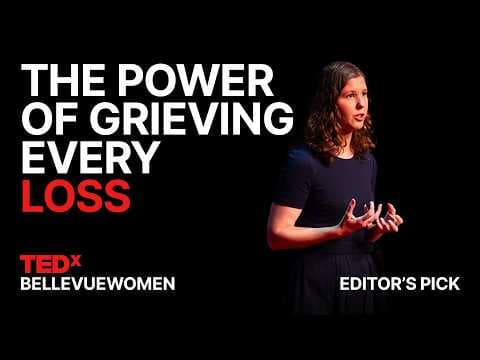
Every kind of grief counts—here’s why | Megan Shen | TEDxBellevueWomen
Audio Summary
AI Summary
The speaker, a social psychologist and researcher, clarifies that her work is not about death itself, but rather about what happens after it – how individuals find their way back to life after experiencing loss. She develops tools to support people living with serious illnesses like cancer and their families, spending considerable time immersed in the world of death and grief. However, she emphasizes that grief extends beyond death, fundamentally representing the loss of an imagined future. This includes losses such as divorce, infertility, job loss, financial setbacks, retirement, and empty nesting. Patients she works with often face not only the loss of life but also the loss of their ability to travel due to treatments, or dreams of having children, settling down, or retiring because of their illness.
The speaker highlights that while people often try to avoid pain and loss, these are inherent parts of the human experience. Avoiding grief can prevent individuals from recognizing its power to foster personal growth. One patient expressed the sentiment, "I had to let go of and grieve the life I wanted to love the life I actually have," illustrating the transformative potential of grieving every loss.
Grief is often likened to a heavy backpack. The speaker advises against carrying it around and pretending it doesn't exist. Instead, healing comes from openly acknowledging its presence, allowing one to set it down or seek help from others. She compares grief to physical pain signaling a need for rest and healing. She outlines a three-step framework for being transformed by grief, enabling individuals to find hope, resilience, community, and compassion.
The first step is "naming your loss," which involves being honest and vocal about what has been lost. Downplaying or dismissing losses hinders healing and the ability for others to offer comfort. Acknowledging a loss by naming it allows for the grieving process to begin, much like funerals provide a formal ceremony for death. The speaker shares her personal experience of moving from bustling New York City to quieter Seattle in 2021, during COVID-19 distancing protocols. She underestimated the profound loneliness and lack of community she would face, experiencing a significant culture shock and a sense of displacement. She realized she was not just sad, but grieving the loss of her community, her way of life, and daily rhythms, including familiar places and relationships. She had to create space for this grief to eventually embrace her new life.
She differentiates this from the more defined grief associated with the death of a loved one, where the specific loss (e.g., a future with a father-in-law, a grandmother's presence, or children lost to miscarriage) is clearer. However, she recognized that the move to Seattle involved many real losses, each deserving to be grieved for comfort and healing. She emphasizes that society lacks rituals for grieving losses like communities, marriages, jobs, friendships, or future children, making the creation of a personal ritual by naming the loss crucial. Patients, for example, name what cancer has taken from them, such as the ability to engage in beloved activities or the retirement they envisioned. Acknowledging this pain aloud is the first step towards transformation. She encourages listeners to reflect on imagined futures that have been lost and the feelings that arise from this acknowledgment, suggesting writing it down, saying it aloud, or sharing it with a trusted person, as pain lessens when shared.
The second step is "finding light in the darkness," inspired by Rumi's quote, "The wound is the place where the light enters you." The speaker has observed that grief often creates openings for moments of light. For many, this light comes through community support, such as neighbors bringing meals to a cancer patient unable to cook. Others find that acknowledging their loss helps them realize what they have gained. A patient, forced to stay put due to cancer treatments and unable to travel, discovered deep roots in a community and lasting friendships she wouldn't have otherwise formed. This step is about surviving grief by finding ways to experience joy and flow, even while still immersed in loss. This can involve simple activities like gardening, cooking, savoring coffee, or connecting with others through clubs, classes, or shared rituals. These moments provide "air" to continue navigating the "ocean of grief." The speaker herself embraced small joys in Seattle, like spending time with her sister, agate hunting, and developing a morning ritual of coffee and journaling, which unexpectedly revealed a love for writing. She suggests creating a "one joy a day" list to consistently identify and engage in activities that bring joy.
The final step focuses on how grieving can transform individuals and those around them. Losses, if allowed, can bring clarity, open new opportunities, and foster new paths of love. They can also cultivate greater compassion and empathy. This step reveals how grief can lead to a more purposeful, compassionate, and empathetic self. Once a loss has been grieved, individuals are better equipped to comfort others facing similar struggles. This can manifest in significant ways, like creating charities in loved ones' names, or in small acts of kindness, such as bringing a meal, writing a thank-you note, or offering encouragement. These acts of connection and compassion ripple outwards, building a supportive community and extending one's story beyond personal grief. The speaker's own loss in Seattle taught her the importance of inviting others in, ensuring they feel a sense of belonging, which in turn helped her build her own community.
She concludes by emphasizing that while grief is an inevitable part of the human experience, encompassing losses beyond death—of health, jobs, communities, and dreams—it doesn't have to be an ending. Her research, patients, and personal experience have shown her that facing pain, allowing oneself to feel it, and remembering that the story continues, can transform grief into a foundation for joy, resilience, and love. She encourages listeners not to dismiss any ache of loss, no matter how seemingly small, but to acknowledge, give space to, and grieve it, as these "cracks" are where light enters, leading to a more meaningful, peaceful, joyful, and connected life. Grieving openly lights up others' sparks, collectively creating a "fire that warms the world."