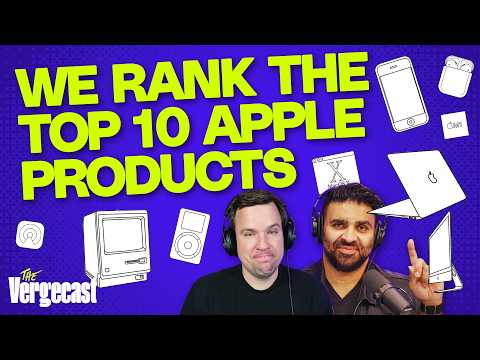
We rank Apple’s top 10 products | Vergecast Clips
Audio Summary
AI Summary
The discussion moves into the top 10 products, with the hosts preparing to reveal their personal rankings, which they anticipate will significantly differ from the overall ranking.
Starting at number 10, one host, David, reveals his pick as QuickTime, arguing for its enduring importance given its continued presence as a Mac app. He acknowledges that Travis, the producer, "vibecoded" the overall ranking. Neil, the other host, struggled with his number 10 spot, confident in his top nine but finding the tenth and eleventh positions difficult to decide between the M1 chip and the iBook G3, ultimately choosing the M1 chip. David notes that he has the M1 chip ranked higher. Both agree the M1 chip belongs in the top 10, despite it being an enabler of products rather than a product itself. The audience's number 10 pick was the iPod with click wheel, which David found acceptable.
At number nine, David had the iPod with click wheel, considering it the iconic "iPod classic." Neil's choice for number nine was the Apple 2e, which he strongly defended as Apple's most important computer for years, defining a generation's computing experience and keeping the company afloat. He asserted that any top 10 list without the 2e is incomplete. The audience's number nine was the slim unibody iMac, which Neil found "way too high" for a top 10 spot.
Moving to number eight, David presented the iPhone 4, despite his own reservations about some of his earlier picks. Neil, expressing surprise at David's choice, revealed his number eight as the Titanium PowerBook G4, which he considers a highly desirable laptop even today. The audience's number eight was the wedge MacBook Air, which Neil felt was "too low, but only slightly."
For number seven, David confessed to "Nei shame" for his pick: the slim unibody iMac. He had considered the iMac G4 for its "sunflower design" but ultimately chose the unibody iMac due to its longevity and user attachment. Neil, however, disagreed, stating it shouldn't be in the top 10. Neil's number seven was the iPad 2, which he believes firmly belongs in the middle of the top 10. The audience's number seven was the Bondi Blue iMac, or iMac G3, a choice David was "not mad at."
At number six, David aligned almost perfectly with the audience, choosing the Bondi Blue iMac G3, emphasizing its significance and personal importance. Neil's number six was the original iPod. He posited that his list focuses on products that definitively changed their industries. A brief debate ensued regarding the original iPod versus the click wheel iPod, with David favoring the click wheel as the more iconic representation. Neil argued that the original iPod was a pivotal moment for Apple, marking their entry into music players after missing out on CD burning. The audience's number six was the iPhone 4, which elicited a strong, humorous reaction of "sheer rage" from Neil, who questioned their understanding of "beauty" and "grace."
For number five, David selected the original Macintosh, believing it unquestionably belongs in the top five and noting that his top five could be rearranged in any order. Neil, surprisingly, did not have the original Macintosh in his top 10 at all. Neil's number five was the Wedge MacBook Air, which he argued the entire industry subsequently chased. The audience's number five was Mac OS 10, a pick both hosts approved of, feeling it redeemed the audience's earlier choices.
At number four, David echoed Neil's earlier pick, choosing the Wedge MacBook Air, reiterating its status as an "iconic, world-shaping Apple product." Neil's number four was the iMac G3, the Bondi Blue one. The audience's number four was the original iPod. The hosts noted that their combined picks, if "smushed together," were largely in step with the audience's.
Moving into the top three, David's number three was the M1 chip, which he speculated the audience might even rank higher. He emphasized its significance as a turning point for Apple across products, allowing them to play a "different game." Neil's number three was the original iPhone. He ranked the M1 chip lower in his top 10, arguing that while important, it led to an "iterative" period for Apple. David countered by highlighting the M1 MacBook Air's transformative impact on battery life and computing experience. Neil differentiated between top 10 (important products) and top five (world-changing products), asserting that the M1, while great, didn't force the entire industry into a "wild left turn" in the same way his top five picks did. David pointed out that Neil's top picks (Wedge MacBook Air, Bondi Blue iMac, and iPhone) are products most people could draw from memory, underscoring their iconic status. The audience's number three was the original Macintosh, which Neil dismissed as "nostalgia."
At number two, David had the original iPhone, asserting its clear place in the top three due to its vast superiority to existing phones and its undeniable legacy. Neil found it humorous that David ranked the iPhone 4 higher than the original iPhone, but David defended the iPhone 4, claiming it created an unparalleled "high" that the industry is still chasing, and that the industry didn't know how to replicate it. Both agreed the iPhone 4 was one of the first phones that immediately impressed everyone who touched it. The audience's number two was the M1 chip, attributed to "recency bias."
Finally, at number one, with the overall ranking system likely placing the original iPhone there, Neil revealed his top pick: Mac OS 10. He declared it the single most important Apple product, asserting "there's no Apple without Mac OS." David enthusiastically agreed, expressing happiness at their shared consensus. He highlighted Mac OS 10's origin from the NeXT acquisition, its role as the foundation of 25 years of Apple software, and its fundamental importance to all other Apple products.