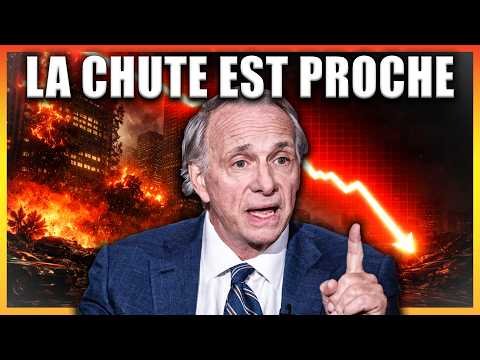
🚨 Cet homme a TOUT prédis, il annonce maintenant un Crash Systémique Mondial !
AI Summary
Ray Dalio, the legendary founder of Bridgewater, the world’s largest hedge fund, has issued a chilling warning that is sending shockwaves through the financial world. In a recent publication titled "It's official: The World Order has broken down," Dalio presents a vision of the future that is perhaps the darkest of his career. His advice to investors is blunt: sell all debt and buy gold. While he explicitly ignores Bitcoin in his latest recommendation, the transcript suggests that the very world Dalio describes—one defined by capital wars, asset freezes, and the collapse of trust in state-backed currencies—is exactly the scenario Satoshi Nakamoto envisioned when creating Bitcoin sixteen years ago.
To understand the weight of this warning, one must look at the current geopolitical landscape. At the recent Munich Security Conference, the tone among world leaders shifted dramatically. Figures like French President Emmanuel Macron and German Chancellor Friedrich Schmerz spoke of an era of destruction and the need for Europe to prepare for war. US Secretary of State Marco Rubio echoed these sentiments, describing a new geopolitical era. Dalio categorizes this shift as "Stage 6" of his historical model of empire cycles—a stage defined by chaos, the absence of rules, and the "law of the strongest." He identifies five escalating types of warfare: trade, technology, capital, geopolitical, and finally, military. We are currently seeing the precursors to physical conflict through the freezing of assets and financial embargoes, drawing terrifying parallels to the 1930s.
Dalio maintains that gold is the ultimate currency of war because it is a "hard asset" with no counterparty risk. However, the transcript highlights a significant oversight in Dalio’s logic. In a world where governments can freeze central bank reserves—as seen with the United States' actions against Russia in 2022—Bitcoin offers a unique advantage: it cannot be frozen. There is no central operator to call, no "pause" button on the network, and no permission required to move funds. While Dalio warns of states blocking access to capital markets and systems like SWIFT, Bitcoin remains operational 24/7, recognizing no borders or intermediaries.
Furthermore, as nations face massive debt obligations—with the US needing to issue $12 trillion just to refinance existing debt—Dalio himself admits that this will lead to the devaluation of money. Bitcoin’s fixed supply of 21 million units stands in stark contrast to the inevitable money printing by central banks. There is also the matter of physical sovereignty. Dalio, now 76, belongs to a generation that values wealth they can hold in their hands. Yet, the transcript points out the logistical difficulty of carrying gold bars across a hostile border compared to carrying a 12-word recovery phrase in one's memory.
Despite Dalio’s previous openness to Bitcoin—suggesting a 15% allocation to gold or Bitcoin as recently as 2025—he has now distanced himself from the cryptocurrency. This shift may be due to his conviction that if Bitcoin becomes too successful, governments will use their power to "kill" it. He also holds concerns regarding the traceability of the blockchain and potential quantum threats.
Recent market data has seemingly supported Dalio’s preference for gold. In 2025, gold surged by 65%, reaching over $5,000 an ounce, while Bitcoin lost nearly half its value, dropping from $126,000 to around $61,000. When true fear hit the markets, capital flowed into gold, not the more speculative "digital gold." However, the transcript suggests this is a matter of timing. Gold has 5,000 years of history; Bitcoin is only 16. It is currently behaving like a risk asset correlated with technology, but its fundamental properties—immutability, decentralization, and lack of counterparty risk—make it a "survival asset" for the chaos Dalio predicts.
Ultimately, Dalio has provided a correct diagnosis of a dying world order but, according to the analysis, perhaps the wrong remedy for the modern individual. While gold remains the refuge for institutions and central banks, Bitcoin represents the emergency exit for individuals seeking sovereignty. As the world moves toward Central Bank Digital Currencies (CBDCs) that threaten privacy and facilitate total state control, the choice between an ancient physical asset and a protocol built specifically for a borderless, trustless era becomes the defining question for the modern investor. Dalio may be right to ignore Bitcoin today, but if the world of "Stage 6" chaos truly materializes, the digital solution created in 2009 may finally prove its necessity.