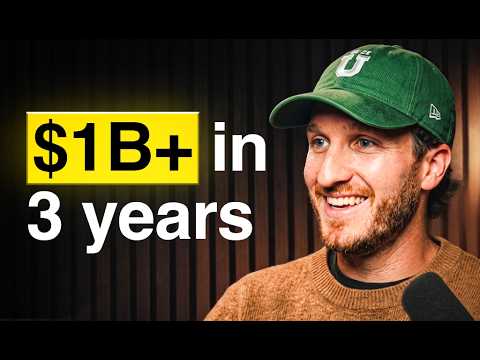
I Went From Broke To $1B+ In just 3 years
AI Summary
The speaker, an entrepreneur with prior experience in private equity and investment banking, shared his journey of building a company from zero to over a billion dollars in 32 months. This is his third company, and the idea for it struck him while he was preparing for an MBA at Stanford. He realized he disliked the frothy, sediment-filled experience of drinking greens powder and the visual clutter of the bottle on his countertop. This sparked the idea of creating a comprehensive nutritional supplement in a more enjoyable format, specifically gummies, that people would look forward to consuming daily.
He emphasized that creating new formats is key to success, citing examples like non-nicotine Zen pouches and his own gummy supplements. He also revealed that the company’s trajectory largely followed the forecasts he set from the beginning, leveraging his extensive knowledge of LTV (Lifetime Value) and CAC (Customer Acquisition Cost) from analyzing hundreds of brands during his time at Summit Partners. He defined LTV as fully burdened gross profit over a three-year period, encompassing all costs from product COGS to shipping, and stressed that a business needs an LTV to CAC ratio of at least three to be viable for acquisition.
The entrepreneur drew inspiration from brands like Dr. Squatch, which successfully transformed a mundane product (bar soap) into a joyful consumer experience through strong branding and partnerships. He aimed to replicate this approach in the often-clinical and fear-based world of supplementation, making it a lifestyle product that resonates with consumers.
Regarding the company's rapid growth, he explained that in its second month, it had already crossed a one million run rate, reaching two and a half to three million. The company burned through approximately $8 million in capital before achieving profitability, a figure that could have been lower if growth had been slowed. He underscored the importance of a "good product," which he equates to finding white space in the market, often by introducing a new product format. He cited examples of successful businesses that differentiated themselves by altering the form factor of existing products (e.g., liquid vitamins, bamboo sheets, or his own greens in gummy form). He also mentioned observing niche but potentially successful form factors like jelly beans and lollipops for supplements.
The company's name, Grüns, with an umlaut over the "u," was chosen for its playful feel and a natural smiley face in its logo, despite 70% of American consumers not knowing how to pronounce it. The founder, who is fluent in German from a mission trip, explained that "Grüns" itself doesn't mean anything in German, but "Grün" means green.
The development of the gummy product was swift. Within a day of conceiving the gummy idea, he questioned why comprehensive nutrition hadn't been put into gummy form. He realized the industry was constrained by traditional 30 or 60-count transparent bottles. His "aha" moment was to offer a pack of eight gummies per serving, akin to a pack of Sour Patch Kids, allowing for comprehensive nutrition that a single, large gummy couldn't provide.
On marketing, he shared a "masterclass" approach, emphasizing testing ads in high volume with new angles, while maintaining authenticity and avoiding exaggerated claims. Once a successful angle is identified, the entire marketing funnel – from static ads, user-generated content, and cinematic shoots to pop-ups, emails, and SMS messages – is tailored to that specific message. This ensures a consistent and relevant experience for the customer, initially addressing their expressed interest (e.g., gut health) and then gradually broadening their understanding of the product's full benefits.
He highlighted that his team, despite being relatively small (around 30 people), produces hundreds of ads monthly. He personally built the initial landing pages and buy boxes, which were later widely copied in the industry. The team is structured with dedicated individuals for retention, paid advertising (including creative strategists, designers, video editors, and ad account managers), and e-commerce, ensuring constant iteration and optimization across the entire customer journey. He also praised platforms like Replo for enabling rapid creation of new ad funnels without needing a large team.
When asked about the difference between average and world-class marketing, he pointed to having a "better product," which often means one that addresses a white space or offers a unique format. He also stressed the importance of product development, mentioning that his own product took a year to develop with custom blends, and its efficacy was based on extensive research into existing scientific studies on ingredients rather than pre-launch blood tests.
He shared a business idea unrelated to consumer products: a "distribution layer" for direct deposits. This system would automatically allocate incoming funds (e.g., salary) to various financial obligations (rent, car payments, investments) before the remaining discretionary income hits the recipient's main account. This concept, similar to the "Profit First" philosophy for businesses, aims to instill financial discipline and automate budgeting, solving common problems with willpower and time-consuming manual tracking. He believes such a platform could be acquired for $500 million to a billion dollars within two years if executed correctly.
He also discussed his philosophy of "access is everything." Coming from a modest background, he learned that by doing good work for mentors and those with existing access, he incrementally gained opportunities (e.g., Lazard, Summit Partners, Stanford). He believes it's his obligation to now provide that access to others, fostering an environment where team members are empowered to make decisions as if they were CEOs, leading to personal growth and potential future entrepreneurial ventures. He expressed a desire to impact the world by facilitating "exposure" for young people, showing them what is possible, as his own exposure to entrepreneurship at 21 years old changed his life's trajectory.
Regarding his personal wealth from the company's acquisition, he stated that while the deal is signed, the money has not yet been wired due to regulatory approval processes (for deals over $133.9 million). He intends for the most meaningful deployment of his capital to come through personal efforts aimed at making an impact, particularly in mentorship and providing exposure to others.
The conversation concluded with an overview of the company's product line beyond the original greens gummies, including Nutropix, Immune (an immunity shot in gummy form), and Juiced (a pre-anything energy product), with 12 more innovations in the pipeline, underscoring the company's ongoing ambition and growth potential.