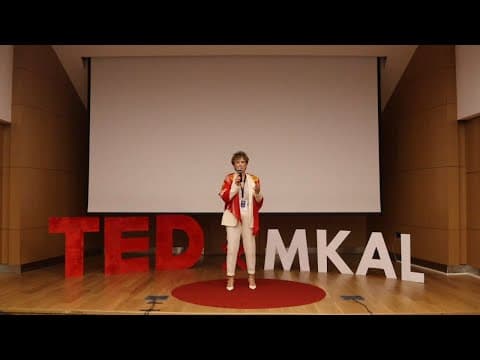
Session III: Transformation | Nalan Kaynak | TEDxMustafa Kaynak Anadolu High School
Audio Summary
AI Summary
The speaker, a housewife who married young and never worked, found a void in her life. After her children grew older, she started working with charity organizations. Following a successful graduation celebration that raised significant funds, friends encouraged her to lead an association, which led to the formation of "those cysts," now a large organization she has headed for 30 years.
The organization has supported nearly 5,000 active students, including doctors and engineers. Their core expectation for students is to be "the right person" and to perform their best in whatever they do. They emphasize helping one's family, then relatives, then the neighborhood, and expanding outwards.
When selecting students, two key questions are asked. First, why should they be chosen among many applicants? Second, what did they do after setting their sights on university? The speaker contrasts two types of responses. One student, after exams, traveled to relieve stress and enjoy their victory, which raises a "question mark" for the organization. Another student worked hard during summers as a shop assistant and waiter, recognizing that current earnings weren't enough. This student is preferred because they demonstrated responsibility and self-reliance, unlike those who shift responsibility to their families.
The speaker shares the story of a medical student who applied for a scholarship in her final year. The student, suffering from a muscle disease, couldn't stay in a dorm due to attacks causing disturbance. She found an apartment, and her uncle offered free accommodation until graduation. She worked various jobs to support herself. However, after her uncle's death, his daughter demanded rent, and the student, needing to focus on her final year of medical studies, could no longer work. Despite her illness, she had worked and supported herself. The organization gladly supported her. She also shared that her father didn't want to know where she studied, and her mother, who remarried, refused to stay with her during surgery, telling her to take care of herself. Despite these challenges, the student graduated with honors and is now specializing in medical genetics. This story served as a significant lesson on resilience and overcoming adversity.
Another influential story involved a girl from Erzurum, the eighth child in a family of theologians and imams, who came to Denizli to study archaeology. Although the organization typically supports students in Denizli first, this story challenged the speaker's prejudices. The family willingly sent their daughter to study archaeology, a field seemingly at odds with their background, highlighting the importance of not being prejudiced. The organization also has a "red line" for admitting students: raising secular young people loyal to Atatürk's Republic.
The speaker then discusses freedom, noting that it has become intertwined with disrespect among youth. True freedom, she argues, is the ability to defend ideas within a framework, not to disrespect elders or juniors. She also addresses the decline of friendship, contrasting the past value placed on lasting friendships with current instances of physical and psychological bullying among young people. She recounted a university student's response to a question about a friend failing a class: "I am a bully," meaning they would humiliate the friend everywhere. This deeply saddened the speaker, emphasizing that such behavior is not friendship.
In closing, the speaker advises young people to carefully choose their idols, ensuring their lives align with the paths they advocate. She acknowledges the differences between generations, noting that today's youth have instant access to information and tools like artificial intelligence. She stresses the importance of engaging with real life, touching others' lives, and internalizing the spirit of cooperation, rather than expecting monetary returns from the organization. She shares that while many students have succeeded, some could not be saved, even those supported from middle school.