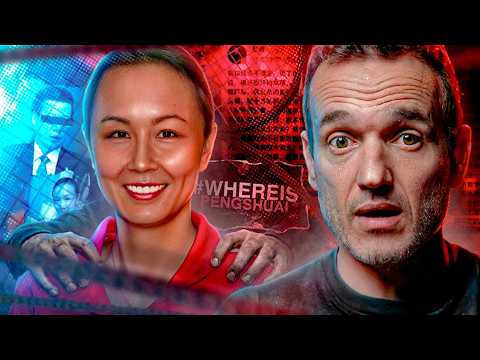
Pourquoi la Chine a EFFACÉ Peng Shuai de l'Histoire (et c'est encore le cas)
AI Summary
On November 2, 2021, at 10:07 PM in Beijing, a social media post was published that would ignite an international crisis. The author was Peng Shuai, one of the greatest tennis players in Chinese history—a former world number one in doubles, a two-time Grand Slam champion, and a three-time Olympian. Her message, posted on the Chinese social network Weibo, accused Zhang Gaoli of sexual assault. Zhang was no ordinary citizen; he was the former Vice-Premier of the People's Republic of China and a former member of the Politburo Standing Committee, the seven-man inner circle that wields supreme power over 1.4 billion people.
Within thirty minutes of the post going live, it was erased. Within hours, the word "tennis" itself was censored across Weibo, preventing 500 million users from discussing the sport. Then, Peng Shuai disappeared. For eighteen days, no one—not her friends, her colleagues on the professional circuit, nor the Women’s Tennis Association (WTA)—knew where she was. This event marked the beginning of a confrontation between a world-class champion and the most tightly controlled political system on the planet.
Peng Shuai’s journey to that moment was remarkable. Born in 1986, she began tennis at age eight, coached by her uncle. At thirteen, she underwent major heart surgery to correct a congenital defect, an ordeal that later became the centerpiece of an Adidas "Impossible is Nothing" campaign. She was a technical anomaly, playing with a rare two-handed style for both her forehand and backhand. Her career was stellar: she reached the US Open singles semi-finals in 2014 and secured 23 doubles titles, including Wimbledon and Roland Garros. Alongside her contemporary Li Na, she pioneered the tennis boom in China. Peng was also known for her independence; in the mid-2000s, she famously rebelled against the state sports system, refusing to hand over half her earnings in exchange for more professional autonomy.
Her November 2021 post was an act of unprecedented defiance. In it, she described how Zhang Gaoli, forty years her senior, had contacted her after his retirement to play tennis, only to later pressure her into sexual relations at his home while his wife reportedly guarded the door. Peng admitted she had no physical evidence or recordings, but she felt compelled to speak. She used a haunting metaphor: "Even if I am like an egg throwing itself against a rock, or a moth drawn to a flame, I will still tell the truth."
The Chinese state’s response was total. Beyond digital erasure, the government initially met international inquiries with silence. When the hashtag #WhereIsPengShuai began trending globally, supported by stars like Naomi Osaka, Serena Williams, and Novak Djokovic, the pressure mounted. The WTA, led by Steve Simon, took a historic stand, threatening to pull all tournaments from China unless Peng’s safety and freedom of speech were guaranteed.
What followed was a series of staged "proof of life" appearances that many observers described as grotesque. First, state media released a screenshot of an alleged email from Peng claiming she was fine and that the assault allegations were false. However, the screenshot clearly showed a typing cursor in the middle of the text, suggesting it was a document under edit rather than a sent email. Then, state-affiliated journalists posted photos of Peng surrounded by stuffed animals and holding a cat. Some noticed a Winnie the Pooh figurine in the background—a character famously censored in China for being used to mock President Xi Jinping—leading to speculation that Peng was sending a hidden distress signal.
Videos then emerged of Peng at a restaurant with friends, where the participants awkwardly and repeatedly emphasized the date to "prove" the footage was current. Investigations later suggested the diners were actually government-linked sports officials. Finally, Peng appeared at a youth tennis tournament and participated in a 30-minute video call with Thomas Bach, President of the International Olympic Committee (IOC). The IOC claimed she was safe and requested privacy, notably failing to mention the sexual assault allegations. This stance was heavily criticized as the Beijing Winter Olympics were just months away, and Zhang Gaoli himself had previously overseen the preparations for those very games.
The international fallout included a diplomatic boycott of the 2022 Olympics by countries like the US, UK, and Canada. Meanwhile, Peng gave a highly controlled interview to the French newspaper *L'Équipe* in a Beijing hotel, accompanied by a Chinese Olympic official. She retracted her accusations, claiming she had deleted the post herself and questioning why the world was so concerned. Analysts noted a linguistic nuance: Peng denied using the specific Chinese legal term for "sexual assault," allowing the state to claim a formal retraction while ignoring the coercion she had originally described.
By 2023, the WTA’s resolve wavered. Despite their conditions for an investigation and a private meeting with Peng never being met, the organization lifted its boycott and returned to China, citing the need to support the sport globally.
As of 2026, the situation remains chilling. Peng Shuai has effectively vanished from public life again. Her name is still a censored term on the Chinese internet and even within Chinese AI platforms like DeepSeek. Zhang Gaoli, meanwhile, has suffered no consequences, appearing prominently at major Party events. Other activists, like MeToo pioneer Sophia Huang Xueqin, have been sentenced to prison for "subverting state power."
The transcript concludes that Peng’s case follows a grimly predictable pattern in China—disappearance, forced retraction, and eventual erasure from the collective memory. Despite the staged interviews, no independent source has been able to verify if she is truly free. For those who remember her "egg against the rock" post, Peng Shuai remains a disappeared person, a champion silenced by the system she dared to challenge.