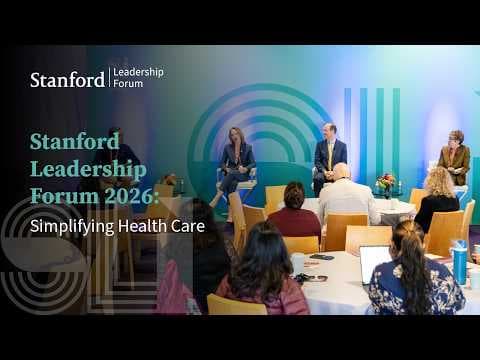
Stanford Leadership Forum 2026: Simplifying Health Care
Audio Summary
AI Summary
The panel discussion, "Simplifying Healthcare," moderated by Stefan Eugenios, a professor at the Business School, explored the complexities of the US healthcare system and potential solutions. Eugenios began by tracing the system's complexity back to World War II, when employment-based health insurance emerged due to price controls and employer competition for talent. This created issues such as access to care between jobs (addressed by COBRA), for the self-employed (addressed by Obamacare), and for retirees (addressed by Medicare). The system has evolved into a patchwork, further complicated by the vulnerability and fear patients experience when seeking care, leading to significant information asymmetry.
The panel featured three leaders in healthcare: Katherine Kerner, CEO of Palo Alto Medical Foundation (PAMF) at Sutter Health; Carter Dredge, Executive Director of the Intermountain Health Institute and President of the Mindshare Institute; and Catherine Field, Senior Vice President and Medical Division Leader for Humana. Each shared initiatives from their organizations aimed at simplifying healthcare and reflected on necessary leadership qualities.
Katherine Kerner focused on simplifying access to care, rather than care itself, by offloading cognitive and emotional burdens from patients and clinicians. Her central thesis is that organizing systems around the patient simplifies their lives and, by extension, the physician's. PAMF and Sutter Health are pursuing three key initiatives:
1. **Online Portal (My Health Online):** Leveraging the Epic electronic medical records platform, Sutter has enhanced its portal beyond basic messaging to include proactive scheduling of complex appointments and information tailored to recent visits. This streamlines communication and reduces the need for in-person visits, a lesson reinforced during COVID-19.
2. **On-Demand Visits:** Sutter activated on-demand video visits, allowing patients to schedule immediate appointments with physicians within their network. Unlike systems partnering with external third parties, Sutter utilizes its 7,000 physicians in California. This approach ensures continuity of care, as episodic video visits often lead to further needs (labs, X-rays), and addresses physician concerns about quality of care and maintaining their organizational culture.
3. **Reducing Physician Cognitive Load (Abridge):** Sutter partnered with Abridge, an AI-powered tool that ambiently listens to patient-physician interactions and generates clinical notes. This has reduced physician time spent on documentation by 20%, allowing doctors to focus more on direct patient interaction. Patients appreciate the increased attention, and physicians find more joy in practice by reducing administrative burden.
Carter Dredge discussed a national strategy led by Intermountain Health to simplify essential healthcare infrastructure. He recounted the challenge of accessing essential medications, leading to the creation of Civica Rx, a non-profit company. Civica Rx rapidly grew to serve 1,500 hospitals, representing a third of US inpatient capacity, and has treated 100 million patients. This model, termed the "healthcare utility model," aims to create new business structures—non-profit, non-stock companies—to provide affordable and accessible mature products. Dredge calls this "disruptive collaboration," focusing on pooling scale to lower costs for standard-of-care products, rather than novel innovations.
This model was extended to retail generic drugs, dramatically reducing the price of a prostate cancer drug from $3,000 to $1,071 per month by aggregating scale from 23 insurance companies covering 100 million people. To further these efforts, the Mindshare Institute was formed, dedicated to solving market failures hurting people by injecting new entities into the market. Its core question is "what is the lowest sustainable price we can deliver?" instead of "what is the highest price the market can bear?" This approach creates "intentional commodities" to ensure affordability and accessibility without harming novel innovation.
The Mindshare Institute has since launched two more national-scale businesses, including Aeroterra Health, an air medical transport company aiming to save billions by offering transparent, lowest-net-cost services. Dredge emphasized that these businesses are designed for market impact, not market share, prioritizing collective benefit over competitive advantage and uniformity over differentiation. He believes this systematic approach can detangle the US healthcare system, providing access to millions and catalyzing novel innovation.
Catherine Field discussed Humana's focus on simplifying healthcare for its members, 80% of whom are in Medicare Advantage programs, covering individuals over 65 or disabled. Given that 9 out of 10 individuals over 65 have at least one chronic condition, and two-thirds have more than two, patients navigate a complex system of primary care, specialists, labs, pharmacies, and post-hospital care. Field highlighted that the current fee-for-service payment model drives complexity and discourages collaboration. Humana is focused on three areas for simplification:
1. **Value-Based Care:** Aligning incentives around quality outcomes, rather than individual services. Field shared a personal story about her 95-year-old mother, whose medication regimen was disrupted during transitions between hospital and skilled nursing, leading to adverse effects. This illustrates the need for a holistic view of patient care. In value-based models, providers are incentivized to coordinate care across transitions, reducing ER utilization, hospitalizations, and improving preventative care. Humana has 70% of its Medicare Advantage population in some form of incentive-based payment structure, with 40% in "two-sided risk" models where providers and Humana share both gains and losses. These models have shown improved outcomes and member satisfaction.
2. **Data Sharing:** Field noted that despite massive investment in electronic medical records (EMRs) post-ACA, data remains siloed within individual EMRs. She mentioned the "kill the clipboard" initiative by CMS and the White House, which promotes transparent data sharing and consumer access to medical information. Humana partnered with BeWell, a data aggregator, to provide members with a longitudinal health record, helping them track their health information across different providers and labs. This is crucial for simplifying the system and enabling better care coordination. Field also mentioned health plans partnering with Epic to provide real-time member information to providers.
For leadership, Field stressed the need for "system thinkers" who can connect disparate parts of the system, strong communicators with empathy, and curious individuals committed to lifelong learning. She emphasized that the common ground in healthcare is always the patient, and focusing on their needs can resolve many conflicts and complexities.
The moderator, Stefan Eugenios, observed that the panelists' examples focused on simplifying individual steps in the patient journey, such as scheduling or drug costs. He shared anecdotes of continued systemic issues, like delayed hospital discharges due to insurance denials for medical equipment or drug interactions missed by doctors not integrated into a common system. He posed the question of how to achieve "radical collaboration" to tackle these interconnected problems, as no single entity can solve them alone.
Carter Dredge responded by suggesting a shift from "alternative payment models" to "alternative production models," aligning by "construct" rather than just contract. He advocated for a "platinum layer" of semantic and syntactic data to remove barriers to digital adoption, noting that piloting digital applications in healthcare can take 18 months. For collaboration, he suggested starting with "meaningful but ancillary pieces" of the healthcare system, rather than attempting to change the "absolute core" where resistance is highest. This "ancillary disruption" allows for collaboration, data liberation, and incentive alignment to gradually work its way into the core.
Catherine Field supported the idea of focusing on "utilities" in healthcare—standardized processes that should not be subject to competition, such as provider credentialing and directory accuracy. She highlighted that these are areas where there's common ground for industry-wide collaboration. Such standardization would enable the use of AI and remove significant costs from the system, allowing resources to be redirected towards access to care and primary care. She emphasized the need for organizations with "staying power" to drive these changes.
Katherine Kerner added that internal collaboration within large healthcare entities is a prerequisite for broader cross-entity collaboration. She shared an example of a Sutter patient who struggled to navigate the system despite being treated at a Sutter hospital, because different parts of the Sutter system did not communicate effectively. She stressed that healthcare providers, payers, and innovators must first get their "internal acts together" before achieving broader "radical collaboration."
Eugenios concluded by summarizing that the approach involves continuous improvement, taking one step at a time, proving smaller opportunities for simplification, and building a case for broader change. Dredge added that streamlining infrastructure can unleash innovation, as startups currently waste capital on bespoke implementations due to the system's heterogeneity.
During the Q&A, a participant raised the challenge of regulation, noting that states regulate health insurance differently, and federal standardization is difficult. Catherine Field acknowledged the complexity, especially with high turnover among legislators, and emphasized that industry players must proactively propose solutions rather than solely reacting to regulations. Another participant questioned why healthcare insurance covers maintenance rather than just catastrophic events, unlike other forms of insurance. Field explained this stems from historical development, societal expectations, and the debate around universal healthcare, noting that high-deductible plans are an attempt to align with other insurance types, but access to care remains a concern. Finally, a question was raised about value-based care in the context of patients frequently switching health plans (averaging 2-3 years), making long-term outcome-focused incentives challenging. Catherine Field explained that in Medicare Advantage, Humana incentivizes members to stay longer by investing in stable benefits and ease of use, as longer tenure allows for better understanding of health conditions and more effective interventions. Katherine Kerner added that the main challenge with value-based care is the need to go "all in" rather than incrementally, as many systems are reluctant to fully shift from fee-for-service. Dredge suggested focusing on "relative tipping points" within specific patient populations or markets where dense care coordination is possible, rather than seeking an aggregate tipping point for the entire system.