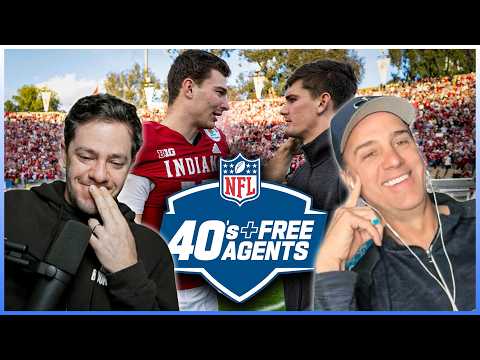
40's and Free Agents: Standout Prospects with Ollie Connolly
Audio Summary
AI Summary
The podcast episode features a discussion among Greg Rosenthal, Daniel Jeremiah (DJ), and guest Ali Connelly, a fellow draft analyst, focusing on quarterback Fernando Mendoza and linebacker Arvel Reese, along with a brief mention of quarterback Ty Simpson and safety Caleb Downs.
The conversation begins with an analysis of Fernando Mendoza. DJ ranks him as his top quarterback and player in the draft, highlighting his physical attributes (6'5", 240 lbs), durability, toughness, and intelligence. He describes Mendoza as a "drive-thrower" rather than a "layer-thrower," comparing his style to Patrick Mahomes and Brock Purdy, while noting a criticism of him being "robotic." DJ points out Mendoza's strong performance in late games, on third downs, and in the red zone, despite playing on a struggling Cal team that took many sacks. He cautions against over-evaluating players based on their system, suggesting Cal's offense was designed to protect Mendoza.
Ali agrees that Mendoza operated at a high level within his system and isn't concerned about him playing within a successful framework. He emphasizes Mendoza's translatable skills in anticipation, touch, and timing, citing his performance on deep comebacks in difficult situations. Ali acknowledges the criticism of roboticism, suggesting a lack of nimbleness compared to pocket passers like Jared Goff, and notes that Mendoza might not have the same elastic arm to navigate pressure. He believes there's projection involved, as Mendoza hasn't operated in a system like Alabama's, but bets on his toughness and intelligence. Ali also clarifies a report about Mendoza learning the Raiders' offense, explaining it's due to training with Brian Griese, who is familiar with that system.
DJ compares Mendoza to other quarterbacks like Bo Nix, JJ McCarthy, and Cam Ward. He rates Mendoza higher than Cam Ward and Bo Nix, but below the top three quarterbacks from a couple of years ago (Caleb Williams, Drake Maye, and Jayden Daniels). DJ defends Mendoza against concerns about fumbles and pocket movement, attributing many sacks to Cal's poor offensive line. He describes Mendoza as a "clunky but robotic athlete" who can throw on the move and absorb contact, possessing more arm horsepower than someone like Goff.
Ali draws a dimensional comparison between Mendoza and Carson Palmer, emphasizing Mendoza's size and toughness. He notes Mendoza's "Brady-esque maniacal energy" and ability to absorb hits, suggesting he operates at a different mental speed. Ali believes Mendoza's resilience after big hits is a positive indicator.
The discussion then shifts to Ty Simpson. DJ expresses reservations about Simpson, particularly regarding his pocket movement and fumbles, and suggests he might be better suited for the NFC West, specifically Arizona, rather than the AFC East with teams like the Jets. He believes Simpson could be a discussion point in the second round, but not a priority for the Jets' early picks, which are geared towards future development. DJ ranks Simpson in his 30s in his top 50, indicating he's a quality player but not a top-tier quarterback prospect.
Ali grades Simpson as a solid starter but expresses concerns about his durability. He notes a difference in Simpson's play between the early and late parts of the season, attributing the decline to potential health concerns, the physical toll of hits, and funky game plans. Ali sees similarities to Brock Purdy in Simpson's playstyle, emphasizing his ability to play on the move and make quick throws, but questions his horsepower for an aggressive, downfield passing game in the NFL. He also worries about Simpson's ability to withstand the punishment of a 17-18 game season.
DJ elaborates on Simpson's struggles, noting he appeared to "shrink" as the year progressed, with fumbles and a decline in field vision. He points to interceptions in easier games as a concern, despite the presence of talented teammates. DJ believes that as defenses got more tape on Simpson, they adjusted, and he appeared more "frazzled," with delayed decision-making and a tendency to bail out of the pocket. He questions Simpson's ability to learn fundamental quarterback play against live NFL competition due to his limited experience.
The conversation then moves to off-ball linebacker Arvel Reese. Ali presents a strong case for Reese, comparing him to a "Zack Baun on Super Serum." He argues that Reese possesses the necessary skills to play the modern "walk-out" linebacker role, starting off the ball, dropping down on the line, and being effective in various defensive schemes. Ali believes Reese can play on the ball as an edge defender in the run game, rush the passer, and drop into coverage. He sees Reese as a "force multiplier" who can be weaponized in the pass rush, potentially transforming a defense.
DJ acknowledges Reese's strengths, particularly his explosiveness, strike, and ability to roll his hips. However, he expresses reservations about Reese's instincts as an off-ball linebacker, comparing him unfavorably to Luke Kuechly and Ray Lewis. DJ also notes that Reese is a "tick late" in both his off-ball instincts and his pass-rush get-off, which he believes is difficult to correct. While he sees Reese's potential in specific defensive schemes, he prefers David Ojabo as a pure rusher at this point. DJ views Reese as a high-quality player, but his evaluation hinges on how much weight is given to his current limitations versus his potential.
Ali counters by emphasizing the increasing prevalence of "mug and drop" schemes and all-out pressure defenses, where Reese's versatility is highly valuable. He believes Reese's "linebacker-level type play" in and around the box, similar to Jalen Pitre, is crucial for modern defenses. Ali highlights Reese's exceptional screen tape as evidence of his instincts and ability to navigate traffic.
The discussion briefly touches on safety Caleb Downs. DJ ranks Downs as his eighth or ninth overall player but expresses concerns about his movement skills compared to players like Jalen Pitre and Brian Branch, who were drafted later. He believes Downs will likely be a top-20 pick rather than a top-10 selection. DJ also notes that some defensive coordinators worry about Downs' lack of length and his tackling average against NFL backs.
Ali sees Downs as a player who can have a structural impact on a defense, similar to Kyle Hamilton, by allowing for defensive flexibility. He compares Downs to Jalen Pitre, highlighting his ability to play weak-side linebacker and then transition to a deeper coverage role, providing valuable versatility without requiring substitutions. Ali believes Downs has enough playmaking ability to be a game-changer.
Finally, the hosts ask their guests to name a "day three" player they are particularly high on. Ali selects linebacker Keashawn Elliot from Arizona State, describing him as a "starting caliber linebacker" who embodies the smart, tough, and instinctual playstyle of many successful NFL linebackers, like T.J. Edwards. DJ picks defensive lineman Caleb Prochaska from Southeastern Louisiana, praising his explosive get-off, ability to slip blocks, and effectiveness on stunts. He believes Prochaska has the potential to sneak into the third round. The episode concludes with a look ahead to the next week's show.