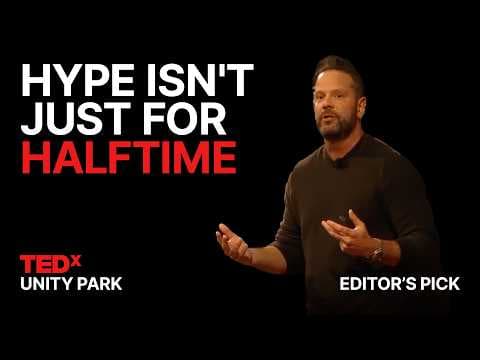
A hype man's advice on supporting others | Jake Fehling | TEDxUnity Park
Audio Summary
AI Summary
In 2021, I became the first hype man for the Carolina Panthers, tasked with energizing fans. Despite my efforts, the team has been the worst in the NFL since then, making me, arguably, the least effective hype man ever. This led to a shift in my role, from "Hype Man Jake" to simply "host," reflecting the difficulty of maintaining enthusiasm when the team is consistently losing.
Beyond the big pre-game, post-game, and halftime shows, I’ve learned that a significant part of my job is to act as a therapist for a passionate fanbase desperate for wins. This became clear three years ago when a soaking wet roll of toilet paper was thrown at me during a game.
"Hype" is the intentional, enthusiastic belief in someone else's potential. However, this is challenging because "haters" exist, quick to dismiss enthusiasm as fake or over-the-top. These headwinds can prevent us from seizing opportunities to uplift those around us, whether at work, home, or in daily life.
At work, while annual reviews and awards are recognized, research shows that micro-encouragement leads to macro-impact. 78% of employees report increased engagement and performance with more frequent recognition. The social media team for the city of Greenville exemplifies this by highlighting behind-the-scenes employees, like the downtown litter crew, through engaging videos. These videos generate hundreds of thousands of views, demonstrating that pouring into employees creates a more engaged workforce and retains top talent.
At home, psychological safety—environments of support—fosters confidence and risk-taking. 81% of individuals raised in supportive environments are more likely to finish high school. The father-daughter duo, Damian and Jackson, who went viral for their daily positive affirmations on the way to school, illustrate how support empowers individuals to pursue opportunities they might otherwise doubt.
In everyday life, Shia LaBeouf’s "Just Do It" video embodies the power of an external push. His chaotic yet inspiring message mirrors a coach’s pep talk, triggering "mirror neurons" that compel us to respond with similar energy. Derek Sivers’ TED Talk on starting a movement highlights the "first follower" as crucial—a hype man who transforms a "lone nut" into a leader.
Public speaking coaches encourage speakers to find "friendlies"—supportive audience members who smile and nod. These individuals, often family and friends, create a psychologically safe environment, boosting the speaker’s confidence and willingness to take risks.
Returning to the toilet paper incident: during a miserable, rainy game where the Panthers were 2-7, a fan threw a soaking wet roll at me. It was a Panthers fan, not an opponent, who broke down, expressing his exhaustion and frustration with the team's constant losing. In that quiet moment, surrounded by other fans, we collectively offered support, telling him it would be okay and that the team couldn’t turn things around without him. It underscored that true hype isn't just about grand gestures but about those quiet, in-between moments of building people up.
We have a responsibility to build up those around us and help them excel. We must ignore the "haters"—the negative thoughts and external criticisms—because succumbing to them means missing opportunities to uplift others at work, home, and in daily life. Embrace your inner hype man or hype woman, because hype isn't just for halftime; it's how we win the whole game.