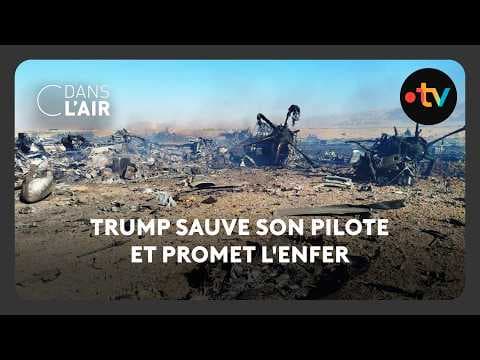
Trump sauve son pilote et promet l'enfer
Audio Summary
AI Summary
The current situation involves D. Trump provoking the world with new statements, particularly from the Oval Office with military personnel. He has refused a proposed ceasefire agreement and has been observed to insult Iranians, calling them "crazies" and threatening severe consequences if they do not open the strait by tomorrow at 8 PM Washington time. This represents another 24-hour postponement of his ultimatum, with a new threat to target civilian energy infrastructure if Iran does not comply. The discussion will likely also cover the dramatic rescue of an American pilot in Iranian territory, an event that caused significant anxiety in Washington.
Panelists include General J.-P. Perruche, former Director-General of the EU Military Staff; F. Encel, doctor in geopolitics and lecturer at Sciences Po Paris and Paris School of Business; M. Pirzadeh, editor-in-chief at France 24 and former Tehran correspondent; and G. Lagane, defense specialist and lecturer at Sciences Po.
G. Lagane notes that Trump's communication style is disruptive, stemming from his background in entertainment and reality TV. He has integrated this style into American politics, unlike previous figures like Ronald Reagan, who adopted traditional political codes. Trump's first term was marked by frequent, unconventional interventions, including early morning tweets with extensive use of capital letters and informal language. The novelty now is that he is live-commenting on the war he is waging, blending negotiation, propaganda, and commentary, which can be unsettling for observers and adversaries alike.
M. Pirzadeh highlights that Trump has dominated the narrative of this 38-day war, making contradictory statements. She observes that he initially encouraged Iranians to protest, promising aid, but later resorted to insults. His close advisors reportedly try to present him with reality, as he seems to surround himself with those who confirm his belief that the war is being won. The chief of staff to Trump has reportedly emphasized the need for truthful reporting, suggesting a lack of accurate information reaching the President.
F. Encel points out the "brutalization" of rhetoric in U.S. politics under Trump, which is particularly concerning during wartime. However, he also notes that such rhetoric is not exclusive to Trump or the current conflict, referencing past insults between Iranian and Saudi leaders during times of less direct conflict. Encel cautions that Trump's unpredictability means that the vulgarity of his statements does not necessarily correlate with the escalation of events on the ground. He recalls that Trump's envoys were negotiating with Iran as recently as February 27, only for massive strikes to occur hours later.
General J.-P. Perruche describes Trump's approach as a personalized exercise of power, where he constantly seeks to occupy the informational stage. To maintain this focus and assert his leadership, he uses shock tactics to destabilize people. Perruche notes that many American military personnel disagree with this approach.
G. Lagane clarifies that Trump uses emissaries for detailed negotiations, while he positions himself as a political leader to sell the spirit of his policy to the American and global public. While his style may be seen as distasteful, Lagane argues it is effective in generating discussion and overshadowing reality. He suggests that the recent successful rescue of an American pilot, a "military success," has boosted Trump's confidence.
The discussion then turns to the implications of Trump's threats to target civilian energy infrastructure. M. Pirzadeh points out that such actions could constitute war crimes. She recounts how the B1 bridge, a civilian infrastructure project, was bombed, causing civilian casualties, despite claims it was used for missile transport. She questions the logic of attacking civilian targets, especially an academic institution like Sharif University, a hub of intellectual talent and a symbol of dissent against the regime. Such actions, she argues, would not endear the population to the U.S.
F. Encel further emphasizes the contradiction in Trump's approach, noting that encouraging protests in January while now threatening civilian infrastructure is counterproductive to winning the support of the Iranian people. He questions how destroying electricity, bridges, or universities could lead to the population's liberation.
General J.-P. Perruche comments on the effectiveness of the strikes, noting that while initial strikes on leaders and military potential are significant, there's a diminishing return on the cost-effectiveness of thousands of additional strikes if Iran can still launch missiles and drones. He suggests that striking energy infrastructure would mark a new, more aggressive phase in the conflict, a "new flight forward." He also points out the internal pressure on Trump, who cannot afford to appear as a "loser," especially given the upcoming constitutional deadline for congressional validation of military operations.
G. Lagane contextualizes the domestic pressure on Trump, noting that while overall war popularity is low, support remains strong among Republicans. He also mentions the long-standing U.S. contentious relationship with Iran, recalling Trump's past interest in seizing Kharg Island. Regarding strikes on civilian infrastructure, Lagane acknowledges that some industrial sites, like steel plants, can have dual civilian and military uses. He also points out that while international law prohibits targeting civilian infrastructure, historical precedents like WWII bombings would now be considered illegal, suggesting a shift in military conduct standards.
The conversation then delves into the rescue operation of the American pilot. The SEAL Team Six, known for the Bin Laden operation, was involved in this high-risk mission. The pilot was hidden for 30 hours in the mountains after his F-15E was shot down. This operation was technically perilous and politically crucial for American military credibility. While one pilot was quickly rescued, the second, a colonel, evaded capture for 36 hours, using survival training and specialized radio equipment. The rescue involved dozens of aircraft, including helicopters that came under fire, leading to the loss of two Black Hawks and an A10 aircraft. Special forces, including Pararescue Jumpers (PJs), were deployed. The CIA reportedly located the pilot south of Isfahan, at 2000 meters altitude. The New York Times reported that Navy SEALs were involved in extracting him from a crevasse, but a plane got stuck, requiring additional aircraft for evacuation and the destruction of American planes to prevent them from falling into enemy hands. Five Iranians were reportedly killed in the operation, and the American pilot was seriously injured.
General J.-P. Perruche emphasizes the strategic importance of rescuing the pilot, noting the disparity in how military events are valued between U.S. and Iranian forces. He finds the 30-hour duration of the second pilot's rescue lengthy, as probabilities of recovery significantly decrease after 48 hours. He also clarifies that the wreckage seen was from planes, not helicopters, contradicting Iranian claims.
G. Lagane views the pilot's rescue as a victory in the "field of perceptions," countering narratives of U.S. entanglement and difficulty in the war. He argues that the successful exfiltration of the pilot from Iranian territory, despite the challenging conditions and the presence of Iranian forces, demonstrates American military dominance. This success also serves as a historical "revenge" for the failed 1980 hostage rescue operation in Iran.
M. Pirzadeh draws a parallel between the current wreckage and the abandoned aircraft from the 1980 operation, which are now displayed at the "Museum of American Arrogance." She highlights the propaganda value for Iran of claiming to have shot down two F-15s and having a pilot hiding in their territory, noting that if the pilot had been captured, it could have profoundly altered the war's trajectory.
F. Encel cautions against premature declarations of "entanglement," comparing the 38-day conflict to the decade-long Vietnam War. He reiterates Trump's unpredictability and ego-driven decision-making, distinguishing the current conflict from more targeted operations like the "Twelve Day War," which was primarily an Iran-Israel conflict.
The discussion also touches on internal purges within the U.S. military, with the Wall Street Journal reporting 17 senior officers dismissed or forced to resign since P. Hegseth's arrival. General J.-P. Perruche interprets this as an autocratic tendency, where Trump seeks unquestioning loyalty from his military rather than expert advice.
The French military presence in the UAE is highlighted, with France acting defensively to protect Emirati airspace and territory against Iranian attacks, as per defense agreements. Emmanuel Macron has reaffirmed France's commitment to its partners. However, the question arises if the UAE might demand more, especially if they decide to join the U.S. in attacking Iran, which would complicate France's defensive posture.
F. Encel and G. Lagane discuss the Gulf monarchies' potential involvement. They suggest that these states, for whom the war is existential, might seek to escalate to definitively eradicate the Iranian threat, leveraging their diplomatic and military capabilities, including advanced aircraft like the Rafale. M. Pirzadeh raises the point of the UAE's inaction regarding freezing the financial assets of the Revolutionary Guards held in Emirati banks, suggesting economic considerations might be a factor. She also warns that if Iran's energy or desalination plants are attacked, the promised reciprocity could target similar vital infrastructure in the Gulf, where water is as critical as oil.
The conversation concludes by reiterating Trump's disregard for international law regarding war crimes, his inconsistent messaging, and the potential for a nuclearized Iran. M. Pirzadeh emphasizes that the Iranian population is largely forgotten in this conflict, with a lack of independent reporting from Iran. The discussion briefly touches on Iranian denials and counter-propaganda, such as claiming the U.S. shot down its own planes or that the pilot's exfiltration was a cover for retrieving enriched uranium.