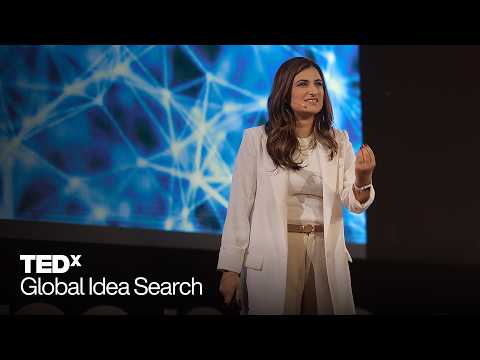
Train Your Brain To Get Smarter | Dina Halaseh | TEDxAmman
Audio Summary
AI Summary
The speaker, who identifies as a brain trainer, notes the common reaction of confusion when they explain their profession, which involves training memory, focus, attention, and other mental skills to "make people smarter." They humorously admit to forgetting their own speech.
The speaker contrasts the past, where education focused on memorizing facts from a board, with the present, where AI and personal devices provide instant information. However, they argue that we haven't been taught how to effectively use, analyze, remember, or focus on this information.
The core of the presentation revolves around three key facts about the brain.
Fact number one is that the brain can be trained. To illustrate this, the speaker uses a memory exercise involving a shopping list. Instead of simply trying to memorize words like "milk," "egg," "bread," "cheese," "apples," "chicken," "rice," "tomato," "coffee," "soap," "juice," and "ice cream," they employ a visualization technique. By creating vivid, interconnected mental images (e.g., milk splashing into an egg, the egg breaking on bread, the bread being washed in a river of cheese), the list becomes much easier to recall. This method, they explain, is how one trains their brain.
Fact number two builds on the first: if the brain can be trained, then one can become smarter. The speaker shares a story about a former student named Sammy, a nine-year-old boy with significant learning difficulties, including issues with reading, writing, focus, and math. Sammy initially believed he was "stupid." Through consistent training, his self-perception transformed, and he eventually became a "genius," going on to complete his schooling and pursue an engineering certificate.
Fact number three emphasizes treating the brain like a muscle. The speaker advises dedicating a small amount of time each day to prioritize brain training, working on focus, memory, logic, and speed. The recommendation is to tackle challenging tasks, practice them until they become easy, and then move on to even harder ones, asserting that consistent effort will yield positive results for the brain.