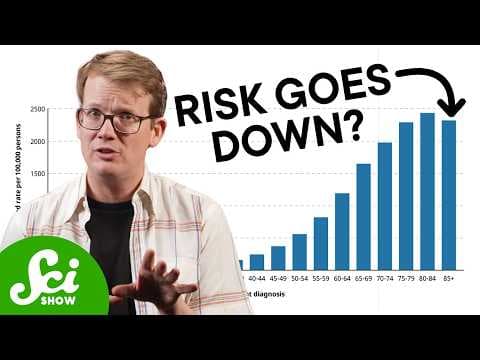
Why 90-Year-Olds Get Less Cancer
Audio Summary
AI Summary
While aging often brings challenges like sore joints and wrinkles, a surprising advantage emerges at a certain point: the risk of cancer begins to decline. Cancer, though it can affect anyone, is generally more prevalent in older individuals due to accumulated genetic mutations from cell division, prolonged exposure to environmental risk factors, a weakening immune system, and diminished DNA repair capabilities. This explains why cancer incidence typically increases with age.
However, this trend reverses in the "oldest-old" group, those 85 years or older, where cancer incidence appears to decrease. This finding is perplexing because this demographic has had the most time to accumulate mutations and environmental exposures, and their immune systems are generally weaker. Some researchers initially questioned the validity of this decline, suggesting it might be an artifact of under-detection in this age group. Factors like the discomfort of diagnostic procedures (e.g., colonoscopies), frailty or chronic conditions making some procedures risky, and a preference for quality of life over aggressive treatment in very old age could contribute to under-diagnosis. Another theory is a natural selection bias, where individuals prone to cancer may have succumbed to it earlier in life, leaving a healthier "oldest-old" population.
Despite these considerations, the current consensus among epidemiologists is that the decreased cancer incidence in the oldest-old is a real phenomenon. Researchers from Stanford and UPenn explored this, using mice to investigate molecular mechanisms. They induced lung cancer in both young (5-month-old) and old (21-month-old) mice using the oncogene KRAS, ensuring genetically identical starting cancers. After 15 weeks, the older mice exhibited significantly fewer and smaller tumors compared to the younger mice, suggesting an active resistance to cancer initiation and growth.
Initially, they tested if the virus delivering the oncogene penetrated older cells less effectively, but found no difference. Their next hypothesis involved tumor suppressor genes, which protect cells from cancer. They focused on the PTEN gene, known to slow the PI3K-AKT pathway, a signaling cascade that promotes cell division and inhibits cell death, thus playing a significant role in tumor development. Surprisingly, knocking out the PTEN gene resulted in tumors growing more than twice as much in younger mice than in older mice, even with increased PI3K signaling in both. This suggested that PTEN was more active in younger cells, contradicting the idea that stronger tumor suppression explained the older mice's resistance. The effect of several other tumor suppressor genes also decreased with age. These findings indicate that while tumor suppressor genes aren't the primary cause, something within the PI3K-AKT pathway might become less effective with age, partially explaining smaller tumors.
Other research, like a 2003 paper, proposed additional reasons for reduced cancer risk in older individuals. One idea is decreased exposure to carcinogens in retirement, particularly occupational ones, and fewer environmental carcinogens in assisted living facilities. Physiologically, as cells age, their division rate slows, including tumor cells, which could explain smaller tumors but not fewer. The paper also credits senescent cells, which are cells that have stopped multiplying but do not die. Older individuals accumulate more senescent cells, making them immune to becoming cancerous and potentially explaining the fewer tumors observed in older mice. However, senescent cells can also release chemicals that increase cancer risk, highlighting the complexity.
Understanding the intricate relationship between aging and cancer is crucial. This research could lead to tailored treatments across the lifespan, for example, by targeting genes like PTEN more effectively in older patients, or identifying protective pathways in the elderly that could benefit younger cancer patients. Critically, these advancements depend on including more older individuals in cancer research, a demographic historically underrepresented, with the FDA now encouraging their inclusion. This inclusive approach promises scientific progress and potentially longer, healthier lives for everyone.