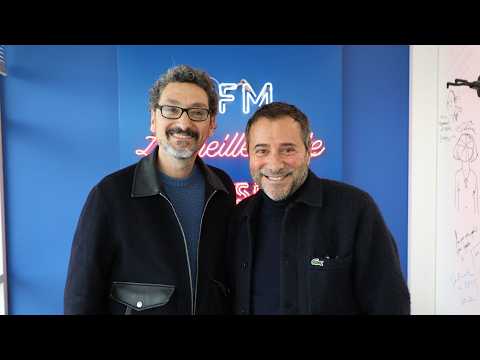
1 heure avec... David Foenkinos - présenté par Bernard Montiel
Audio Summary
AI Summary
Bernard Montiel of RFM interviews David Foenkinos, a writer and filmmaker known for his sensitive, deeply human, and subtly humorous style. Foenkinos's work, including his breakthrough novel "The Delicatesse," explores life's challenges and emotional complexities with accessible and subtle writing, capturing human frailties with tenderness and sincerity.
Foenkinos, despite being 51, is introduced as a "young writer" due to his vibrant presence. Montiel praises his books for their engaging characters and themes, such as believing in dreams, experiencing sadness, and the profound impact of childhood on destiny. Foenkinos appreciates the compliment that his books are hard to put down, emphasizing his goal to craft compelling stories with clear beginnings and ends that readers want to follow. His latest novel, "Je suis drôle" (I Am Funny), is an educational journey following a young man named Gustave Bonsoir through the early stages of his professional life and its many trials. The book is structured in two parts, with an ending that cannot be revealed but centers on an obsession with making people laugh to be loved.
The discussion delves into the theme of humor as a defense mechanism and a means of connection. Foenkinos agrees with the idea that humor can create a bond with others, often stemming from a reserved or timid nature. It serves as a language, a way to express things, and a means of maintaining dignity in hostile situations. The phrase "humor as the politeness of despair" resonates, acknowledging that many comedians use humor to mask sadness or melancholy, seeking consolation through audience applause. Foenkinos views humor as a necessary tool in difficult and violent times.
He observes a contemporary "frenzy" of comedy, particularly among the younger generation, who are drawn to making and watching humorous videos online. This trend is evident in the proliferation of comedy clubs and stand-up acts. His character, Gustave, embodies this desire to be funny, though initially without success. Foenkinos notes a generational shift: while past generations aspired to be footballers or models, today's youth often aim for fame through humor, a stark contrast to earlier aspirations like becoming a pastry chef a decade ago. He highlights that the desire for laughter extends beyond young people, with comedy clubs for seniors and even humor integrated into nursing homes, suggesting that laughter is seen as beneficial, perhaps even worthy of social security reimbursement.
Gustave's journey as a comic is fraught with challenges, including the unfortunate experience of performing after an exceptionally funny act. He uses humor as a mask to exist in the eyes of others, grappling with fragility, failure, and rejection. His need for validation stems from a childhood experience where making his parents laugh made him feel he was fulfilling his purpose.
The conversation touches upon the book's second part, which involves a "Museum of Sadness." Foenkinos reveals that this was an alternative title for the book and will be the title for its Spanish edition. He clarifies that while the Museum of Sadness is fictional, it's inspired by a real "Museum of Broken Relationships" in Zagreb, a place where people can share their heartbreak through letters and broken objects. Foenkinos describes his fictional museum as an immersive experience of sorrow, complete with sad music and films. He acknowledges that experiencing sadness, like crying during a film, can be cathartic, viewing tears and laughter as closely related emotions. Gustave, despite his drive to be funny, finds himself in this Museum of Sadness, embodying the paradox of humor and melancholy.
Foenkinos reflects on his artistic evolution, noting that his early films and books were highly humorous and fantastical. "The Delicatesse," a turning point in his career, combined humor and fantasy with themes of loss and rebirth, a blend he continues to explore. He explains that his own experience with a serious heart operation at 16 profoundly influenced his artistic path, imbuing him with a "joyous energy" and a heightened sensitivity to beauty and art. This near-death experience, where he briefly glimpsed a "tunnel of light," led him to embrace life with an "amused" perspective, even when dealing with profound subjects.
He discusses the influence of other artists in his work, such as Charlotte Salomon, an artist who maintained an optimistic spirit despite living through the horrors of Nazi Germany. Foenkinos admires her ability to find beauty and joy amidst suffering, a theme echoed in Gustave's persistent desire to be funny despite his hardships.
Montiel asks Foenkinos to define "Je suis drôle," to which he responds "drist" – a blend of "drôle" (funny) and "triste" (sad). The book is a coming-of-age story about a 19-year-old character navigating a period of life filled with both joyous experimentation and difficult uncertainties. Gustave, despite setbacks, continues to believe in his dreams, both professionally and romantically.
Foenkinos explains his ability to create such touching characters by emphasizing his personal affection for them. He sees Gustave as a young man with an inherent strength, who must eventually reconcile with his past to build self-confidence. Gustave's fragility and lack of self-love make him unprepared for success, leading him to seek understanding of his biological origins and to reconstruct his self-assurance. Foenkinos believes that understanding oneself is fundamental before connecting with others. He admits that his writing process, though seemingly detached, often reveals autobiographical elements, making him feel as though he "disappears" into his work.
Despite receiving prestigious awards, Foenkinos confesses to still feeling a touch of "imposter syndrome," constantly driven by the desire to invent and write new, interesting novels rather than resting on past achievements.
He also incorporates references to art and culture in his novels, mentioning Marina Abramović and various films and writers. He expresses admiration for John Lennon, whose traumatic childhood and abandonment deeply influenced his art and left him with a permanent fragility despite global adoration. Foenkinos's character is inspired by Lennon's journey. He also mentions his recurring motif of "two Polish people" in all his books, a personal quirk stemming from his first unpublished novel. The discussion concludes with a reflection on Billy Joel, another artist whose complicated life and suffering resonate with Foenkinos's exploration of the link between creative life and personal pain. He reiterates that his own encounter with death at a young age profoundly shaped his artistic drive.
Foenkinos emphasizes the theme of renaissance and second chances in his books, evident in Gustave's journey from disillusionment to an unexpected new phase of life. He shares a quote by Henri Calet, "Don't shake me, I'm full of tears," which he finds beautiful and pertinent to the book's exploration of sadness. He believes embracing sorrow can be a necessary step.
The novel also touches on the complexities of love and relationships, specifically Gustave's decision to leave his girlfriend, Margot, due to intense pressure. Foenkinos views this as an act of love, acknowledging that sometimes one cannot protect another from their own suffering. Gustave, anxious about his artistic career, tries to shield his loved ones from his failures, eventually receding from them to avoid being witnessed in his struggles.
Foenkinos, a father of two, observes how his 11-year-old daughter, Alice, is immersed in the current trend of short, humorous videos, reflecting a generational shift towards seeking humor as a primary form of entertainment and connection, particularly on platforms like TikTok. His 23-year-old son, Victor, is a sports journalist, having already published in Le Monde. Foenkinos expresses a parent's universal wish for his children's happiness, noting their individual inclinations towards writing and theater.
Montiel revisits Foenkinos's heart operation at 16, drawing parallels to his hero's struggles. Foenkinos confirms that this near-death experience, where he felt an "ecstasy" before being resuscitated, profoundly shaped his artistic energy and appreciation for life. He recalls being in intensive care during the first Gulf War in 1991, an unsettling period where the outside world seemed on the brink of apocalypse while he navigated his personal uncertainty. During his prolonged hospital stay, books, including Albert Cohen's "Belle du Seigneur," became his lifeline and consolation in an era before digital distractions. He believes authors read between 15 and 25 years old leave a lasting impact. He also mentions Beckett, whom Gustave's mother mistakenly believes her son will perform in "Waiting for Godot," a humorous recurring gag throughout the book.
The interview concludes with Montiel's strong recommendation of "Je suis drôle," praising its captivating nature and emotional depth.