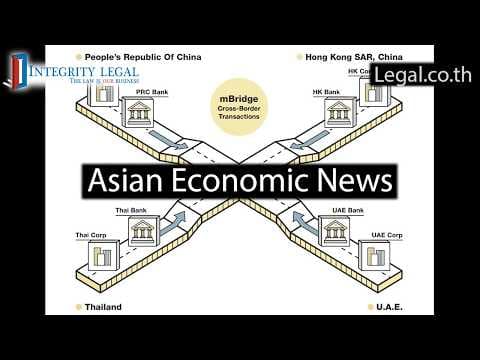
mBridge, the Thai Baht, and the Oil Trade?
Audio Summary
AI Summary
Benjamin Hart, an American attorney and managing director of Integrity Legal in Bangkok, Thailand, discusses Enbridge, the Thai baht, and the oil trade, particularly in the context of recent global events. Having recently returned from China, Hart reflects on observations made during his trip, though these are elaborated upon in a separate video. His current focus is on a development he believes is largely overlooked: Enbridge.
Hart explains that Enbridge is a platform for capital movement between mainland China, Hong Kong, Bangkok (Thailand), and the UAE. The nodal points for this system are the Hong Kong Monetary Authority, the Bank of Thailand, and the United Arab Emirates Monetary Authority. He relates this to Halford Mackinder's "World Island" concept, where Enbridge acts as a "mortar" connecting points along the "rimland" of Eurasia, allowing maritime powers to engage in foreign trade.
The Enbridge protocol was initially established under the Bank for International Settlements (BIS) before being spun off. Hart notes the unusual nature of this spin-off, highlighted by two press releases issued on the same day by Karstens, the head of the BIS, regarding Enbridge. The intention was to allow participating national countries to manage it.
Hart draws a connection between Enbridge and the current hostilities in the Middle East, specifically the Strait of Hormuz, which has become a focal point of conflict making shipping difficult. He suggests that certain jurisdictions are experiencing varying degrees of ease in trans-shipping through the Strait. The UAE, Bangkok, Hong Kong, and China (with its digital RMB/yuan) are all part of this capital movement platform. While Hart cannot confirm specific capital movements on the platform, he finds it unlikely that nothing is moving, especially given the current global events. He observes that the UAE is currently facing difficulties, and surmises that significant capital could be moving over Enbridge to other jurisdictions like Thailand or Hong Kong, and potentially into mainland China.
Hart posits that the world, particularly Southeast and Middle East Asia, along with the global south, may be witnessing a pivot towards a new system of trade and trade relationships. He believes Enbridge will likely play a role in this new system, if not exclusively or largely, then at least to some extent. He speculates that capital has already moved via Enbridge into Thailand and China through Hong Kong, and this trend is unlikely to reverse.
China, according to Hart's understanding, is currently able to trans-ship oil through the Strait of Hormuz, and Thailand has secured a similar deal. While the specific terms are unknown, Thailand appears to have made an agreement with Iran. Hart highlights Thailand's diplomatic strategy of maintaining friendly relationships with many countries, which proves advantageous during global difficulties, enabling them to secure deals in their national interest.
Hart anticipates significant positive consequences for the Thai baht and Thailand generally, as these new trade relationships may differ from those of the past. He foresees cordial relations with the United States continuing, and believes Thailand's economic prospects are strong. The Thai baht's relative weakness against the dollar, pound, and euro creates favorable trade relationships. Furthermore, Thailand's energy inputs are expected to be lower than many other jurisdictions globally. This is partly due to discussions with Russia about oil purchases, positioning Thailand uniquely with lower energy costs. This allows Thailand to continue trading with traditional partners without disrupting relationships, as the currency exchange rates are in a "sweet spot."
Regarding domestic issues, Hart addresses the current Prime Minister Anutin's situation concerning electric vehicles and a perceived energy crisis. Hart suggests that this reflects a misunderstanding of a transitional period. Thailand is moving from an old, stable economic system to a new one. While the transition may involve temporary disruptions, such as the initial need for price control mechanisms on petroleum, Hart believes Thailand will eventually find a new equilibrium, fostering mutually beneficial trade and long-term domestic economic growth. He points to the recent increase in fuel costs as a sign that market mechanisms are being allowed to operate within this new supply chain, ultimately aiming for an equilibrium that benefits Thailand's national interests.