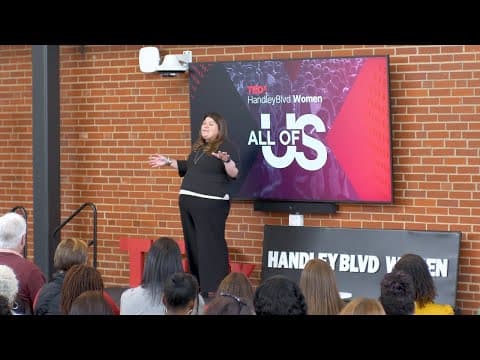
The power of doing one small thing | Julia Healey | TEDxHandley Blvd Women
Audio Summary
AI Summary
The speaker proposes that global change doesn't stem from a single hero but from individuals addressing small issues that deeply affect them. Drawing from a career in turning compassion into action, the speaker asserts that real change originates in quiet, everyday settings like kitchens, locker rooms, classrooms, and churches, where ordinary people decide to take action. Examples include athletes creating resource rooms in high schools, families discussing values with financial advisors, and business owners developing community give-back programs. These initiatives all begin with the feeling that "someone should fix this."
Often, people hesitate due to perceived limitations in their gifts, time, or influence, waiting for a perfect moment, more time, or more money. The speaker challenges this mindset by introducing the principle of compounding interest, which, though not dramatic, is a powerful tool where small, consistent investments grow exponentially. This concept also applies to personal improvement, as committing to just 1% improvement daily can lead to being 37 times better by year-end.
The speaker extends this principle to generosity. For instance, if one person commits to picking up 10 pieces of trash daily on their walk and inspires 25 others to do the same for 25 walks, over 6,000 pieces of trash would be collected. This impact arises from individual action, not from large-scale initiatives or grant applications.
Another example is participating in a 5K race for a community nonprofit. While a participant might feel their contribution is small, their registration fee provides immediate, unrestricted funding for the nonprofit. Their presence validates the organization's work, and sharing selfies on social media offers crucial visibility, helping the nonprofit tell its story. This narrative can then be converted into data, providing leverage for grant applications, attracting sponsors, and securing new donors. Repeating this action consistently creates a compounding effect.
Donating also demonstrates compounding. A monthly donation of $50 totals $600 annually, which can cover essential supplies for many nonprofits. If an individual rallies 10 friends to also donate $50 monthly, the collective contribution becomes $500 a month or $6,000 a year, potentially funding an entire program. Consistent, reliable funding allows nonprofits to plan, hire, expand, and serve more effectively.
The speaker highlights a profound example of compounding through a client who donated $5,000 monthly to a donor-advised fund for 25 years. This client's vision was for his grandchildren to distribute the funds on their birthdays, teaching them the value of giving. The account grew to over $240,000, but the true compounding was in cultivating a perspective of empathy and a way of seeing the world centered on what one can give rather than what one receives.
To conclude, the speaker conducts an experiment, asking the audience to identify a cause that deeply resonates with them and hold up a colored folder representing that interest. This exercise reveals a collective willingness to care, despite diverse callings. The speaker urges everyone to commit to one small action in the next 30 days—volunteering, donating, texting a friend, or starting a conversation. The goal isn't to solve the entire problem but to honor one's part in it.
The speaker emphasizes that when individuals act, a personal shift occurs: helplessness diminishes, the need for permission subsides, and the assumption that someone else will handle it disappears. This shift, when repeated, integrates generosity into one's identity, making it an inherent part of who they are, requiring no willpower or debate. The world, the speaker concludes, needs more people willing to act on the spark within them, as ordinary people choosing to act ultimately changes the world for everyone.