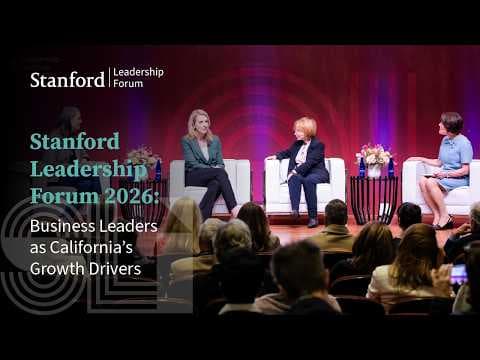
Stanford Leadership Forum 2026: Business Leaders as California’s Growth Drivers
Audio Summary
AI Summary
The current business climate in California is characterized by anxiety and uncertainty, largely due to federal issues like tariffs and immigration, as well as impending state leadership changes and policy decisions impacting affordability. While headlines often suggest a mass exodus of businesses, many companies continue to thrive and plan to remain in California, indicating a mixed narrative. The panel emphasized that businesses need certainty to forecast and plan effectively, and the current stickiness in regulation and tax uncertainty, coupled with affordability challenges, makes it difficult for new companies to establish headquarters and for employees to find affordable housing, quality schools, childcare, and transit.
Despite these challenges, California stands at a critical inflection point with the opportunity to lead in a new, prosperous economy, especially given its strong foundation in technology. The state must make important choices to avoid internal conflicts, stop picking winners and losers, and instead focus on competing globally.
Energy, particularly electricity, is poised to play an increasingly significant role in California's economy, driven by the growing demand from AI and other industries. PG&E, as the local utility, sees this growth as a much-needed opportunity to rebuild and modernize the aging grid, which has lacked new load for two decades. The influx of new demand, according to PG&E's CEO, Patty Poppy, could actually lead to lower rates for everyone by spreading infrastructure costs across a larger base. She highlighted the massive scale of applications for new energy demand, equivalent to 16 gigawatts across the state, which could fund the rebuilding of the entire grid. While building large infrastructure projects has always been challenging in California, as evidenced by the 15 years it took to permit the Golden Gate Bridge, the state has a history of accomplishing such feats. San Jose, for example, is experiencing a significant increase in capacity, with the city and PG&E collaborating to accelerate permitting processes through modernization and AI.
AI-driven growth is crucial for the state's economic health, contributing significantly to the general fund and helping to mitigate budget deficits. However, the slow pace of building infrastructure and housing due to red tape and bureaucracy is a major impediment. Expediting permitting processes, without compromising environmental review, is essential to address the affordability crisis. Employers consistently cite the lack of affordable housing as a top issue, hindering talent attraction and retention. California needs to build housing faster to serve the next generation.
Regarding capital flow, California continues to attract investment due to its talent pool and innovative ideas. However, the "stickiness" of regulations and tax uncertainty makes it difficult for companies that start in California to stay and grow there. While California boasts more Fortune 500 companies and IPOs than any other state, it struggles to retain them because employees face challenges with housing, education quality, childcare, and transportation. Capital is interested but often nervous about long-term investments, questioning the sustainability of growth and demand for completed projects. Regulatory certainty, faster building processes, and a stable tax environment are crucial to attract and retain capital.
The current uncertainty in California's tax structure, where tax credits and incentives can be withdrawn during tough budget times, further discourages long-term investments. This unpredictability makes it challenging for businesses to project revenue and make confident investment decisions. A stable tax structure and a predictable regulatory environment are vital for fostering investment.
A specific acute capital attraction problem exists for California's investor-owned utilities. Following fires, investors have shown reluctance, leading to a significant discount in their valuation compared to the rest of the sector, primarily due to wildfire risk and the state's liability regime. Legislation addressing liability reform, such as Senate Bill 254 phase 2, is critical. This reform is not about a "free pass" but about ensuring investment in community hardening to mitigate wildfire risks. The investor-owned utility model relies on attracting investor capital to spread infrastructure investment costs over the life of assets, making it affordable for customers. Without improved credit metrics and the ability to attract equity investment at a lower cost, funding the massive electric infrastructure needed to power California's economy becomes challenging. This highlights the importance of business engagement in good policy to ensure the state's prosperity.
The Stanford Leadership Institute aims to address these issues by emphasizing that leaders must not only focus on personal leadership skills but also strategically understand and influence the complex context in which they operate.
Business leaders in California are increasingly recognizing their role in civic life. Historically, San Francisco's business community became disengaged, leading to an "unfortunate" government. However, with a new mayor, a more moderate board of supervisors, and a population that understands the importance of business for jobs and tax revenue, the Partnership for San Francisco has emerged as a crucial voice. It facilitates dialogue between city hall and businesses, addressing priorities like public transportation funding while advocating for business concerns such as increased police presence and a safe, clean environment.
This model of business engagement is scaling to the state level through the California CEO Council, a statewide group of CEOs collaborating with the California Chamber of Commerce. Inspired by the San Francisco partnership and similar initiatives in other states, the council aims to bring data-driven, problem-solving, and pragmatic business perspectives to policy discussions in Sacramento. This fills a long-standing void, as legislators often questioned the absence of CEOs when discussing issues critical to their industries. The council comprises CEOs committed to California, who are dedicating their time and resources to partner on addressing state challenges, benefiting not only their businesses but also their workforce and the entire state. Their collective expertise is particularly valuable at this "critical time" as California grapples with the consequences of past policy choices and seeks to re-evaluate and adopt new approaches to foster growth and affordability.
For aspiring and current business leaders in California, the advice is clear: there is no better place to innovate and build a business due to the talent and capital available. However, commitment is key. Leaders must be engaged, both at the community and state levels, to ensure their voices are heard in shaping policies. Businesses are crucial partners in the state's growth. Patty Poppy offered a "million-dollar question" for future leaders: instead of asking "Is it possible?" (which invites reasons for failure), ask "What has to be true to achieve your wild idea?" This "breakthrough thinking" approach, used at PG&E, has led to significant achievements, such as making their system safer for wildfire and reducing energy rates for vulnerable customers by 23% in two years. This mindset allows for breaking down complex challenges into actionable steps, fueling progress and prosperity.
The Stanford Graduate School of Business aims to instill an entrepreneurial mindset in its students, empowering them as investors and leaders to drive economic growth in California.