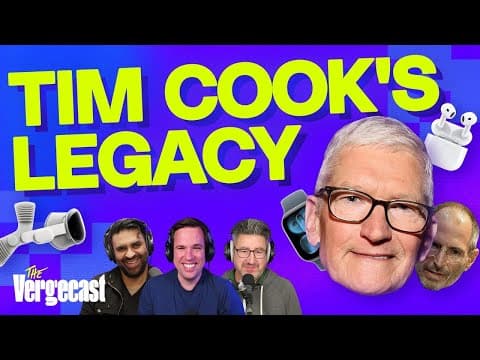
AirPods, Touch Bars, and the rest of Tim Cook's legacy | The Vergecast
Audio Summary
AI Summary
The podcast begins with the major news of the week: Tim Cook's departure as Apple CEO and John Turnis's ascension. The hosts, David Pierce and Neil, along with guest John Gruber, discuss their reactions to the announcement, which, despite prior speculation, still felt sudden. Gruber compares it to an election day whose date was unknown, while Neil notes Tim Cook's immediate clarification about his health and long-term commitment as executive chairman, suggesting Apple wasn't prepared for health concerns to arise. This leads to a discussion about the sensitivity surrounding health and succession at Apple, given Steve Jobs's history.
The hosts then delve into Tim Cook's legacy as CEO. Neil argues that while Cook oversaw immense growth and managed global complexities, he lacked the deep product involvement needed for truly transformative innovations. He points to Apple's car project as an example of a "failed lark" where excessive rope was given to Jony Ive. Gruber, however, contends that the iPhone represents the ultimate personal computer, and subsequent products like the Apple Watch and AirPods are natural extensions, making further "step changes" difficult. He highlights Cook's lack of ego, contrasting him with John Sculley, who sought his own "thing" in the Newton, separate from the Mac.
A list of major products launched under Cook's tenure is presented, including the iPhone 5 and later models, iPad mini/Pro, Apple Maps, Beats acquisition, Apple Watch, Apple Pencil, Apple Pay, AirPods, HomePod, Apple Card, and Vision Pro. The hosts debate the hits (Apple Watch, AirPods), misses (Trash Can Mac Pro, Touch Bar), and incremental improvements. The Touch Bar becomes a point of contention, with Pierce and Gruber arguing its potential was squandered by a lack of iteration, while Neil dismisses it as a fundamentally flawed idea. This discussion leads to a broader point about Apple's product development under Cook, where ideas, even flawed ones like the butterfly keyboard, were sometimes held onto for too long without significant improvement.
The conversation shifts to the belief during the Cook era that the iPad would supplant the Mac, leading to a perceived neglect of the Mac line. The hosts credit John Turnis with advocating for the Mac internally, leading to its resurgence, particularly with the introduction of Apple Silicon. This suggests Turnis's influence as a "product person" who understands the importance of iterating and improving existing product lines.
Moving beyond Apple, the podcast covers significant news from Microsoft's Xbox division. Asha Sharma, the new CEO of Microsoft Gaming, has rebranded the entire division as "Xbox," aiming to simplify its identity and re-engage gamers. While the memo outlines a renewed focus on players and creators, and a commitment to a global platform across various devices, Neil points out that the core strategy—"Xbox everywhere"—remains largely similar to Phil Spencer's previous vision. The main challenge, getting Xbox onto mobile phones without paying platform taxes, persists.
Sharma also announced a new "northstar" metric: daily active players. The hosts discuss the implications of this, suggesting it will necessitate a successful mobile strategy, potentially more investment in casual games like Candy Crush, and less emphasis on traditional game sales or offline play. They also touch on the re-evaluation of exclusivity and the controversial decision to remove Call of Duty games from Game Pass on launch day, which is seen as an attempt to solidify Game Pass as a standalone offering.
The podcast then transitions to the "Brendan Carr is a Dummy" segment, criticizing FCC Commissioner Brendan Carr for launching an investigation into children's TV shows featuring transgender or non-binary characters. The hosts argue this is a politically motivated attempt to regulate content on internet platforms and an affront to human dignity, linking it to broader conservative efforts to restrict LGBTQ+ rights.
Finally, the hosts discuss Anthropic's new AI model, Mythos, which the company claims is so powerful it can find vulnerabilities in operating systems and browsers, leading them to implement "Project Glasswing" for cybersecurity mitigation. There's a debate about whether this is genuine concern or "scare tactics marketing." The hosts highlight the irony of Anthropic's own cybersecurity vulnerabilities, with Mythos's URL being leaked. They also note the Trump administration's shifting stance on Anthropic, potentially seeing Mythos as a way to mend ties despite earlier classifications as a supply chain risk. The discussion concludes that while Mythos might not be "the end of the world," it underscores the increasing capability of AI models to find cyber vulnerabilities, emphasizing the need to focus on strengthening open-source software infrastructure.
The episode closes with a humorous look at BMW's new 7 series interior, which features a bewildering array of screens and a TIE-fighter-like steering wheel, criticized for its confusing and aesthetically unpleasing design. They also discuss a new "creator gadget," the Insta360 Mic Pro, a microphone designed to display a brand logo, perfectly encapsulating the live-stream era. The final topic is Meta's controversial "model capability initiative," where employees' computer activity is tracked to train AI agents. While acknowledging the "intense internal backlash" and the ethical implications of training AI to potentially replace human jobs, the hosts also point out that extensive employee monitoring is already a widespread practice in large companies.