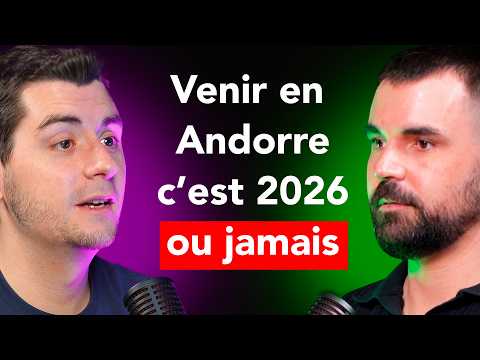
Business en Ligne et Expatriation en Andorre (Sécurité, Impôts, Galères...)
AI Summary
In this podcast episode, host Hervé and co-host Alex are joined by Romain, a member of the "YouTube Business" project who is currently visiting Andorra. The discussion explores Romain’s unconventional path to entrepreneurship, the mechanics of building a faceless YouTube empire, and the lifestyle shifts that come with international expatriation.
### From Chicken Sales to Real Estate Mastery
Romain’s entrepreneurial journey began at the age of 12 on a farm in Brittany, where he bought and raised chickens to resell to neighbors. This early exposure to commerce laid the foundation for a career defined by bold moves. After studying agriculture, Romain moved to Australia in 2012, where he worked on a massive 12,000-hectare grain farm.
It was in Australia that Romain met a mentor who introduced him to the concepts of real estate investment and financial independence. Inspired by books like *Rich Dad Poor Dad* and *The Millionaire Fastlane*, he returned to France with a five-year plan. Despite working a standard job in a bike shop, he invested heavily in "colocation" (flat-sharing) in Quimper—a concept that was virtually unknown in the region at the time. He achieved financial freedom within his five-year target and eventually moved to Georgia (the country) to continue his entrepreneurial ventures.
### The Power of the YouTube Business Model
A significant portion of the conversation focuses on Hervé’s "YouTube Business" program, which teaches participants how to create and manage YouTube channels without ever showing their faces. Hervé has been operating in this space since 2012, and the model offers several unique advantages:
* **No Client Acquisition:** Unlike traditional businesses, there is no need to hunt for customers or handle sales calls.
* **No Customer Support:** There are no physical products to ship or complaints to manage.
* **Algorithm-Driven Revenue:** Income is generated through views and the YouTube partner program, allowing for a highly automated and scalable business.
Alex serves as a prime example of this success; two years ago, he was a recent engineering graduate living with his parents, unsure of his future. After discovering Hervé’s methods, he built a network of channels and eventually relocated to Andorra. The hosts also highlight a student named Jimmy, who reached $10,000 in monthly revenue just two months after starting, proving that the market is far from saturated.
### The Realities of Expatriation in Andorra
Romain’s visit to Andorra serves as a catalyst for a discussion on the benefits of living in an "entrepreneurial bubble." Both Hervé and Alex emphasize that Andorra offers a unique ecosystem characterized by security, a sports-oriented lifestyle (particularly cycling and skiing), and proximity to other high-level entrepreneurs.
However, the gates to this "principality bubble" are closing. Hervé notes that when he arrived a decade ago, the process was simple. Today, the government has introduced strict "active residence" requirements. Prospective entrepreneurs may soon face an investment requirement of €250,000 to €300,000, in addition to existing security deposits (currently around €50,000). The limited capacity of the country—roughly 88,000 residents—means that Andorra is increasingly selective, favoring profiles that contribute significantly to the local economy.
### Wealth, Mindset, and the "Supercar" Debate
The participants address the cultural differences regarding wealth. In France, luxury items like Supercars are often met with jealousy or suspicion, frequently dismissed as "rentals" or "scams." Hervé shares an anecdote about a critic who viewed his Lamborghini as a "red flag."
In contrast, the hosts argue that in places like Andorra or the US, such assets are seen as markers of success and sources of inspiration. For Hervé, the car is both a "toy" that rewards his hard work and a networking tool that facilitates connections with other successful individuals. They conclude that once an entrepreneur has acquired dozens of real estate assets, a luxury car is simply the next logical "case to check" to challenge oneself and stay motivated.
### The "Brute Force" Approach to Success
The core philosophy shared by all three men is "action over reflection." Romain describes himself as a "brute"—someone who prefers to dive into projects and learn through experience rather than over-analyzing. They argue that the most successful students are often those who come from manual or "classic" labor backgrounds because they possess the discipline to work hard without questioning every minor detail.
Hervé explains that his role in the coaching program is to act as a "problem solver" and "barrier remover." Unlike many "infopreneurs" who delegate their coaching to underlings, Hervé remains involved seven days a week. He views the program as a way to "teach people to fish" rather than giving them a fish, ensuring that students understand the underlying mechanics of YouTube so they can adapt as the platform evolves.
### Conclusion and Future Outlook
The episode concludes with a look toward the future. Romain plans to return to Georgia but expresses a strong desire to eventually settle in Andorra. Meanwhile, Hervé is expanding the "YouTube Business" project beyond digital screens, planning a live seminar in Toulouse to bring the community together in person. The final message to the audience is clear: stop overthinking, surround yourself with people who have the results you want, and take the first step by hitting the "publish" button.