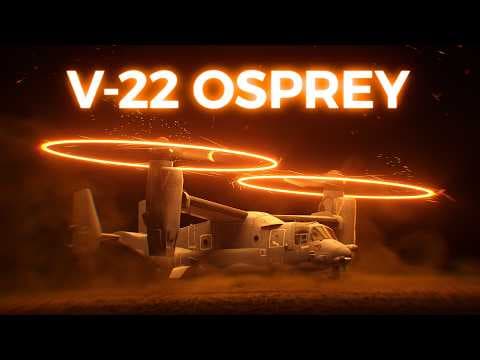
The Insane Engineering of the V-22 Osprey
Audio Summary
AI Summary
Here's a summary of the provided transcript:
* **Emergency Rescue in Libya:**
* An F-15 fighter jet crashed in the Libyan desert during the Arab Spring in February 2011, leaving its pilot stranded behind enemy lines.
* The pilot's life was in danger as Gaddafi's forces were brutal, threatening to show no mercy.
* NATO had imposed a no-fly zone over Libya due to Gaddafi's use of fighter jets against his own people.
* The rescue mission depended on an MV-22 Osprey, which was on an aircraft carrier.
* The V-22 Osprey, a controversial hybrid aircraft, was chosen for the mission due to its unique capabilities.
* **V-22 Osprey's Unique Flight Mechanics:**
* The V-22 operates in two distinct modes: vertical (helicopter) and horizontal (plane), using the same controls.
* The Thrust Control Lever manages collective pitch in vertical flight for altitude control and engine thrust in forward flight for speed.
* A "fly by wire" system is crucial for the control logic to switch between these modes, especially during transition.
* Pilots control the nacelles' tilt, trading vertical rotor wash for forward thrust. During this transition, the computer blends both control logics.
* Once in airplane mode, the V-22 flies nearly twice as fast as a Blackhawk helicopter.
* **The Rescue Operation:**
* The V-22 flew low to the water at 500 km/h to avoid radar, reaching the Libyan coastline in under 30 minutes.
* Upon arrival, the pilots encountered a well-lit, populated area, forcing them to navigate to the darkest patch.
* On the ground, the pilot was cornered by enemy vehicles and had to call for a "danger close" bombing run from US Harrier jets, which bought crucial time.
* The V-22 arrived at the landing zone in 41 minutes, a journey that would have taken standard rescue teams hours.
* The V-22 quickly transitioned to hover, opened its rear ramp, and extracted the pilot in under 90 seconds, showcasing its engineering.
* **Evolution of Tiltrotor Technology (XV-3 and XV-15):**
* The V-22's development traces back to the 1950s with the XV-3, the first tiltrotor to transition between flight modes.
* The XV-3 had a piston engine in the fuselage and rotors mechanically linked through the wings, but lacked stiffness, leading to intense vibrations that injured a test pilot and damaged the prototype.
* The XV-15 moved the propulsion to the wingtips, placing engines closer to the rotors and bolstering pylons with nacelles for stiffness.
* The XV-15 introduced a cross-shaft through the wings for engine synchronization, which the V-22 adopted. This design allowed for single-engine landings by disengaging a failed engine.
* **Impact of Operation Eagle Claw:**
* The failed 1980 Operation Eagle Claw, a rescue attempt in Tehran, highlighted the limitations of conventional helicopters regarding speed and range.
* This led the Pentagon in 1981 to approve a program for a transport aircraft capable of both vertical takeoff and airplane-like cruise, setting the stage for the V-22 Osprey's development.
* **V-22's Core Engineering - The Conversion Actuator:**
* The Osprey's "tiltrotor" status relies on the conversion actuator, which handles the nacelles' tilt.
* Pilots typically use three modes: helicopter (90 degrees), airplane (0 degrees), and short take-off and landing (60 degrees).
* The actuator manages varying forces: compression when the nacelle is in helicopter mode, tension as it rotates, and then compression again as it approaches 0 degrees.
* A screw drive is used to spread these loads, specifically a double telescoping screw for space-saving and jam redundancy, crucial for safe landings.
* **Proprotor Design Compromises:**
* The V-22's proprotors are a blend of helicopter rotor and airplane propeller, evident in their size (between a C-130 propeller and a Sea Stallion rotor).
* They have an aggressive 47-degree twist angle, significantly more than typical helicopter blades (8-14 degrees).
* This twist allows efficient lift generation across the blade's length despite high-speed airflow at the tips, which can approach supersonic speeds in forward flight.
* However, these small rotors result in lower hover efficiency and high downwash velocities (up to 150 km/h), making ground operations difficult.
* **Composite Materials and Structural Integrity:**
* The V-22 extensively uses composite materials to achieve lightness and strength, crucial for preventing vibrations.
* Over 2700 kg of the aircraft's 6000 kg structural weight is carbon-epoxy composites.
* The wing structure uses stiffer carbon composite (IM-6) compared to the fuselage or tail (AS4).
* The proprotor yoke, subject to cyclical forces, is made from S-2 fiberglass composite, which absorbs, flexes, and transfers force without vibrating, unlike the titanium or stainless steel tested in the XV-15.
* Carbon composite blades required "preloaded clamp rings" to prevent delamination at hinges during folding.
* Proprotors are armored with hot-formed titanium strips on the leading edge and electroformed nickel caps at the tips for protection against high-speed debris and sand.
* **Drivetrain and Engine Synchronization:**
* The V-22's two proprotors must match rotational speed, especially in hover, to prevent crashes.
* A mechanical link is required, navigating complex angles: the wings tilt up 3.5 degrees (dihedral) for nacelle clearance, and are swept forward to prevent proprotor-fuselage contact.
* The drivetrain must handle nacelle rotation, wing flexing, and wing rotation parallel to the fuselage, all while rotating at 6300 rpm.
* An innovative lubrication-free multi-disk convoluted diaphragm flexible coupling replaces the XV-15's geared system, allowing shafts to move out of alignment while transmitting torque.
* These 0.2 mm thick stainless steel disks endure millions of revolutions and bending, with squeaking sounds indicating failure, allowing for 5 hours of continued flight at maximum torque.
* Fuel delivery to the wingtip engines from sponson tanks uses a rotating coupling system, similar to a rotating house design.
* **Engine Design and Safety Features:**
* Engines are Rolls Royce turboshafts mounted on wingtips.
* A filtration system with clever aerodynamics forces air to make a sharp turn, separating heavier grit and sand from clean air entering the compressor.
* One proprotor gearbox has an extra gear to spin it in the opposite direction, canceling adverse rolling moments from the gyroscopes.
* A mixer deliberately blends cooler outside air with hot exhaust, spreading and cooling the plume, and aiming it outward to prevent damage to structures or re-ingestion.
* **V-22 Safety Record:**
* The V-22 has a reputation for being unsafe.
* Since 1991, there have been 25 incidents: 9 pilot error, 10 mechanical, 2 mixed, 2 under investigation. These resulted in 58 deaths and 52 injuries.
* Compared to the H-60 (390 incidents, 970 deaths since 1979) and H-47 (historically high death rate, but improved safety recently), the V-22's safety record is not an outlier.
* In incidents per airframe, the V-22 (0.0625) fares well against the H-60 (0.075) and H-47 (0.11).
* However, the V-22 has more deaths per 100,000 flight hours.
* Larger aircraft like the V-22 or H-47 tend to have higher death rates per incident due to carrying more people.
* Complex aircraft often see an initial spike in incidents that decrease as problems are identified and fixed.
* The data suggests the V-22's safety record is comparable to other military aircraft, acknowledging that all aircraft have flaws and every accident is a tragedy.