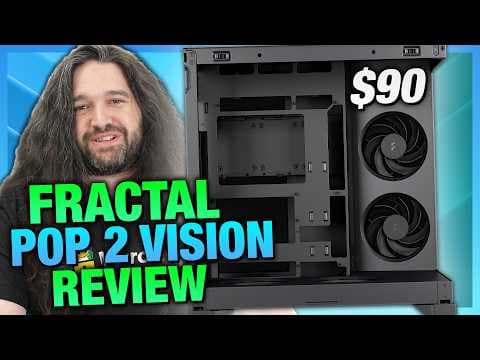
$90 Fractal Pop 2 Vision Case Review & Benchmarks: Cable Management, Thermals, Build Quality
Audio Summary
AI Summary
The Fractal Pop 2 Vision is a $90 PC case that presents a mix of sturdy materials and cost-cutting measures, notably using DC fans instead of PWM and combining USB-A and USB-C on a single cable. This reflects a broader trend in the case market where companies are struggling with reduced sales due to high RAM prices. Despite these cuts, the case offers several positives, including an angled front wall for embedded fans to improve thermals, a chamfered design for improved fan performance, and a deep back for easy cable management. A unique feature is the stamped steel bottom filter, offering surprisingly high build quality.
The Pop 2 Vision is an O1D-inspired dual-chamber "fish tank" style case, sharing only its $90 price point with the original Pop family. An RGB version is available for $100. Unlike other Pop models, it's exclusively glass-paneled.
Fractal has been encouraged to release a sub-$100 case, and while the Pop Air was well-received, the current market makes achieving this price point difficult. Case companies are resorting to cost-cutting, which may lead to cheaper cases but also a "resetting of expectations" regarding features like DC fans. However, the Pop 2 Vision stands out for its impressive sturdiness, particularly the front corner, and its stamped steel top filter, which is an improvement over flimsy magnetic filters.
The two glass panels don't contact each other, maintaining a consistent gap, and all panels can be screwed down for shipping. The fractal tag on the front is decorative; the front panel is removed from the top edge or inside. The bottom filter requires side panel removal for access, which is unusual but better than pulling the case from the back.
During assembly, it was noted that accessing bottom cable channels is easier by tilting the case due to their restricted placement. This design choice, however, allows Fractal to hide cables behind the fan sheet without increasing case height. Conversely, the dual-chamber design provides ample depth for cable management at the back.
The case features visually distinctive flat blank plates around the four stock fans, which are angled to improve airflow. A significant limitation is that the side and bottom fan mounts are exclusively 120mm and only fit Fractal's stock fan dimensions, restricting fan and liquid cooler options. Access to the side and bottom fans is relatively easy, requiring only side panel or dust filter removal. All four included fans are reverse-blade intakes, pulling air from the side and front, with exhaust primarily at the top and back.
The only real radiator mount is at the top, theoretically fitting up to 360mm, but 280mm is strongly recommended due to tight clearance. The Pop 2 Vision deviates significantly from the Pop series in design, layout, and tooling, suggesting Fractal opted to avoid branding a new case family.
As a dual-chamber case, it offers extensive space for power cable routing, with five pre-installed Velcro straps. However, the main cutout for motherboard cables is hard to reach with a power supply installed, and CBI power cutouts conflict with top-mounted fans or radiators, which is a design weakness. The front I/O includes one Type-C and one Type-A port, both routed from a single internal USB 3 header, a cost-saving measure compared to the original Pop Air's more feature-rich (though optional Type-C) I/O. The RGB version includes RGB button controls.
A clear sign of cost-cutting is the use of three-pin DC-controlled fans, which is unusual for reverse-blade fans typically more expensive due to lower production volume. The drive bracket and power supply can swap places, offering flexibility, especially for back-connect motherboards. The drive bracket is a simple metal piece accommodating one 3.5-inch and three 2.5-inch drives, aiding cable management, and includes rubber vibration dampers for hard drives – a detail often missed in higher-end cases. Expansion slot covers are unventilated, potentially affecting air-cooled GPU thermals. EATX clearance is claimed up to 274mm, but larger boards will overhang the motherboard tray. The inclusion of rubber cable grommets is an unexpected touch at this price point.
Thermal testing was kept simple due to limited reconfiguration options. The standardized fan test was skipped as the fan slot layout forced a "nonsense layout" for comparison. The case performs best with its stock fan configuration.
Comparisons:
The Pop 2 Vision is compared to the Pop 2 Air (similar price, different style), and budget fish tank cases like the Montech HSO2 Pro, Antec C8 ARGB, and Hyte Y60. More expensive options like Corsair's Air5400/6500D and the Lian Li O1 family are in a different price class. The Pop 2 Vision, with included fans, is cheaper than most of these at $90. Non-dual-chamber competitors include the Corsair 3200D and Frame series.
Noise-normalized CPU temperatures: The Pop 2 Vision averaged 50°C over ambient on peak cores and 47°C overall. This places it better than other bottom-intake fish tank cases like the HSO2 Pro (52°C), C8 ARGB (54°C), and Y60 (57°C). However, cheaper, non-dual-chamber cases like the $83 Lancool 207 (44.5°C) and $90 Corsair Frame 4000D (47°C) offer competitive or better CPU cooling. For a dual-chamber case at its price, the Pop 2 Vision is a strong contender.
Noise-normalized GPU temperatures: The Pop 2 Vision is better suited for GPU cooling, averaging 44°C above ambient for the GPU and 49°C for VRAM. It performed similarly to the HSO2 Pro (43°C) and C8 ARGB (42°C), but significantly better than the Y60 (53°C). The Lancool 207 (non-dual-chamber) performed better.
Full-speed case fans: The Pop 2 Vision was relatively quiet at 34 dBA with four stock fans, which operated within rated RPM tolerances. Competitors like the HSO2 Pro and C8 ARGB were louder and hotter. The Y60 was quieter but hotter. For a dual-chamber case, the Pop 2 Vision performs well in this category, though standard towers like the Antec Flux 9 Pro and Lancool 207 are louder but cooler.
Full-speed GPU thermals: The Vision averaged 42°C for the GPU and 46°C for VRAM, tying with the HSO2 Pro and C8 ARGB (which had slightly better VRAM temps). The Y60 was much worse. The Pop 2 Air had warmer GPU temperatures than the Vision.
VRM and DAM temperatures: The Pop 2 Vision showed unusually good VRM (31°C above ambient) and DAM (22°C above ambient) readings, potentially due to a large gap between the motherboard top and case roof.
Initial skepticism about the Pop 2 Vision, based on renders, gave way to appreciation for its unique angled front side intake and interesting bottom design, especially at the $90 price point. The biggest downside is the heavy restriction on customization options for fans and radiators. If a budget dual-chamber "fish tank" aesthetic is the priority and customization is not, this case makes sense. Otherwise, other cases offer more flexibility or better thermal performance.
Overall, the Pop 2 Vision's thermal results are middling but acceptable for its price. Its main appeal is being one of the best budget dual-chamber ATX "fish tank" options available, primarily due to its price. If the dual-chamber requirement is removed, numerous other cases offer higher airflow performance, such as the Antec Flux Non-Pro, Corsair Frame 4000D, and Lancool 207. The Frame 4000D is an excellent thermal performer often similarly priced, while the Lancool 207 offers exceptional performance for its cost but has different design and cable management challenges.
For dual-chamber alternatives around this price, the Montech HSO2 Pro or potentially the Corsair 3500X (if on sale) are options, but Fractal's sturdy build quality makes the Vision a strong choice among these. The RGB version of the Pop 2 Vision might be worth the $10 extra for its included controller and external controls, and white color option. The current market's challenges for case companies mean less skew complexity and fewer color options.
In conclusion, the Pop 2 Vision offers a compelling option for those seeking a budget-friendly dual-chamber case with a specific aesthetic, provided one is aware of and accepts its limitations regarding customization and its middling thermal performance compared to non-dual-chamber alternatives.