Transforming Global Governance: From "We the State" to "We the People" | Sukehiro Hasegawa | TEDxICU
Audio Summary
AI Summary
The speaker, a former UN official, shares experiences from 37 years with the organization, highlighting both its failures and successes. He discusses working in developing countries like Nepal and Indonesia, and later in peacebuilding in war-torn nations such as Cambodia, Somalia, Rwanda, and Timor-Leste. He recounts the UN's failure to intervene in the Cambodian genocide, where two million people were killed, and the Rwandan genocide in 1994, where one million died, with the UN withdrawing forces.
Conversely, Timor-Leste is presented as a success story where the UN helped restore peace, build the nation, train police, and empower communities. The speaker attributes the UN's inability to resolve conflicts to power struggles among major Security Council members like the US, China, and Russia, who prioritize national interests over global well-being, leading to continued deaths in places like Ukraine, Gaza, and Sudan.
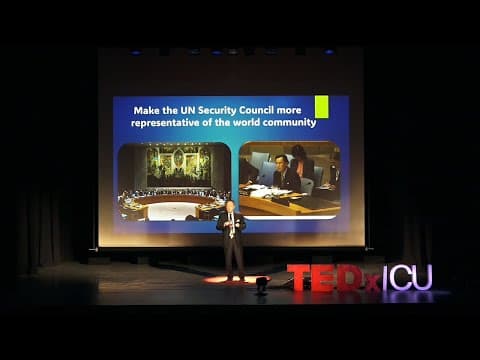
He proposes reforming the Security Council to be more representative, noting that while the UN grew from 54 to 193 countries, the Council still has only 15 seats. He criticizes Japan's continued pursuit of a permanent seat despite its diminished economic power. The speaker suggests electing 10 additional Security Council seats and strengthening the General Assembly by creating a parliamentary assembly representing people, not just states, akin to the European Council. He also advocates for strengthening the International Criminal Court and the International Court of Justice.
Drawing a parallel to Japan's Meiji Restoration, where samurai united under a central government to face external threats, he urges young leaders to join the Japanese government or the UN.