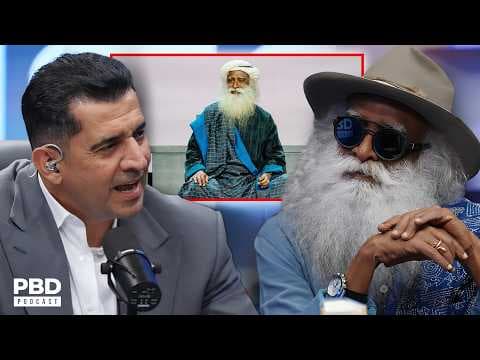
“The Fear Of FAILURE” - Sadhguru UNCOVERS The Mind Games KILLING Your Potential
AI Summary
The speaker describes himself as "just pure life," untouched by philosophy, ideology, or belief systems, existing as the Creator intended. He is the youngest of four siblings, with one brother and two sisters, one of whom has passed away. He notes that the youngest child in a family often tends to be the most vibrant.
Growing up, he was close to his family and friends but also very aloof, spending significant time alone in jungles and forest areas. He recounts a habit of disappearing into the wilderness for three to four days with minimal food, only returning when supplies ran out. Initially, this led to searches and police complaints, but eventually, his family understood that he would always return. Today, he feels at home wherever he goes, not tied to a single location.
When asked about his biggest accomplishment, he states he has none, believing he is only doing his best and not making a big deal of what has happened. He perceives himself as not even achieving 2% of his potential, primarily because creating conducive situations and convincing others of possibilities in the world is challenging. He had once believed he could bring everyone to a state of bliss in two and a half years, but found people too invested in their miseries, despite their desire for bliss.
He acknowledges facing many challenges daily but does not allow them to give him a hard time, nor does he grant others the freedom to do so. This is possible because he has no vested interest in the outcomes of his endeavors. If he starts a project and some participants deviate or drop out, he tries to inspire them, but whether the project succeeds or fails is not personally consequential to him; its benefit is for the world. He starts initiatives wherever he sees possibility, regardless of the fear of failure expressed by others. He believes that not doing what one *can* do is a "disastrous life," emphasizing the importance of effort even if the outcome is uncertain. He cites historical figures like Gautam Buddha, Manzoor, and Jesus, who, despite facing rejection or persecution, did what they could.
He reveals that he hasn't been a big reader in recent times, though he did read extensively once. After high school, he took a year-long break, choosing to educate himself rather than attend college, which he found inefficient. This decision was controversial in his family, where education was highly valued, especially since his father was a physician who expected his children to follow in his footsteps. His three older siblings did not pursue medicine, placing the expectation on him.
During this year, despite his father's academic background and preserved medical texts, he declared he would not be a doctor. Instead, he spent his days from 9 AM to 8 PM in the Mysore University library. At 18, having just finished high school, his refusal to attend university was considered a "crime" in his family, signifying a "finished life."
In the library, he read "anything and anything," from popular mechanics to Homer, National Geographic, literature, and philosophy. Geography particularly captivated him. He consumed a vast amount of books on world geography that year. He notes that his physical activity and metabolism were so high then that despite eating 10-12 times his current intake, he never gained weight. The year of intense reading with only one meal a day (breakfast and dinner) was physically challenging.
He hasn't read much since that year, especially not spiritual texts. He enjoys literature and poetry, having written a lot himself. His interest in geography stemmed from a deep connection to the land. He has cycled and motorcycled extensively across India and other parts of the world, like Canada and Tibet, not for the mode of transport, but to experience and "drink up the land." He emphasizes that understanding the planet we live on is fundamentally important.