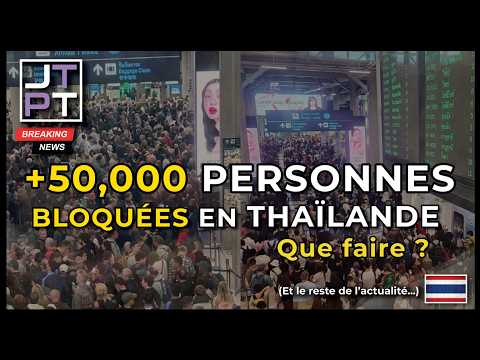
⚠️Crise de l’essence en Thaïlande! Bientôt la pénurie ? #thailande #thaïlande #essence #gasoil #jtpt
AI Summary
This summary provides an overview of the latest developments in Thailand as reported by JTPT, focusing on the regional conflict’s impact on travel, the economy, and local social issues.
### The Impact of the Iran-Israel-USA Conflict on Travel
The ongoing geopolitical tensions involving Iran, Israel, and the United States have created significant uncertainty for travelers in Thailand. While the intensity of the conflict fluctuated over the week, the repercussions on air traffic and passenger transit remain severe. The French Embassy in Thailand has issued recommendations for travelers, advising them to consult airline booking sites—specifically those that do not transit through the impacted conflict zones—or to seek assistance from local travel agencies.
Air France has announced additional flights to accommodate the surge in demand, offering direct routes from Bangkok and Phuket. Travelers are strongly encouraged to register on the "Fil d'Ariane" platform, a government census tool that ensures citizens can be contacted and informed during international crises. A critical point for travelers is that any additional costs resulting from flight cancellations, such as new tickets or extended hotel stays, must be covered by the individuals themselves.
For those unable to leave, Thai authorities are offering a 30-day visa extension for approximately 1,900 to 2,000 Baht. Crucially, the Thai government has signaled leniency regarding overstays, stating that travelers will not be sanctioned if their delay is directly linked to the conflict, provided they can show proof of original bookings. Currently, an estimated 50,000 passengers are stranded in Thai airports, with the majority located at Suvarnabhumi in Bangkok (33,000) and Phuket (16,000). Major affected airlines include Emirates, Qatar, Etihad, and Gulf Air.
### The Transit Crisis in Dubai
The situation at Dubai International Airport, a primary hub for travelers between Europe and Thailand, has been particularly volatile. Reports emerged of a drone attack at the airport, involving 15 ballistic missiles and 119 drones, most of which were intercepted. While initial reports suggested a total suspension of operations, the airport later resumed partial service.
Navigating information regarding Dubai has become difficult due to strict local laws. Authorities have announced that spreading "negative publicity" about the situation can result in fines exceeding €40,000 or even imprisonment. This has led to a noticeable shift in social media reports from influencers who initially voiced panic but later claimed the situation was calm. Real-time flight radar currently shows a significant "hole" in air traffic over Iraq and Iran, though activity in Dubai appears to be recovering slowly.
### Fuel Panic and National Reserves
The potential blockage of the Strait of Hormuz by Iran sparked a wave of panic at Thai gas stations. Initially, reports suggested the country only had 60 days of fuel reserves, leading to long queues and instances of hoarding. In response, the Thai government froze fuel prices for ten days to prevent an economic escalation and banned the filling of large jerry cans to curb selfishness and supply shortages.
The outlook improved after the government secured additional supplies from the United States, Malaysia, and South Africa, extending the national reserve to 95 days. Comparatively, Thailand is in a stable position compared to neighbors like Vietnam and Indonesia, which reportedly hold only 15 days of reserves, whereas Japan and South Korea maintain over 200 days.
### Airline Pricing and Tourism Forecasts
Travelers are facing "astronomical" increases in ticket prices. Some one-way economy tickets from Bangkok to London have reached €1,900. In one extreme case, a KLM/Air France flight with two stops and a 32-hour duration was listed for over €14,800. The Civil Aviation Authority of Thailand has clarified that it lacks the jurisdiction to cap prices for international flights, leaving travelers at the mercy of market volatility.
The Tourism Authority of Thailand (TAT) has already revised its forecasts downward. While the original goal was 36.7 million tourists for the year, a worst-case scenario involving a prolonged conflict could see a 25% drop, bringing numbers down to 27–29 million. If the conflict resolves quickly, the impact may be limited to a 2% decrease.
### Social Controversies: Phuket and Koh Tao
On a lighter but still contentious note, a "secret" nudist beach in Phuket, known as Shadow Beach, has sparked local outrage. Authorities have reminded the public that public nudity is illegal in Thailand, carrying a 5,000 Baht fine and potential deportation for repeat offenders. While nudity is permitted in private villas or hotel rooms, it is strictly prohibited on public shores.
In Koh Tao, a German tourist was arrested after a drug-fueled rampage. The individual reportedly harassed locals, stole a mobile phone, a motorcycle, and eventually a kayak, which he paddled out to sea while completely naked. He was eventually apprehended and tasered by police. Local officers noted that such "GTA-style" incidents involving intoxicated tourists occur almost every night in the party-heavy regions of the islands.
### Financial Summary
The Thai Baht remains relatively stable despite the global turmoil, currently trading at approximately 36.93 Baht to the Euro. While this rate is favorable for tourists on a budget, the overall cost of visiting Thailand has risen due to the aforementioned flight and fuel challenges. Travelers are advised to stay informed as the situation continues to evolve weekly.