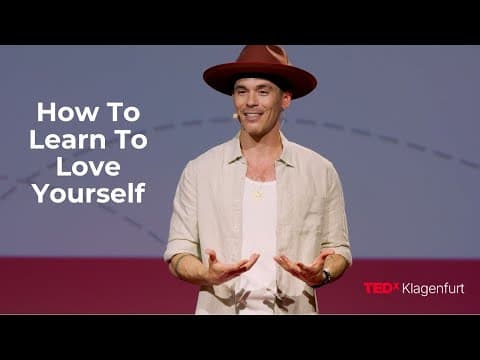
Treat Yourself Like Someone You Love (How To Learn To Love Yourself) | Adam Roa | TEDxKlagenfurt
Audio Summary
AI Summary
The speaker begins by asserting that individuals are who they have been searching for, suggesting that the feeling of emptiness or a void is a result of believing one lacks what is necessary. This belief, the speaker argues, is perpetuated by a consumerist society that profits from the idea of not being enough, pushing products with promises of fulfillment. The speaker points out the irony that makeup, marketed to make one feel prettier, is often bought to alleviate feelings of inadequacy stemming from the very lie of not being enough. Similarly, media messages often convey a need for another person to complete oneself.
While love is presented as the answer, the speaker questions how one can love another without first loving oneself. The concept of "loving yourself" is explored, with the speaker finding the common interpretations of messages and selfies to feel superficial. Raised with the notion that arrogance and vanity are negative, and influenced by teachings to act in a certain way, the speaker grappled with how to genuinely practice self-love.
A turning point came from a friend who observed the speaker's tendency to defend her against her own self-criticism while simultaneously being harsh on herself. This friend posed the question: "Why are you so dutifully filling up her cup constantly and yet treating your own cup so irresponsibly?" This prompted the speaker to confront the negative self-talk reflected in the mirror – criticisms about appearance and perceived flaws. The friend’s life-changing advice was simple yet profound: "Treat yourself like someone you love."
This advice led the speaker to a realization: they had been forgetting that they were the very person they had been seeking. The core message is that happiness comes from within, and that one is already enough. The speaker emphasizes that this truth applies to everyone, not just themselves, and that recognizing this inner sufficiency leads to a brighter world and a lighter load, enabling one to be a lover rather than a fighter. The speaker asserts that everyone deserves a life and is inherently worthy, and that perceived flaws are merely protective mechanisms against self-doubt.
The speaker then reveals that the poem containing these messages went viral, garnering over 250 million views. This overnight success brought global speaking invitations but also plunged the speaker into a deep suicidal depression. While experiencing this, in Bali, the speaker witnessed the poem's mega-viral status, receiving millions of views daily. However, this was accompanied by an influx of messages, many expressing profound gratitude and claiming the poem changed their lives. Crucially, a significant portion of these messages revealed deep pain and vulnerability, with people asking for help with issues like domestic abuse, suicidal thoughts, and the inability to love themselves.
The speaker felt inadequate, unable to provide the deep help needed beyond the poem. This led to feelings of shame, guilt, and a physical breakdown, culminating in a period of intense depression characterized by fever, shivering, and an inability to tolerate light. This marked the beginning of a multi-year journey to understand how to truly love oneself.
Initially, the speaker attempted various self-love practices – meditation, journaling, creative pursuits, physical therapies, and even plant medicine journeys – believing self-love was a switch to be flipped. However, this approach proved ineffective, as the expected shift never materialized. Instead, the speaker began to notice small, incremental changes. This led to the realization that self-love is not an instantaneous event but rather the *result* of consistent, daily self-care and the way one shows up for themselves. It is the byproduct of one's relationship with oneself, a relationship that requires the same nurturing as any other.
To cultivate this inner relationship, the speaker adopted the framework of "The Five Love Languages" (Acts of Service, Quality Time, Physical Touch, Gifts, and Words of Affirmation). Applying these to oneself, the speaker illustrates how easily one can neglect their own needs, such as confusing being alone with spending quality time, or engaging in constant negative self-talk. The solution lies in a combination of attention and intention. By directing attention to these five areas and intending to love oneself more deeply, one can identify moments of self-neglect and make conscious choices to strengthen the relationship with oneself.
These choices, even small ones, unlock further guidance from the universe, which can manifest as significant life changes like leaving toxic situations or starting therapy, or as simpler steps like writing a poem or watching an informative video. For the speaker, this journey involved all of these elements, including confronting oneself in the mirror.
The speaker expresses regret for not having answers for those who reached out years ago but thanks them for inadvertently helping them find those answers. The core message is reiterated: it is absolutely possible to emerge from darkness and find self-love, even if it takes years. The journey involves a gradual softening of inner criticism, a different way of relating to emotions, others, and life itself. This leads to a brighter world and a lighter load, as described in the initial poem.
The speaker then introduces a second poem, "Heaven," which expands on the theme of embracing life's full spectrum of emotions. It suggests that true impact comes from learning to love all of life, acknowledging pain and sadness without succumbing to them. Choosing love doesn't mean ignoring fear, but rather being willing to feel it. The courage to feel is presented as the key to healing, as the fear of feeling is the root of all fears, including the fear of living.
The poem emphasizes that the ability to feel, even difficult emotions, is a gift and a celebration of being human. Emotions, though sometimes overwhelming, contain the key to freedom. The coexistence of sorrow and bliss is highlighted, with heartbreak often being preceded by love. The speaker encourages a shift from focusing on lack to practicing gratitude for what one has, distinguishing between abundance and scarcity based on perspective.
The speaker concludes by urging listeners to focus on their breath and their presence, recognizing their inherent miracle and blessing. The sheer improbability of existence is presented as evidence of being blessed since before birth. The speaker contrasts the listener's situation with those facing far greater hardships, emphasizing gratitude for walking, dancing, singing, and talking. Spotting abundance in simple things, like taste, touch, breath, and smell, unlocks further abundance.
Finally, the speaker posits that living is more than just being alive. It's about actively embracing life, feeling through hurt and rage, and turning the page. This process, though painful, is how healing occurs and how one can still love life, thereby paving the way for others. This, the speaker concludes, is heaven, and it is here today.