Frame Generation Doesn't Fix Bad Performance!
Audio Summary
AI Summary
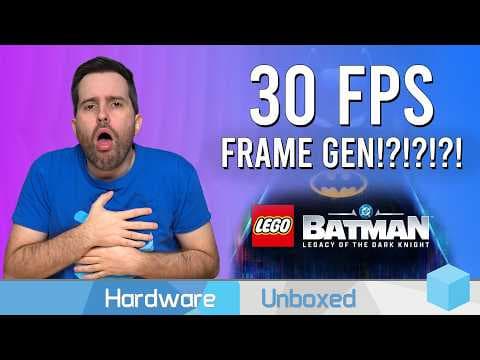
A concerning trend has emerged in game development, with a developer officially using frame generation as a crutch to achieve a 30fps output, equating to a native render rate of just 15 fps, as listed on an official spec sheet for the upcoming game, "Lego Batman Legacy of the Dark Knight." This is problematic because frame generation, while increasing output frame rate, does not improve actual performance, especially input latency, which is crucial for a responsive gaming experience.
The official PC system requirements for "Lego Batman Legacy of the Dark Knight," slated for release on May 22nd, detail hardware specifications for various resolutions and frame rates. For 4K 60fps, the requirements list components like a Core i7-4700K with an RTX 4070 or RX 970 XT, but crucially, this is with DLSS, FSR, or XSS quality and frame generation enabled. This means the game is natively rendering at 1440p 30fps, with upscaling and frame generation used to reach the 4K 60fps output.
The situation worsens with the recommended and minimum specifications. The recommended spec for 1440p 60fps with frame generation implies a 960p native render resolution at 30fps. For the minimum spec, targeting 1080p 30fps with FSR or XSS balanced and frame generation, the native render resolution is a mere 635p at a 15 fps render rate. This is an unprecedented and unacceptable configuration for an official spec sheet.
Traveler's Tales, the developers, have switched to Unreal Engine 5 for this title, departing from their proprietary Entity engine used in previous LEGO games like "The Skywalker Saga." This switch, potentially driven by the Entity Engine's difficulty and development crunch, is significant given Unreal Engine's documented performance issues on PC. The system requirements, therefore, hint at low performance, which is not surprising.
The core issue is the deceptive advertising of performance. Most gamers find 30fps unpleasant, but 60fps is more acceptable. Frame generation is being "slapped on" to achieve the higher advertised frame rate, masking the true underlying performance. Gamers who read closely and understand frame generation would realize that an RTX 4070 isn't truly playing the game at 4K 60fps, but rather 4K 30fps in terms of native rendering.
Frame generation does not improve performance; in fact, enabling it often reduces native render performance due to overhead. While it increases output frame rate, making the game appear smoother and reducing motion blur, it does not reduce input latency. Input latency is a critical component of gaming performance, affecting responsiveness, control feel, and even player success in competitive titles. Historically, higher FPS has been synonymous with better performance because it simultaneously delivered smoother visuals and lower input latency. Frame generation breaks this link, offering only half the benefits.
For example, in Cyberpunk 2077, enabling 2x frame generation boosted output FPS from 78 to 139, but latency increased from 34ms to 40ms. The native render rate also decreased from 78 to 69 FPS. This demonstrates that while the displayed frame rate is higher, the game feels less responsive. If a game truly runs at 120fps natively, latency is significantly lower than achieving 120fps via frame generation from a 60fps native render.
When TT Games advertises "Lego Batman" running at 60fps with frame generation, it means the game will feel like it's being played at 30fps due to the latency. The 30fps configuration with frame generation will feel like 15fps, which is an "absolutely horrible" experience.
Frame generation is acceptable when the base render rate is already high enough to provide good latency, and the technology is used to further enhance smoothness. Nvidia recommends a final output of at least 120fps for optimal frame generation, and Intel suggests a base frame rate of 60fps (or 40fps for entry-level graphics). The listed 15-30fps render rates for "Lego Batman" fall far below these recommendations, making the generated frames more prone to artifacts and less effective visually.
Furthermore, frame generation should be an optional feature, not a mandatory one to hit target performance. It's akin to making motion blur mandatory to hide low frame rates. While frame generation is a more sophisticated form of smoothing than motion blur, using it to mask poor native performance is misleading.
This practice aligns with concerns that companies would weaponize frame generation to mislead gamers and deliver subpar experiences, as seen with some of Nvidia's marketing claims. If the frame generation "garbage" is removed from the "Lego Batman" requirements, the game is revealed to be very taxing, potentially similar to other intensive Unreal Engine 5 titles like Stalker 2, running at 4K 30fps on an RTX 4070. This highlights a lack of proper optimization, with frame generation being used as an "excuse" for inadequate performance, which often leads to negative gamer reception and refunds.