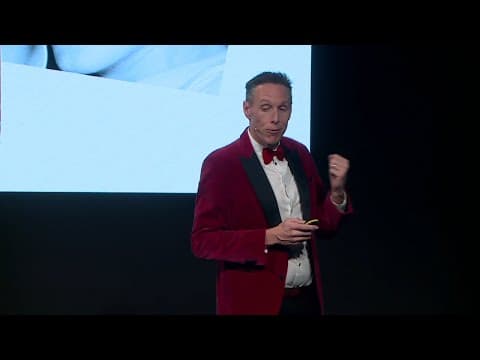
Why we should challenge mental health stigmas | Damien O’Brien | TEDxGVAGrad
Audio Summary
AI Summary
The speaker, Damian, shares his personal journey with mental illness, aiming to break the stigma and silence surrounding it. He reveals he has bipolar disorder and possibly ADHD, emphasizing that his illness is dangerous to himself, not others. His vision is a world where mental health is treated with the same compassion as physical health, a reality he believes is not yet achieved.
He poses questions about why mental health, particularly mental illness, remains a difficult topic. He suggests the stigma, fear of judgment, prejudice, and the crushing weight of shame prevent open discussion. He notes that one in three people will develop a mental health condition, highlighting the widespread impact. For many, the hardest step is seeking support, a challenge he personally faced as a man.
Damian introduces the concept of the "vulnerability gym," where vulnerability is presented as a superpower that makes others feel safe. He encourages the audience to practice vulnerability by sending a message of kindness to someone they care about, comparing this act to creating a "nuclear weapon of kindness." He observes that society often masks vulnerabilities, striving for a manufactured perfection, citing filtered social media posts as an example. He admits to having previously worn a mask of a happy, fun-loving Australian, hiding his inner pain.
He then recounts his childhood, marked by violence and abuse, growing up in social housing with limited food. His mother suffered from mental illness, diagnosed as manic depression at the time, and struggled with medication and alcohol. His father was an alcoholic. This chaotic environment was his "normal." As a young boy, he developed an inner voice, a "monkey in his head," to cope and survive. He describes instances where he tried to save his mother from suicide attempts, an experience he likens to being electrocuted.
After his mother's death, his "monkey" grew, fueled by trauma. This internal voice, initially a protector, evolved into a survival mechanism that constantly scanned for threats. He found it difficult to talk about his childhood due to the prevailing attitude of "lapping it up and moving on." He ran from his past, accumulating wealth and material possessions in Switzerland, but remained internally "bleeding." His "monkey" became wild and bipolar, capable of creating but also destroying relationships and friendships.
Despite having a supportive wife of 22 years, his destructive behavior escalated. He engaged in risky behavior and gambling, seeking a rush for his "monkey." This led to self-destruction, culminating in him hitting "rock bottom." His wife confronted him, suggesting he was mentally ill, and helped him seek hospitalization. He describes the difficulty for men to reach out for help and credits the psychiatric hospital and its staff for helping him surrender to his "monkey" and begin to heal.
The diagnosis of bipolar disorder was a heavy burden, but in the hospital, doctors provided him with a "new blueprint" and a glimmer of hope, initiating his seven-year journey of managing his mental illness. He acknowledges the struggles of caregivers, like his wife, and advocates for collective support, suggesting everyone can become an "expert" in caring for others.
Damian made a pact with his "monkey" to shift from destruction to construction. He now travels, advocating for active listening, stating that most people just want to be heard. He emphasizes that vulnerability is not weakness but speaking one's truth and removing the armor of pretense. He believes that in a world increasingly reliant on technology, human values like family, love, and support remain paramount and irreplaceable.
He concludes by reiterating that talking, even when uncomfortable, is the first step. He urges the audience to be a support network, to talk and check in with those around them, practicing active listening and kindness without expectation. He questions how many friendships are lost due to caring too much and reflects on his own experience of friends not intervening in his self-destructive patterns. He now has new friends who supported him through his darkest times, embodying the idea that "we are stronger together." He ends with a quote from Leonard Cohen: "There's a crack in everything and that's how the light gets in."