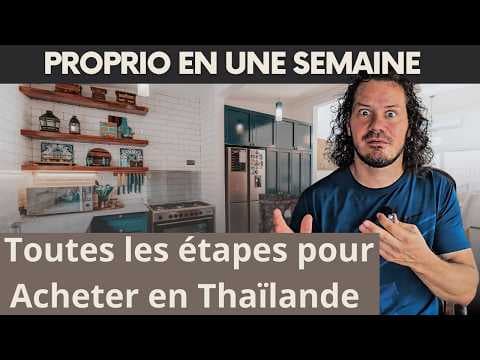
J’ai acheté un bien en Thaïlande (toutes les étapes, sans rien cacher)
AI Summary
This video details the process of buying property in Thailand, as experienced by the speaker in real-time. The speaker recounts an opportunity to purchase a neighboring apartment, which would expand his current 80 m² unit to 120 m² with three bedrooms and an office. He had previously expressed interest to his neighbor, who recently decided to sell due to fears of a third world war and a desire to be near family in Austria.
The neighbor initially asked for 1.5 million baht, the price he paid ten years ago. The speaker, enjoying negotiation, offered 1.3 million baht, which the neighbor accepted. This agreement initiated the buying process, which the speaker decided to document live for the video, promising updates at each stage, from legal consultations to signing documents and court hearings.
The first step involved the seller's lawyer preparing the sales contract. The speaker was contacted by Mali, the legal representative for the building, who informed him that the contract was ready for signing. He then gathered 130,000 baht in cash for the deposit and his passport, heading to Mali's office to sign the contract.
Upon signing, the speaker exchanged the 130,000 baht for the sales contract. He explains that the document contains sensitive information, including the names, surnames, and dates of birth of both buyer and seller, the property address, and withdrawal clauses. If the buyer withdraws, the deposit is forfeited; if the seller withdraws, the deposit must be returned with interest. The contract also included copies of both passports and the "Chanop" (title deed) copy. The actual Chanop would be obtained in a few days.
The next phase involved a visit to the bank. The speaker, who has multiple bank accounts in Thailand, went to the Kingsglee bank with his passport. His objective was to request a TT3 document, which he acknowledges is now commonly referred to as an FET. This document serves as proof that foreign currency entered a Thai bank account from abroad, tracing the money to prevent illicit activities like money laundering. Obtaining a TT3/FET typically takes 2-3 business days. This document is crucial for the transaction at the Land Office. Additionally, he requested a check for 1,170,000 baht, representing the remaining balance of the 1.3 million baht purchase price after the 130,000 baht cash deposit. This check, made out to the seller, would be handed over personally after the Chanot is received at the Land Office, ensuring payment is not made prematurely.
After leaving the bank, the speaker recounted his actions: he submitted the purchase contract and his passport to the bank. He requested the check for 1,170,000 baht from his account, which corresponded to the amount to be paid at the official registration. He received a message from his bank manager the following morning, confirming the document was ready for pickup, having been processed in less than 36-48 hours.
The speaker then displayed the document he collected from the bank, which he identified as a Credit Advice, serving a similar purpose to the TT3/FET in proving the origin of funds. He detailed its contents, including the bank's stamp, creation date (processed in less than 24 hours), his name (with the last name redacted), the nature of the SWIFT transfer (received on March 10th), and a reference number. He also noted that the document showed the conversion rate from his multi-currency Citibank account (euros) to Thai baht. He emphasized that sensitive data like his address was removed for privacy. With both the Credit Advice and the previously obtained contract, he was fully prepared for the official registration on Monday.
The video then fast-forwards to March 17th, the morning of the official registration. The speaker confirms he received the keys and the Chanot. He explains the process at the Land Office: taking a ticket, waiting for one's turn, presenting the sales contract and all required documents (buyer's and seller's), identity verification, and signing the transfer of sale. Subsequently, they move to a different floor in the same building to pay the fees. The speaker paid 46,613 baht, which covered all transfer fees. He contrasts this with significantly higher notary fees he would have incurred in Belgium or France (e.g., €60,000 for a previous purchase in Belgium), highlighting the affordability in Thailand (approximately €1,000). These transfer fees are the only costs paid during the transaction in Thailand. After payment, confirmation is shown downstairs, and the process is complete.
The speaker stresses that when buying in Thailand, apartments are always subject to taxes and bills, which the seller must pay in full before the Land Office approves the transaction. The Land Office thoroughly verifies everything. Buyers receive a white document containing sensitive data, official stamps, seals, signatures, and their name in Thai, which should be carefully checked. The address, age of buyer/seller, passport numbers, and square footage are also included. Upon receiving the deed and keys, the check is handed over, eliminating the risk of scams when going through official channels.
The video concludes by stating that this was a step-by-step tutorial on the buying process, not a tour of the apartment or future renovations. The speaker managed to complete the purchase in just 8 days, from Sunday to Monday, which he considers an incredible record. He also mentions other apartment-related expenses: €10 in monthly condo fees, and a property tax of 150 baht (€4) per year, noting the absence of council tax, sewage tax, pool tax, balcony tax, or garbage collection tax in Thailand, making property ownership very inexpensive. He further touches on tax residency in Thailand, stating that he paid only 1,700 baht (less than €45) in taxes for 2025, despite having significant income from businesses and shops that do not directly enter Thai bank accounts. He operates legally using money previously brought into Thailand, benefiting from full tax optimization. This, he notes, is a separate topic he might discuss later. He concludes by reiterating that buying property in Thailand remains incredibly appealing, marking this as his fifth purchase in Pratamnac alone. He invites questions and offers to clarify any unclear points.