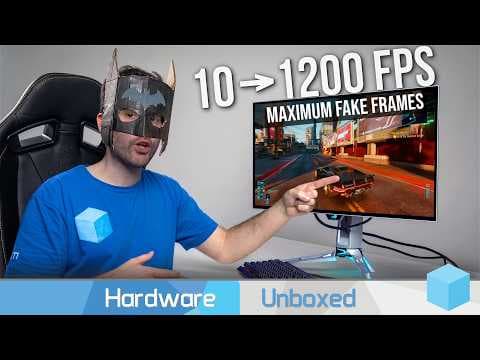
I "Fixed" 10 FPS Gaming: The Future of Optimization
Audio Summary
AI Summary
This video explores the implications of developers increasingly relying on frame generation, particularly in light of upcoming games like Lego Batman: The Legacy of the Dark Knight, which suggests using frame generation to target extremely low base frame rates, such as 15-30 FPS. The presenter argues that this approach misuses frame generation technology and leads to a poor gaming experience.
The video begins by showcasing Cyberpunk 2077 running with a configuration considered a good use of frame generation: a base frame rate of 60 FPS, doubled to 120 FPS using DLSS frame generation with path tracing at 1440p. While not offering super low latency, this setup provides a smoother experience than native 60 FPS, especially on a high refresh rate OLED monitor. The presenter notes that a base rate of around 100 FPS (resulting in 150-200 FPS with frame gen) would offer an even more responsive and ideal experience.
However, the video then delves into the problematic scenario of 15-30 FPS frame generation. When Cyberpunk 2077 is configured to render at a base rate of 15 FPS, resulting in a 30 FPS output with 2x frame generation, the experience is described as a "slideshow." It lacks smoothness and fluidity, even with motion blur off. More critically, a 15 FPS base render rate introduces significant input lag, making the game difficult to control, with movements feeling delayed and unresponsive (50-100 milliseconds latency). Furthermore, numerous visual artifacts appear, especially around moving objects like car wheels, due to the limited data (only 15 real frames per second) fed to the frame generation algorithm. This demonstrates that 15-30 FPS frame generation is not a viable or recommendable way to play modern PC games.
Next, the video explores even more extreme levels of frame generation, utilizing Nvidia's announced 6x mode with dynamic frame generation, set through the Nvidia app override. With a 15 FPS base render rate, this configuration aims for a 90 FPS output (15 to 90 FPS frame generation). While the visual smoothness improves significantly, aligning with expectations for 90 FPS gaming, the input lag remains massive, estimated at around 140 milliseconds. This makes precise actions, such as driving or targeting enemies, extremely difficult. The visual artifacts also become more pronounced and persistent. Since only 1/6th of the frames are real, and the rest are generated, artifacts around complex details and fast-moving objects are visible for much longer. This highlights the limitations of current frame generation algorithms when dealing with insufficient real frame data, particularly with disocclusion and fast motion. The presenter concludes that 15-90 FPS frame generation is unlikely to ever be a recommended configuration due to these persistent issues.
The experiment then escalates by combining Nvidia's frame generation with a third-party utility called Lossless Scaling, which offers its own frame generation mode (LSFG3.1). With Nvidia's 6x frame generation applied to a 15 FPS base (resulting in 90 FPS), Lossless Scaling is then used with a 2x multiplier to further generate frames, achieving a theoretical 15 to 180 FPS output. While the smoothness is "amazing," the latency remains "horrendous," and the visual artifacts become "absolutely crazy." Large flickering blocks and improperly rendered elements appear on screen, especially around fine details and complex movements. This demonstrates that simply increasing the output FPS through multiple layers of frame generation does not equate to a good gaming experience if the underlying base frame rate is too low.
Pushing the limits even further, the presenter configures Lossless Scaling to achieve higher multipliers, aiming to match the 540 Hz refresh rate of the monitor. With Nvidia's 6x frame generation and Lossless Scaling's 6x multiplier, the system achieves 15 to 540 FPS frame generation. This setup is described as having "unparalleled smoothness" in terms of raw frame rate output, which could be advertised by developers and hardware manufacturers. However, the input lag remains unchanged (around 150 milliseconds), making the game "really hard to play." While simple lateral camera movements and static textures are handled surprisingly well, demonstrating the algorithms' ability to interpolate basic translations, complex movements, fine details, UI elements, and fast motion cause severe flickering, garbling, and visual disintegration. The presenter notes that if one ignores the input lag and visual issues, the smoothness might trick a viewer into thinking the game is running natively at 30 or 60 FPS, rather than a 15 FPS base.
The video then attempts to reach even higher frame rates by maximizing Lossless Scaling's multiplier to 20x, combined with Nvidia's 6x frame gen, aiming for 120x total. Starting with a 15 FPS base, this initially yields around 700-800 FPS, hitting a GPU limit for frame generation. By reducing the base render rate to 10 FPS and stopping screen recording (to free up GPU resources), the system eventually achieves 10 to 1200 FPS frame generation. This demonstrates that such extreme frame rate outputs are technically possible, but again, the latency is "absolutely horrible," and visual artifacts are rampant.
Finally, the most extreme test involves attempting 1 FPS to 120 FPS frame generation. While challenging to configure and unstable, the video shows a brief glimpse of 2 to 240 FPS frame generation. This utterly unplayable state, with severe lagging and visual corruption, serves as the ultimate illustration of the dangers of over-reliance on frame generation.
The core message of the video is that while frame generation can enhance smoothness when used appropriately (with a high base frame rate of 60 FPS or, ideally, 90-100 FPS), it is not a fix for poor performance. Using it to target extremely low base frame rates (like 15-30 FPS) leads to unacceptable input lag and pervasive visual artifacts, fundamentally ruining the gaming experience. Developers should not recommend such configurations, as it misrepresents the technology's intended purpose, which is to provide a smoother high-refresh-rate experience without drastically increasing input lag or introducing artifacts. The video emphasizes the need for a sufficient number of real rendered frames to minimize interpolation errors and ensure responsiveness, preventing the screen from being dominated by generated artifacts.