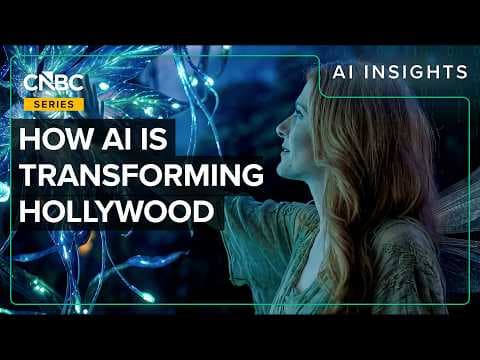
How An Amazon-Backed Hollywood Production Startup Deploys AI For Speed And Cost-Cutting
Audio Summary
AI Summary
Innovative Dreams, a new production company backed by Amazon Web Services and AI firm Luma, is pioneering "real-time hybrid filmmaking." This innovative approach combines performance capture, virtual production, and generative AI at every stage of the filmmaking process, aiming to revolutionize how content is created. Founded by filmmaker Jon Erwin, the company showcased its technology at a virtual soundstage in Manhattan Beach, California.
The core of this new method lies in integrating generative AI tools to accelerate filmmaking. It merges performance capture, similar to how avatars are created, with virtual production techniques, like those used in "The Mandalorian," which utilize LED walls for generating backgrounds. By combining these methods and leveraging AI, Innovative Dreams can rapidly visualize and create digital environments and characters. For instance, footage of an actor can be captured on a soundstage and, within an hour, transformed using AI into a character in a fantasy world. This allows for real-time dreaming and iteration, drastically reducing the time previously required for such processes, which could take months.
This technology offers significant advantages, particularly in addressing the current challenges faced by Hollywood. The film industry has seen a substantial decline in production activity and job losses, with L.A. County losing over 40,000 industry jobs since 2022 and production levels reaching historic lows. Studios are under immense pressure to produce more compelling content at lower costs, a demand that Innovative Dreams' hybrid filmmaking aims to meet. Jon Erwin believes this method can make shooting in L.A. viable again, countering the trend of productions moving to locations offering tax incentives. He estimates that this approach can enable creators to work three to four times faster at 30% of the cost, making projects more likely to receive the necessary green lights from studios.
The company's journey began with Erwin's production studio, Wonder Project, known for faith-based content. Their flagship show, "House of David," extensively used AI for production and enhancement, serving as a case study for this new filmmaking style. Erwin is now fully embracing AI and virtual production to create large-scale films and shows without leaving the soundstage. He has progressively integrated these technologies, starting with pre-visualization in "House of David" season one, advancing to virtual production and VFX pipelines in season two, and finally implementing live visual effects, or "digital principal photography," in his film "Washington."
The first project utilizing this complete workflow is the upcoming three-part series "The Old Stories: Moses," starring Ben Kingsley, set to debut this spring in partnership with Amazon. By combining live actors with LED walls, motion capture, and AI tools like Luma, Google's Nano Banana, and Bytedance's Seedream, Innovative Dreams significantly reduced both costs and production time. For "Moses," the entire series was shot in just one week, a feat that would have traditionally required five to six weeks and involved extensive travel to over 40 locations.
Innovative Dreams not only aims to produce more content for Wonder Project but also to empower other creators with this hybrid filmmaking approach. Erwin's inspiration stemmed from the transformative experience with AI on "House of David," realizing that this powerful technology was not widely adopted. The reliance on AI video generation necessitates substantial computing power, which is why Amazon Web Services is a key investor and partner, providing the cloud and AI infrastructure. Luma, valued at over $4 billion, is another major investor and partner, with its Luma Agents tool integrating various AI generation tools into a collaborative workspace. This partnership allows Innovative Dreams to actively shape the development of these tools.
The company's ultimate goal is to bring more productions back to Los Angeles, fostering job creation by making filmmaking more efficient and cost-effective. This is particularly important given the industry's struggles with the pandemic and the prolonged actors' and writers' strikes, which have led to a significant decrease in local productions. While AI is a controversial topic in Hollywood, with concerns about job displacement, especially for background and voice actors, Erwin remains optimistic. He believes that by challenging the status quo of production costs and timelines, this technology will ultimately create more jobs, citing the 600 people who worked on "House of David" as an example. He views these tools as an "antidote to job loss" rather than the cause.
Erwin acknowledges that those who don't adapt to AI risk being left behind. He notes that the most effective AI artists are often retrained industry professionals – editors, cinematographers, directors – who possess a deep understanding of filmmaking. These individuals can more readily translate their expertise into the new AI-driven workflows. The essence of this new approach is consolidating traditionally sequential filmmaking processes, which could take weeks or months, into a single day and space, making it creatively intuitive and, according to Erwin, the future of filmmaking.