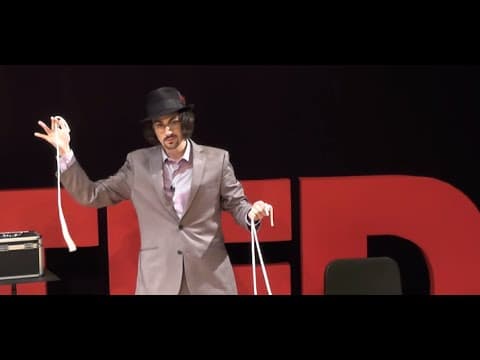
How to Magically Connect with Anyone | Brian Miller | TEDxManchesterHighSchool
Audio Summary
AI Summary
Our world is a shared experience, fractured by individual perspectives. The speaker, a magician, shares a transformative experience from his early career performing in restaurants. One night, after a particularly successful string of performances, he approached a table with an elderly man and his wife, asking if they wanted to see some magic. The man responded that he would love to, but couldn't, as he was blind. The speaker, embarrassed, realized he had been so caught up in his own world that he hadn't truly seen the man. He apologized and promised to have a special trick for them if they returned.
A few weeks later, the couple, Ed and his wife, came back. The speaker, having completely forgotten his promise, panicked. Rushing to his prop room, he desperately searched for anything he could do. He then remembered an obscure idea from an old manuscript. Composing himself, he approached their table again. Ed, smiling, eagerly asked what he had for him. The speaker sat down and, after asking Ed if he trusted his wife, took out a pack of cards. He instructed Ed's wife to mix the cards and then began placing cards in Ed's hand, asking him to guess if they were red or black. Ed correctly identified every card, much to his wife's initial skepticism, which turned into tears of joy by the end. The entire restaurant watched, as Ed howled with laughter. The speaker describes this as the most beautiful magic he had ever experienced.
The true secret of this trick, and of magic itself, lies in understanding and adopting different perspectives. To illustrate this, the speaker performs another illusion with ropes. He shows three pieces of rope, claiming they are all the same length, then seemingly changes their lengths to big, medium, and small. He then "removes" the ends and middles of the ropes, before revealing that there were actually multiple ropes involved, leading to an applause. He explains that he and the audience had very different experiences of the same event. He saw the sleight of hand and juggling, while the audience saw impossible changes in rope length, violating physics. While the audience might have felt wonder, amusement, or frustration, he felt focus.
Magicians face a unique dilemma: they cannot see the magic themselves because they know the secret. This knowledge is a limiting perspective. Therefore, a magician must wholly adopt the audience's point of view to create illusions. This technique is called "perspective taking," the ability to see the world from another person's viewpoint. It sounds simple but can be incredibly difficult in practice.
The speaker then demonstrates this with a Rubik's Cube. He knows that simply solving it quickly would make him seem like a "jerk" or a "show-off." Instead, he makes jokes about taking off stickers, rearranging them, or breaking the cube apart, which elicits laughter and understanding from the audience. When the audience feels understood, a connection is made, allowing them all to enjoy the magic in a shared space.
Perspective taking, the ability to see the world from another's point of view, is used by magicians to create illusions and connect with their audience. However, the speaker emphasizes its profound impact on his life off-stage. He admits to struggling with maintaining relationships due to a lack of investment perceived by others. While he cared, he wasn't making others *feel* understood or cared about. By applying perspective taking from the stage to his personal life, he formed deeper, more meaningful connections, leading to lasting friendships and an engagement to a woman he deeply loves.
The question then becomes: how does one practice perspective taking? The speaker distinguishes between visual perspective, which magicians traditionally use (understanding what the trick looks like to the audience), and emotional perspective, which is crucial for relationships (understanding how someone feels about an interaction).
Returning to Ed, the blind man, the relevant question was, "What would magic feel like to someone who is blind?" The speaker didn't want Ed to feel tricked, as a blind person might easily be. Instead, he wanted Ed to *feel* magical, and for his wife to see him in that light, sharing the experience.
To understand someone's emotional perspective, one of the simplest ways is to *ask questions*. We often hesitate, fearing rudeness, but underestimate people's willingness to answer. Before the trick, the speaker asked Ed if he had always been blind, which was crucial information. Someone blind from birth would have a different perspective than someone who lost their sight later. This allowed the speaker to adjust his tone, demeanor, and language to ensure Ed felt understood and connected.
Beyond asking, it's vital to *listen to understand*, not just to respond. The speaker admits this was a major flaw in his past relationships. We often listen only to formulate our own clever reply, rather than truly absorbing what the other person is saying. He uses the example of forgetting names: we often forget because we're thinking about how we'll introduce ourselves, not truly listening to their name. By asking questions and genuinely listening to understand the answers, one can build better, more meaningful connections both personally and professionally.
Finally, the speaker reveals how Ed, the blind man, "saw" the cards. It was a simple secret: the speaker placed his foot gently on top of Ed's under the table. One foot tap meant "red," and two taps meant "black." He taught Ed this secret communication system. When Ed understood, they connected. The speaker then taught Ed's wife the secret so they could perform it for their friends and family. Ed was thrilled, eager to "freak out" his grandkids.
Magic, the speaker concludes, isn't about technical skill, tricks, or even secrets; it's about connecting. Life is about connecting, and connecting is about taking on other points of view. Our world is a shared experience, fractured by individual perspectives, and by understanding each other, we can all feel understood.