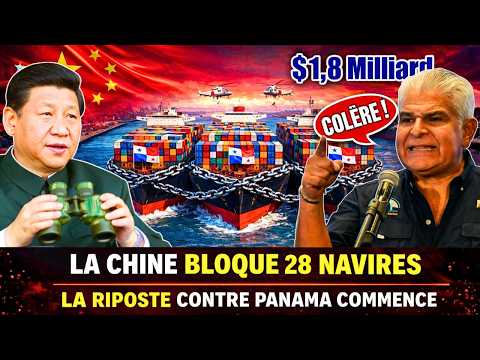
La Chine vient de détenir 28 navires panaméens — et la riposte a déjà commencé
Audio Summary
AI Summary
The Panama Canal, vital for the country, is not controlled by China, contrary to some allegations. Panama maintains control, and its relations with China are similar to those with other nations like the Netherlands or the United States. However, a recent incident involving China has escalated tensions. Chinese authorities detained 28 ships flying the Panamanian flag, a rare move in international transport. This action, while firm, avoided direct confrontation, signaling a broader and potentially more costly response from Beijing, beyond a mere diplomatic protest. The maritime community is now questioning the extent of China's next steps.
To understand the situation's gravity, one must consider Panama's strategic importance. For decades, ships connecting the U.S. East and West coasts had to navigate around South America via Cape Horn, a long and perilous route. Control over a Central American maritime passage offered influence over trade routes and geopolitical balances. In the 19th century, Panama, then part of Colombia, saw the U.S. attempt to build a canal. After Colombia refused, the U.S. supported Panama's independence movement in 1903, leading to an agreement that granted the U.S. control over the canal's construction and operation. This effectively gave Washington quasi-control over a strategic zone within Panamanian territory, leading to local resentment.
Over time, demands for Panama to regain sovereignty over the canal grew, culminating in a 1977 treaty between the U.S. and Panama. This agreement stipulated a gradual transfer of the canal to Panama and affirmed its neutrality and openness to all countries. Even after the transfer, international competition for this strategic infrastructure persisted. In the following years, Panama began entrusting the operation of several port facilities to international operators.
In 1997, CK Hutchison secured rights to operate two crucial ports, Balboa on the Pacific and Cristobal on the Atlantic, which quickly became major maritime hubs. This agreement was automatically renewed in 2021 for an additional 25 years, until 2047. However, in early 2026, the situation drastically changed when Panama's Supreme Court declared the contract unconstitutional. The Panamanian government then took direct control of the two ports, assigning their operation to Maersk and Mediterranean Shipping Company, two global maritime transport giants.
CK Hutchison attempted negotiations with Panamanian authorities but received no clear response. The company subsequently initiated international arbitration, seeking approximately $2 billion for lost assets and investments. These investments were substantial, with CK Hutchison having injected about $1.8 billion into modernizing and expanding the two ports, which together handled nearly 40% of Panama's container traffic.
This dispute extends beyond a simple commercial disagreement. If the international arbitration proceeds, the financial pressure on Panama could rapidly intensify. Public information indicates that by mid-2025, Panama's foreign assets totaled around $41 billion, with about $13 billion in the United States and the remainder distributed across European and Latin American financial centers. These funds are crucial for the country's financial stability, supporting state functions, infrastructure, and public programs. If these funds become targets of international legal procedures, the impact could far exceed a commercial conflict.
It is within this context that Beijing's decision to detain 28 Panamanian-flagged vessels takes on strategic significance. This action may not be the final step in China's response but could signal the beginning of a larger economic escalation surrounding the Panama Canal. The pressure has not been confined to the ports. China is now impacting one of the invisible pillars of Panama's maritime economy: its flag registration system.
Following discreet meetings in Beijing with major maritime transport actors, several companies have begun reorganizing routes and reducing operations linked to Panama. For a country heavily reliant on international traffic, even minor adjustments in merchandise supply can create significant pressure. A more direct signal emerged between March 8 and 12, 2026, when 28 Panamanian-flagged ships were detained in ports. During this period, these vessels accounted for over 75% of all recorded immobilizations, far exceeding usual maritime statistics. Officially, these were technical inspections, focusing on safety certificates, equipment, or environmental standards, which every state has the right to conduct on foreign vessels entering its ports.
However, in the maritime industry, time is a critical cost. A ship immobilized for several days for inspection disrupts its commercial rotation. For large ports, a single day of immobilization can incur hundreds of thousands of dollars in losses due to logistics, contractual penalties, and supply chain disruptions. This makes the situation particularly delicate for Panama, as officially, these inspections are difficult to contest. Panamanian authorities have adopted a measured tone, with the foreign minister acknowledging an increase in controls but affirming they remain within normal maritime operations. Yet, in the maritime transport sector, immobilizing 28 ships from the same flag within five days appears to be a strategic signal rather than a mere coincidence.
To grasp the full scope of the problem, one must understand the role of flags in the global maritime system. A ship's flag signifies its legal identity, determining tax rules, security regulations, and applicable law. Panama holds a central position in this system, with nearly 8,000 ships sailing under its flag, making it one of the world's largest maritime registries. Many companies choose the Panamanian flag primarily for economic reasons: low taxes, often almost zero for certain maritime activities, quick and remote registration procedures, and generally less stringent regulatory requirements compared to developed countries, which significantly reduces costs for shipowners.
Panama earns hundreds of millions of dollars annually from its flag of convenience system. If inspections of these ships multiply, some companies might opt to change their flag, with countries like Liberia already offering attractive alternatives. A shift of even a portion of the fleet to these alternatives could gradually diminish Panama's maritime revenue. Thus, this conflict extends far beyond the question of two canal ports. It directly impacts Panama's place in the global maritime system and raises a strategic question: Is this a simple commercial dispute or a repositioning of the balance of international commerce?