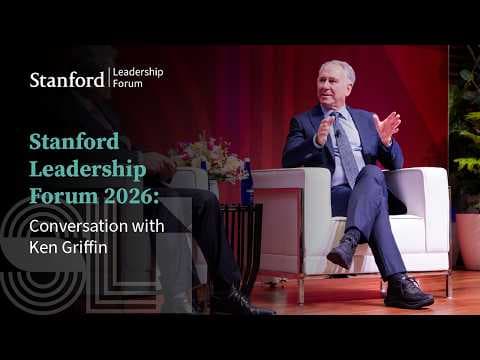
Stanford Leadership Forum 2026: Conversation with Ken Griffin
Audio Summary
AI Summary
Ken Griffin, founder and CEO of Citadel, and founder of Citadel Securities, engaged in a conversation with Amit Saru from Stanford Graduate School of Business about leadership in an environment of market fragmentation, polarized politics, and institutional pressure.
Griffin emphasized that every business constantly makes decisions under uncertainty, and leaders must be flexible and willing to pivot as new information emerges. He likened working with him to a roller coaster, constantly moving fast in a chosen direction but ready to change course when necessary. Successful businesses avoid the sunk cost fallacy and maintain an open and honest dialogue about mistakes to learn and improve. He cited instances where Citadel underperformed competitors, leading to intense internal scrutiny to understand what went wrong and how to prevent recurrence.
When asked about developing such instincts, Griffin noted that history is often written by winners, and success stories often overlook numerous failures. He highlighted Steve Jobs' return to Apple when the company was near bankruptcy and the failures like the Newton handheld, stressing that great businesses demonstrate resilience, learning from both successes and setbacks.
The 2008 financial crisis was a "near-death experience" for Citadel, revealing the critical difference between banks with Federal Reserve access and non-banks left to fend for themselves. The key lesson was not to pretend to be a bank unless one truly is, as access to wholesale funding can vanish during a crisis. This experience profoundly shaped Citadel's approach to risk and funding.
The discussion then shifted to the role of firms like Citadel as part of the broader financial infrastructure and their influence on policy. Griffin distinguished between genuinely pro-market policies and those that are merely pro-business or crony capitalism. He argued that American business thrives on competition, which drives continuous improvement and delivers better goods and services to consumers. Crony capitalism, conversely, replaces merit with favoritism, leading to inferior products, lower innovation, reduced living standards, and public anger. He celebrated American success stories like Amazon, NVIDIA, and Google, founded by first-generation entrepreneurs, as antithetical to crony capitalism.
Regarding public discourse, Griffin believes corporate executives should use their voice in areas where they possess credible expertise, such as immigration, tariffs, antitrust, and regulation. He advised against speaking on social issues, where their opinions may not be uniquely distinguished and could alienate a large segment of the population.
The conversation then turned to the impact of AI on firms and talent. Griffin acknowledged the recent "step change function" in AI's productivity, noting that tasks previously requiring weeks or months of work from highly skilled individuals (masters and PhDs in finance) are now being completed by AI agents in hours or days. This automation of high-skilled work, he admitted, was initially "fairly depressing" due to its dramatic societal implications. He stressed the importance of lifelong learning for the next generation of business leaders, as AI will make flexibility and resilience even more critical for the workforce.
Griffin is optimistic about American entrepreneurs' ability to leverage AI to create new commerce and businesses, viewing it as a race between job destruction and job creation. He sees AI as eroding competitive moats for large companies, making it an unprecedented time for entrepreneurs to challenge incumbents, similar to how cloud computing democratized access to computing power. He shared an anecdote about a pet insurance business using AI for highly personalized marketing, which sold for a billion dollars, illustrating the vast potential for new companies to harness AI for unique consumer experiences and personalization.
Addressing the fragile public trust in institutions and capitalism, Griffin expressed concern about declining institutional trust in America, despite the country being a beacon of justice, freedom, and opportunity. He criticized the lack of historical education, particularly regarding socialism, noting that many do not appreciate its detrimental effects on human lives and economies. He cited the Cuban immigrant community in Miami as an example of those who have witnessed the failures of socialism firsthand. He emphasized the need for K-12 education to inform students about different forms of government and economic systems, their successes and setbacks, to foster a functioning democracy and an informed citizenry. He highlighted alarming statistics on student proficiency in math and reading, stressing that fixing K-12 education is crucial for America's future competitiveness in an AI-powered world, especially against countries like China and India that prioritize education.
Finally, on the responsibilities of business leaders beyond building great companies, Griffin asserted that the business community is aligned on the importance of improving education. He mentioned the challenges in public education leadership, with superintendents in major cities lasting an average of only three years, hindering meaningful change. He advocated for increasing competition within the school system, citing Miami's embrace of public and charter schools, and praised organizations like Success Academies for demonstrating the power of curriculum, dedicated teachers, and high expectations. He believes business leaders have an important role in supporting such initiatives to create a better-educated American population.
Griffin concluded by telling the Stanford Business School graduates that they are entering the "best of times." He highlighted the ease of accessing capital, particularly in Silicon Valley, and the dramatically lowered barriers to competition thanks to AI, cloud computing, and the internet. Entrepreneurs can now reach hundreds of millions or billions of consumers globally almost instantly. He advised them to surround themselves with the best and brightest, diverse individuals who will challenge and improve them. He shared stories of his diverse leadership team, emphasizing that their varied life experiences drive better outcomes, embodying the American dream. He urged them to find their true passion, as intrinsic motivation, talent, and passion are the keys to achieving greatness, far more enduring than the pursuit of wealth alone. He also reminded them of the intergenerational spirit of giving back, encouraging them to contribute to their communities and mentor future generations.