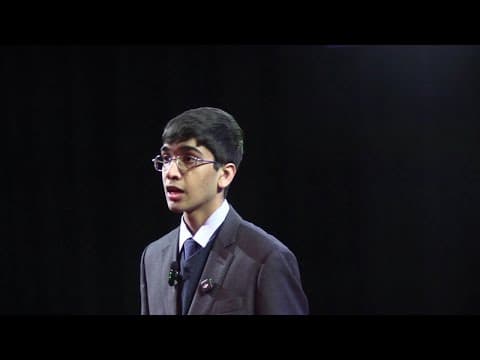
Not Saviours but Stakeholders: A New Model for Aid | Keshav Aggarwal | TEDxQESB Youth
Audio Summary
AI Summary
Foreign aid, despite significant global spending, is failing to end extreme poverty due to its flawed construction, not a lack of compassion. The current model is bureaucratic, polarizing, and often leads to dependency rather than dignity and self-sufficiency. While billions are spent annually, progress is stalling, and much of the poverty reduction seen is due to industrialization in the global South, not aid interventions.
The speaker argues that aid should be long-term and structural, focusing on building local capacity rather than providing temporary relief. Instead of sending bottled water, aid should fund the creation of wells. Instead of dispatching relief teams, it should train local doctors. The current "aid industrial complex" often produces more reports and meetings than tangible change. A significant portion of aid money doesn't reach frontline organizations, with only about 14 cents of every US aid dollar making it to the ground.
A key issue is that aid often doesn't align with what developing countries actually need. For instance, donations of secondhand clothing have decimated local textile industries in countries like Ghana, which previously employed thousands. These nations desire the capital and infrastructure to build their own industries, not a flood of low-quality imported goods. This creates a gap between what is given and what is wanted, resulting in a loss for the giving country and minimal gain for the receiving one.
The future of aid, the speaker suggests, lies not in charity but in partnership. The focus should shift from being "saviors" to becoming "stakeholders" and "enablers" of mutual trade. This involves opening up markets, creating opportunities, and building trust. Instead of simply giving more, the approach to giving needs to change.
This transformation entails cutting down on non-essential commodity shipping and bureaucracy, while preserving humanitarian and emergency relief. Investment should be redirected into three key sectors: energy, infrastructure, and technology. The smartphone revolution is highlighted as a powerful tool, providing access to information, agency for individuals to share their stories, and acceleration of knowledge sharing. Aid should focus on building the physical infrastructure, like data centers and fiber optics, to support this digital growth.
Energy and infrastructure are presented as foundational elements essential for any development investment to succeed. Roads, ports, and bridges connect communities and facilitate trade, growth, and employment. Reliable energy powers essential services like hospitals and factories. The intersection of affordable, decentralized energy, the smartphone revolution, and stable infrastructure promises to unleash significant investment and growth.
Crucially, the principle of local ownership must be embedded in all development efforts. Without it, progress is not built, only monuments. The ultimate goal is to be enablers, not bestowers, and to trust that by creating the right conditions, genuine development will follow.