The emerging role of AI in cancer research | Hercules Konstantopoulos | TEDxVUW
Audio Summary
AI Summary
The speaker, a former astrophysicist and data scientist, aims to redirect AI from frivolous or dangerous applications towards solving critical problems like curing cancer. Their optimism stems from a personal shift from being a meticulous toolmaker to a problem solver, a transition triggered when an off-the-shelf AI tool automated their job. This experience highlighted that AI, while transformative, is not metaphysical but based on mathematical principles like linear algebra.
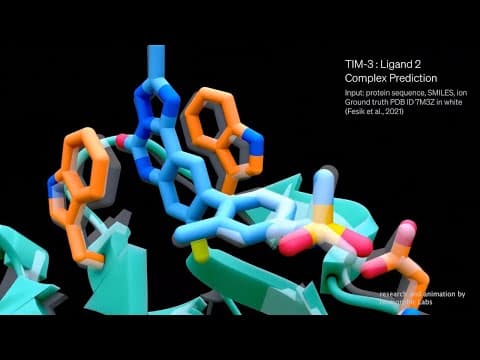
This shift is now occurring across all scientific fields, particularly in biology. Traditionally, developing new drugs, like antibodies, involved laborious manual processes of creating and testing millions of molecular combinations. This could take years. Today, AI is revolutionizing this by allowing for the computational prediction of millions of protein structures, drastically reducing the time from years to months or even days. This is achieved by simulating the process of building a desired structure from random noise, effectively compressing time and enabling rapid exploration of vast possibilities.
However, the speaker emphasizes that simulated results do not equate to real-world cures or knowledge. The role of the biologist remains crucial: to sift through the massive amounts of AI-generated data, using their scientific knowledge, intuition, and understanding of complex biological systems like immunology, to identify which potential solutions are worth pursuing in the lab. This is akin to a "golden age" in immunology, where AI acts as a catalytic technology, analogous to the digital camera in astrophysics, enabling the testing of countless hypotheses.
The speaker urges the audience not to fear AI but to see it as a powerful, regular tool that can be honed for specific discoveries. Adaptability is key, as AI means we are no longer alone in knowledge creation. The true human value lies in creativity and intuition, which are essential for selecting and translating AI's predictions into tangible progress. Even with a deep understanding of the technology, the human "spark" of genius remains vital and feels like magic.