EEVblog 1745 - How LOUD is the Continuity Tester
Audio Summary
AI Summary
The video presents a follow-up on the EEV Blog BM2257 multimeter, specifically focusing on a new firmware version (256) which differs from the original (253) by changing the continuity frequency. The original firmware was stated to produce a 2.5 kHz tone, while the new version was supposed to be 2.7 kHz, with the intention of making the sound louder.
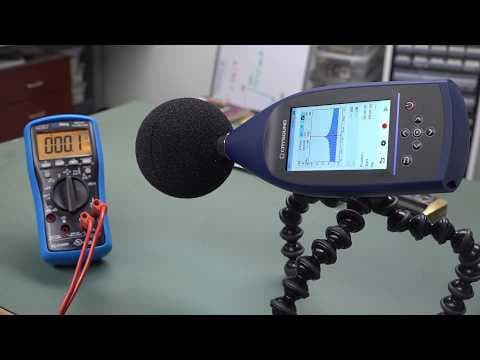
To objectively test this claim, a high-precision Class 1 sound level meter from Cry Sound was introduced. This professional-grade instrument is designed for accurate acoustic measurements, featuring a calibrated half-inch free-field microphone, a tripod mount, and replaceable capsules for different ranges. The meter also includes data logging capabilities, an internal rechargeable battery, and various measurement parameters like A, C, and Z weighting.
The presenter explained the significance of different weighting types: A-weighting is filtered to match human ear sensitivity, suitable for lower noise levels and common in fan or instrument noise specifications. C-weighting is for louder sounds, while Z-weighting provides a flat frequency response, crucial for instrument measurement calculations without filtering. For assessing perceived loudness, A-weighting was chosen.
Measurements were conducted in an underground bunker, selected for its quiet environment. Despite the bunker's relative silence, an ambient noise floor of approximately 33 dBA was recorded. Analysis with the FFT (Fast Fourier Transform) revealed significant low-frequency noise below 60 Hz, likely originating from external sources like car park filtering through concrete walls. This low-frequency noise contributed to the overall A-weighted sound pressure level, indicating that a dedicated acoustic test chamber would be necessary for more precise low-noise measurements. The presenter solicited ideas for constructing such a chamber, especially one capable of filtering out sub-100 Hz frequencies.
When testing the multimeters, the original firmware, claimed to be 2.5 kHz, was measured at 2.7 kHz. The new firmware, claimed to be 2.7 kHz, was measured at 2.93 kHz. Contrary to the expectation that the higher frequency would be louder, the older firmware (2.7 kHz) registered 58.2 dBA, while the newer firmware (2.93 kHz) registered 49.2 dBA, making the older version approximately 9 dB louder. This contradicts the stated purpose of the firmware change.
Further testing at a closer distance (20 cm) and different orientation also showed the older firmware to be louder (65.4 dB) compared to the new one (63.8 dB), although the difference was less dramatic than at 1 meter. The sound produced by the multimeters was also observed to contain significant harmonics, indicating it was not a pure sine wave.
An additional test was performed to measure the difference made by turning off the ventilation fan in the bunker. With the fan on, the ambient noise was about 10 dB louder (around 44 dBA) compared to when it was off (around 34 dBA). The FFT response with the fan on showed broader peaks and higher frequency content, particularly in the 500-600 Hz and 1400 Hz regions, indicating a more complex noise profile.
In conclusion, the new firmware on the BM2257 multimeter, despite aiming for increased loudness by changing the continuity frequency, actually resulted in a softer sound than the older version. The Class 1 sound level meter proved essential in objectively disproving the initial claim. The presenter expressed a strong interest in building an acoustic test chamber to enable accurate noise measurements for various products, especially for low-noise fans, highlighting the challenges posed by low-frequency ambient noise even in seemingly quiet environments like the bunker.