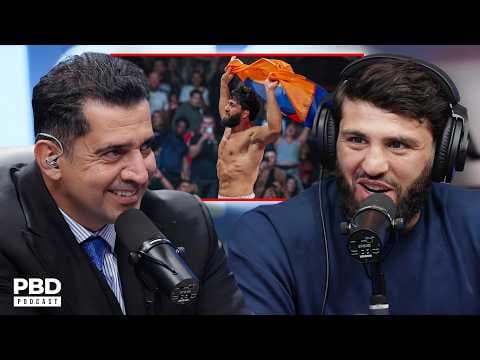
“You CAN’T Talk Like That To Armenians” - Arman Tsarukyan CLARIFIES The Line In Trash Talk
Audio Summary
AI Summary
The speaker discusses cultural differences, particularly concerning Armenians, noting that certain rules exist, such as not cursing, and that Armenians tend to get angrier than other communities over specific remarks. This is attributed to their upbringing and a "genetic testosterone." The speaker explains that in places like Armenia, Georgia, Dagestan, and Chechnya, children grow up fighting, which fosters a particular mentality that produces excellent fighters.
When asked about trash talk in fighting, especially from an American perspective where it's more common, the speaker acknowledges that Armenians, like Khabib, have limits regarding disrespect towards family or religion. As a promoter, the speaker sometimes engages in "crazy things" for show to gain attention, even if it means appearing "too crazy" and struggling to control himself.
The speaker clarifies that personal hatred for an opponent doesn't matter once inside the cage. He describes being calm and controlled during fights, even against opponents he previously disliked, emphasizing that losing composure leads to defeat. While opponents might talk during a fight, he doesn't care, focusing instead on winning. He notes that trash talk is easier outside the cage because you can't immediately retaliate, but inside, you can "smash" them.
Unlike Khabib, who often talked during fights, the speaker's style is generally more focused on the fight itself, though he admits he "never knows" if he might surprise someone. He has not directly grappled with Khabib but has trained extensively with his teammates. He maintains a good relationship with Khabib, Islam, and their camp due to shared culture and respect.
Currently, the speaker trains with Hamzat, describing the training as incredibly hard. He identifies a shared problem with Hamzat: overtraining. Both require coaches to stop them from overdoing it, as overtraining hinders performance and can lead to injuries, especially as they get older. He emphasizes the importance of smart training and body care, particularly given the significant weight cuts (e.g., 15 kg or 30 pounds in a month).
Training with Hamzat, whom he considers the biggest name he's trained with, is beneficial due to Hamzat's wrestling and striking skills. Hamzat has a unique mindset, never studying his opponents' fights. He focuses solely on his own game plan and what he will do, unlike the speaker, who meticulously studies opponents. However, the speaker is now trying to adopt some of Hamzat's approach, watching an opponent only once and letting coaches handle the rest.
Hamzat trains with the speaker because they are friends, and Hamzat appreciates the training environment in Newport, where he can focus without being bothered by his superstar status. The speaker describes Hamzat as having extreme mood swings—one moment funny, the next serious—a trait the speaker's friends also attribute to him.