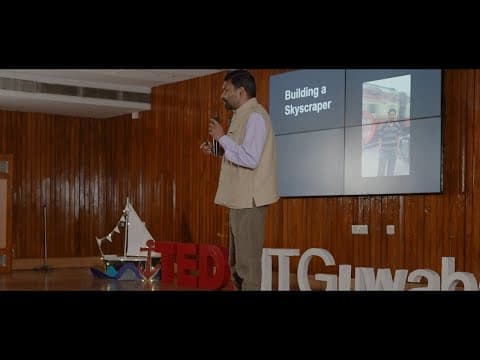
The Structure Of Self | Sparsh Johari | TEDxIITGuwahati
Audio Summary
AI Summary
The speaker uses the analogy of building construction to illustrate the stages of life and personal development. He begins by asking the audience to imagine a building from 1975, made of red bricks with natural ventilation, and then contrasts it with the same building 50 years later, renovated with glass walls and modern amenities. While externally different, the underlying structure and load-bearing elements remain the same. This highlights the importance of the foundational aspects of a building, irrespective of its facade.
He identifies four crucial elements for a stable building: the soil, the foundation, the skeleton and walls, and renovation. He then applies this framework to his own life story.
First, he discusses testing his "soil," which he equates to his upbringing and early influences. His father instilled in him the values of hard work and humility, teaching him to work diligently without boasting.
Next, he focuses on laying his "foundation," drawing from his mother, who provided discipline through strict household rules, and his maternal uncle, an army officer, who taught him decisiveness and the importance of taking action without getting paralyzed by "what if" scenarios. His elder brother contributed the value of faith, offering unwavering support and belief in his potential.
The "skyscraper" of his life represents his academic and professional journey, starting with his B.Tech. He describes a rigorous daily routine involving long commutes and demanding study hours, emphasizing that one must learn to love the struggle and be consistent to build something significant.
Finally, he addresses "renovation," which requires disruption. He recounts two key disruptions. The first was quitting table tennis, a sport he excelled at and gained recognition for, when he felt his performance was stagnating. This allowed him to refocus on his academics. The second disruption was leaving a comfortable, well-paying job after his master's to pursue a PhD at IIT Delhi, despite the initial hardship. This decision was driven by a desire for growth and to add value to his life.
He concludes by stating that while the facade of life can change through renovations like changing cities or titles, the foundational soil and structure, representing core values and upbringing, remain constant. He encourages listeners to keep their journey alive, even as they change the "bricks" of their lives.