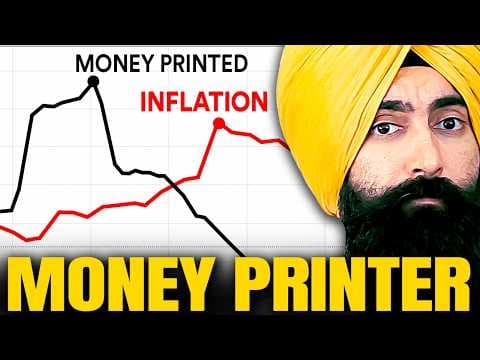
The Fed Just Quietly Turned The Money Printer Back On
Audio Summary
AI Summary
Six months ago, the Federal Reserve Bank began increasing its balance sheet, which is akin to restarting the money printer. This action has coincided with rising oil prices, increasing inflation, and geopolitical instability in the Middle East, yet the stock market has simultaneously reached new record highs. However, a shift is anticipated with President Trump's appointment of a new Federal Reserve Chairman, set to take office on May 15th. This incoming chairman has publicly expressed his intention to halt the growth of the Fed's balance sheet, meaning an end to the money printing. The primary challenge with this cessation is its potential to cause economic disruption.
The current Federal Reserve Chairman, Jerome Powell, announced in December 2025 the initiation of purchases of shorter-term Treasury securities, primarily Treasury bills, with the stated purpose of maintaining an ample supply of reserves. To understand the implications, it's crucial to grasp the government's financial operations. The U.S. government's sole revenue source is tax dollars. In 2026, tax revenue is projected to be around $5 trillion. However, government spending is estimated to reach $7 trillion, resulting in a $2 trillion deficit. This deficit necessitates the issuance of debt, in the form of Treasuries, which are essentially loans to the U.S. government.
There are three primary buyers of these Treasuries: private entities (individuals, institutions, investment funds, pension funds, banks), foreign governments (like Japan, the UK, and China), and the Federal Reserve Bank when private and foreign demand is insufficient. The Federal Reserve Bank, despite its name, is not a traditional bank. When it purchases Treasuries, it effectively lends money to the government by creating money out of thin air. The Fed currently claims these actions are "reserve management purchases," not quantitative easing (QE), to avoid concerns about money printing.
The core issue with creating more money without a corresponding increase in wealth is inflation. Printing more dollars devalues existing ones, leading to price increases. While the Fed distinguishes its current actions as reserve management purchases rather than QE, the underlying mechanism of money creation remains. QE, seen during the 2008 financial crisis and the 2020 pandemic, involved the Fed creating money to buy Treasuries, thereby injecting funds into the economy to stimulate it through measures like stimulus checks and business bailouts. Reserve management purchases, conversely, are presented as a measure to support the banking system, though they still involve money creation.
This money creation, regardless of its stated purpose, contributes to inflation. The rising inflation observed in early 2026, even before the conflict in the Middle East, and the subsequent surge in oil prices and geopolitical concerns, are linked to these reserve management purchases. Despite this, the stock market has continued to reach record highs, and gold prices have also increased. The impending change in Federal Reserve leadership is significant because it could alter the trajectory of the economy and financial markets.
The speaker emphasizes the importance of investing, stating that the economic system is designed to benefit investors, and those who are not investors often miss out on these gains. A free investing masterclass and market briefs are offered to help individuals identify investment opportunities.
The Federal Reserve's independence from direct government control is noted, but the President can appoint a new chairman when a term expires. The incoming chairman, Kevin Worsh, has explicitly stated his desire to shrink the Fed's balance sheet. Shrinking the balance sheet means selling Treasuries, which withdraws money from the economy. This is the opposite of QE and is termed quantitative tightening (QT), which was implemented from 2022 to 2025 to combat inflation.
The dilemma arises if the Fed stops buying Treasuries, as the government still needs to finance its deficit spending. Worsh believes private demand will suffice. However, global demand for U.S. Treasuries has shown signs of weakening. China has become a net seller of U.S. dollars, and Japan, a major lender, has reduced its holdings. This raises concerns about what happens if demand for Treasuries falters, especially given the U.S. national debt, currently around $39 trillion, and the rising interest payments on this debt. Interest payments have become the fastest-growing government expense, diverting tax dollars from services.
The interest rate on Treasuries is determined by supply and demand. If demand is high, interest rates are low. If demand falls, the government must offer higher interest rates to attract lenders. This scenario has a ripple effect: higher government borrowing costs lead to increased interest rates on mortgages, car loans, credit cards, and business loans, making borrowing more expensive for everyone.
The transition from the Fed being a buyer of Treasuries to a seller, while simultaneously reducing money printing, presents a critical question: will private demand be sufficient to absorb the supply of Treasuries? The speaker suggests that the government might resort to forcing entities, like government-sponsored enterprises (GSEs) such as Fannie Mae and Freddie Mac, to purchase Treasuries, as seen with mortgage bonds under President Trump.
There are three potential outcomes if Kevin Worsh proceeds with his plan to stop money printing:
1. **Strong Private Demand:** If private demand for Treasuries surges, interest rates could fall. This would reduce the government's debt servicing costs, potentially leading to economic growth, lower mortgage rates, and a booming stock market.
2. **Balanced Private Demand:** If private demand simply replaces the Fed's purchases without a significant surge, interest rates would remain stable. The primary benefit would be the reduction in money printing, which could help cool inflation in isolation.
3. **Insufficient Private Demand (Worst Case):** If private demand is inadequate, the government would be forced to raise interest rates to attract lenders. This would exacerbate the national debt problem, increase all borrowing costs (mortgages, car loans, business loans), and likely lead to a stock market decline.
The speaker concludes that inflation is unlikely to disappear and advises against relying solely on salary or savings. Investing is presented as essential for wealth growth in an inflationary environment. Options for investment include the stock market, real estate, and gold. The importance of active investing to find opportunities is highlighted.
The discussion also touches on credit card usage, with a recommendation to use them strategically for perks and cash back if money management is sound, and mentions credit card options for debt reduction and rewards.
In summary, the shift from expansionary monetary policy (reserve management purchases) to a potential contractionary one (shrinking the balance sheet) under a new Fed chairman introduces significant economic uncertainty. The key challenge lies in securing sufficient private demand for government debt without the Fed's active participation, which could lead to higher interest rates and economic strain. The speaker reiterates that being an investor is crucial for navigating these economic changes and protecting and growing one's wealth.