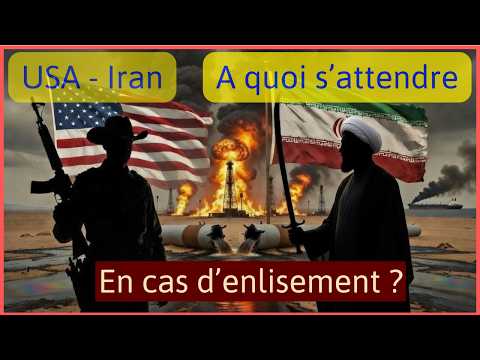
USA- Iran : A quoi s'attendre en cas d'enlisement du conflit en cours ?
AI Summary
The following summary analyzes the potential evolution of the conflict involving the United States, Israel, and Iran, focusing on the economic and market consequences of a prolonged stalemate.
**The Current Context and the Two-Week Window**
The conflict has reached a state of stagnation, having lasted approximately ten days without a clear resolution. According to the speaker, the global economy is currently in a critical window. Experts estimate that there are roughly two weeks remaining before the logistical disruptions in the Strait of Hormuz lead to severe, irreversible supply chain issues for the global economy. The speaker categorizes the potential outcomes into "good" and "bad" scenarios based on whether the Strait reopens within this timeframe.
**Potential Positive Scenarios**
A "good" scenario is defined as any situation where the Strait of Hormuz reopens within the next two weeks. The first possibility is the rapid collapse or surrender of the Iranian regime. While there are currently no signs of this, it remains a theoretical path to resolution. A second possibility involves the United States abandoning the campaign. Under pressure from Middle Eastern allies, Western public opinion, and volatile markets, Donald Trump might declare a symbolic victory, claiming all Iranian installations were destroyed and objectives met, before withdrawing. In this version, Iran might fire a few missiles at Israel to save face, allowing the situation to settle.
Other positive outcomes include a "cooperative" regime change, where the Iranian leadership stays in place but agrees to work with the U.S. while distancing itself from China and Russia. Finally, the speaker suggests that internal chaos or a semi-civil war within Iran could force the regime to focus entirely on domestic order, thereby losing its capacity to maintain the maritime blockade.
**The Negative Scenarios and Economic Impact**
The "bad" scenarios involve Iran maintaining the blockade for more than two weeks. A total blockage would result in the loss of 20 million barrels of oil per day. Even with partial bypass routes, a deficit of 12 million barrels would remain, which is an enormous blow to global supply. A mitigated version of this scenario might see Iran allowing "cooperative" nations like China and India to continue receiving oil, though this would only partially alleviate the global logistical crisis.
The speaker predicts that global oil demand will remain resilient until prices reach approximately $200 per barrel. We are already seeing daily price increases, and it is likely that both Brent and WTI will surpass $100 immediately upon market reopening. Such a spike would trigger uncontrollable inflation. Central banks would find themselves powerless, as raising interest rates cannot create more oil. Instead, monetary authorities might shift focus toward job creation and preventing recession by maintaining negative real interest rates, a strategy reminiscent of the post-WWII era.
**Historical Comparisons: 1973 vs. Today**
The speaker emphasizes that the impact of this conflict would be far more powerful than the Russia-Ukraine crisis. While the latter required rerouting 10 million barrels of Russian oil, the current situation threatens 20% of global production—double the Russian output. The only comparable event is the 1973 oil shock following the Yom Kippur War. However, the 1973 embargo was targeted specifically at the U.S. and its allies, whereas a total blockade today would affect the entire world. In 1973, oil prices quadrupled and the Dow Jones fell by 40% over the following year. A similar market crash is a realistic expectation today if the "bad" scenarios manifest.
**Investment Strategy and Market Behavior**
Historical data from the 1970s shows that oil stocks are not immediate safe havens. During the 1973 crash, majors like Exxon and Chevron initially declined significantly alongside the broader market. While they eventually served as excellent long-term hedges against inflation, they did not protect investors during the initial months of the crash. Furthermore, current valuations for these companies are much higher today than they were in the 1970s, making them more fragile. Gold mines, which performed well in the 70s, are also currently trading at high valuations, suggesting they may not provide the same level of protection this time.
The speaker recommends a specific allocation strategy: 10-12% in physical gold and 35-40% of financial assets in "anti-inflation" sectors such as oil, gas, coal, palm oil, and fertilizers. However, success depends on extreme selectivity. Investors should avoid broad ETFs and overvalued majors, focusing instead on small and mid-cap "value" stocks that offer high dividend yields and are currently at the bottom of their cycle.
Finally, the speaker advises maintaining 20-30% liquidity. This provides a buffer against volatility and allows for flexibility if a "good" scenario triggers a sudden market rally. While there is no miracle solution for the next 6 to 12 months, a disciplined, value-oriented approach should prevail over a three-to-four-year horizon.