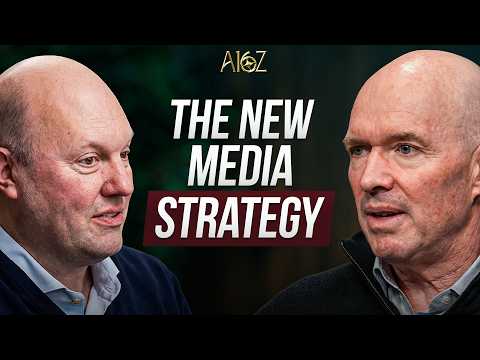
Inside the New Media Team with Marc Andreessen & Ben Horowitz
AI Summary
In this discussion, Ben Horowitz and Marc Andreessen outline the philosophy and operational strategy behind "New Media," specifically how Andreessen Horowitz (a16z) is navigating the shift from traditional information gatekeepers to a direct-to-audience model. The core tenet of this new approach is simple: in media, offense is always better than defense.
**The Shift from Old to New Media**
The firm’s transition was born from the realization that old media is fundamentally defense-oriented. Horowitz recalls an early crisis where a major publication leaked the firm’s young results and misinterpreted them. In that era, such an article was an existential threat because there were only a handful of powerful channels, and their word was permanent. There was no way to correct the record effectively.
Today, the laws of physics have changed. Under the "flood the zone" principle, if a negative narrative emerges, leaders no longer need to issue defensive press releases. Instead, they can appear on dozens of podcasts that command larger audiences than traditional outlets. By providing interesting, direct content, they can effectively erase a negative story from the public’s memory by simply being more engaging elsewhere.
**The Death of the Corporate Brand**
For 80 years, corporate communication was "synthetic, plastic, and boring." CEOs aimed to say as little as possible to avoid controversy. This was a byproduct of narrow communication channels—television airtime and newspaper column inches—which forced messages to be compressed into the least offensive, "low-bit" versions of the truth.
Andreessen argues that this era is over. The "corporate brand" as an abstraction is fading, replaced by the reality that "corporations are people." Modern audiences want to hear directly from the decision-makers. While this directness—exemplified by figures like Elon Musk—often "blows people’s minds," it is a net improvement. It allows leaders to explain their reasoning and assumptions without the filter of a third-party interpreter.
**The Power of Long-Form and Context**
A significant challenge in the new media landscape is the "viral post." Andreessen notes that while short-form content like Twitter is excellent for reach, it is prone to misinterpretation because it lacks context. Most "cancellations" occur because a snippet of information is stripped of its surrounding logic.
The solution is long-form content. Podcasts and essays allow for the "full explanation" required for complex systems like technology and politics. A "Joe Rogan CEO"—someone interesting enough to sustain a three-hour conversation—has a massive advantage. Original ideas are inherently interesting, and while they may be controversial, long-form media provides the "room to explain" that prevents the knee-jerk outrage typical of sound-bite culture.
**The OODA Loop and Competitive Speed**
The firm applies military theory to media strategy, specifically the "OODA Loop" (Observe, Orient, Decide, Act). The goal is to cycle through these steps faster than your opponent. If you can sustainably make decisions and act while your competitor is still in the "observation" phase, you force them to restart their process constantly.
This lead to "psychological breakdown" for the slower party. Traditional media outlets, burdened by multi-layer bureaucratic editorial processes, are currently experiencing this breakdown. They can no longer move fast enough to stay ahead of internet cycles. Consequently, mainstream media has been relegated to "chasing the car," reporting on viral internet posts from days prior—turning "news" into "olds."
**Oral vs. Written Culture**
Andreessen distinguishes between two modes of communication:
1. **Oral Culture:** Emotion-first, interpersonal, and "hot." This includes short tweets and TikToks.
2. **Written Culture:** Abstract, logical, and analytical. This includes long-form substacks and, surprisingly, long podcasts.
Even though a podcast is spoken, its depth makes it a "written culture" artifact. Conversely, a tweet is written but functions as "oral culture" because it is a burst of emotionality. Understanding these nuances allows the firm to choose the right medium for the specific impact they want to achieve.
**Operationalizing New Media at a16z**
To execute this strategy, a16z has built an internal media empire. They hire platform-native experts—often very young creators who understand the "vibe" and technical nuances of X, Instagram, and YouTube. They have developed several specific products for their portfolio companies:
* **Launch as a Service:** A "soup-to-nuts" offering that includes custom high-quality video production and social media strategy to guarantee a viral announcement.
* **Founder Go Direct:** Training CEOs to build their own mindshare directly rather than waiting for the press to notice them.
* **New Media Fellowship:** A program to identify and train talent who are "online enough" to have taste but professional enough to work within high-growth startups.
**Conclusion**
The overarching advice for founders is to abandon the instincts of the old media regime. Speed, interestingness, and directness are the new requirements for power. While the internet can be caustic—fueled by a "rage undercurrent" from anonymous critics—the benefits of reaching a specific target audience (like 90% of all founders) far outweigh the risks of upsetting the "mass market." By embracing long-form context and rapid response, leaders can dominate the narrative and "king-make" their own companies.