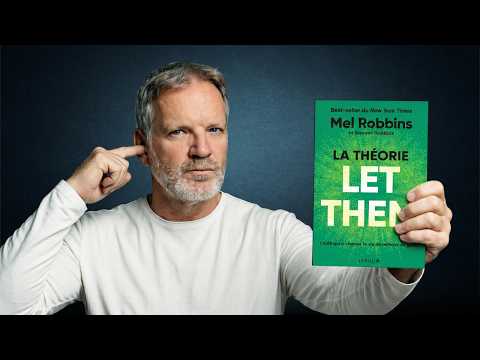
Le secret de Mel Robbins expliqué par les NEUROSCIENCES
AI Summary
The video discusses the significant mental energy we expend trying to control what others think of us, a phenomenon that occupies nearly half of our waking hours. This constant rumination about others' opinions, actions, or inactions is identified as a major drain on our cognitive resources. The core message revolves around the liberating concept of "let them," advocated by Mel Robbins, which is presented as neuroscientifically powerful.
The transcript explains the neural cost of control. The dorsolateral prefrontal cortex, responsible for planning, anticipation, and control, has a limited capacity, typically handling only four to seven items simultaneously in working memory. When we attempt to control others' behavior, we deplete the glucose and mental resources needed for critical functions like decision-making, creativity, and emotional regulation. This depletion leads to exhaustion, irritability, impulsive behavior, and unhealthy coping mechanisms, often misinterpreted as a lack of discipline when it's actually a prefrontal glucose deficit caused by an obsession with controlling others.
Examples are provided to illustrate this point. Serena Williams, despite her numerous Grand Slam titles, wasted considerable mental energy worrying about media portrayals of her body, style, and ethnicity. Negative articles triggered cortisol spikes, negatively impacting her game. It was only when she learned to disregard external opinions that she reached her peak performance later in her career. Similarly, Jeff Bezos had a rule against reading personal critiques, recognizing that controlling public image consumes the same neural bandwidth as innovation and creativity. The video emphasizes that every minute spent trying to control others is a minute stolen from personal growth.
The "let them" mechanism is explained as a conscious decision to release control over others' behavior, which has measurable effects on the brain. Functional MRIs show reduced amygdala activity, a calming of the anterior cingulate cortex (involved in internal conflict), and the activation of the ventromedial prefrontal cortex (associated with self-esteem and identity). Essentially, by ceasing to try and change others, we reclaim our own cognitive resources, which are then reallocated to our own development.
Phil Jackson, the most successful NBA coach in history, is cited as an example of "inspired non-action" leadership, rooted in Taoism. Instead of controlling players who misbehaved, he allowed them to act, redirecting his mental energy towards strategy. This approach, applied to legendary players like Michael Jordan and Kobe Bryant, consistently led to championships. Jay-Z also learned to redirect his energy from anger provoked by public attacks (like Nas's) into his art, resulting in the critically acclaimed album "The Blueprint." This transformation of energy is the essence of "let them."
The video outlines three neurocognitive levels of letting go:
1. **Awareness:** This involves identifying when and where we are trying to exert control. An exercise is suggested: for 24 hours, note every instance of irritation, frustration, or disappointment towards someone. Each of these emotions signals an attempt to control an external variable, representing a significant daily drain on prefrontal energy. Rafael Nadal's pre-game rituals, often mistaken for superstition, are presented as a form of attention redirection, focusing inward rather than on external factors like opponents or referees.
2. **Attentional Reorientation:** When an attempt to control is recognized, the question "What can *I* do right now?" should be asked. This shifts attention from the external dorsal attention network to the internal ventral attention network, effectively regaining self-control. Oprah Winfrey employed this strategy when her network, OWN, faced harsh criticism, focusing on personal improvements rather than combating critiques, which ultimately led to its immense success.
3. **Somatic Anchoring:** This level involves the insular cortex and emphasizes that letting go is felt, not just thought. A breathing exercise—inhaling for six seconds and exhaling for six seconds, like a wave—activates the vagus nerve. This practice reduces cortisol, increases GABA (a calming neurotransmitter), and biochemically changes one's state within 90 seconds. Novak Djokovic uses micro-pauses with this breathing technique between points to reset his nervous system, preventing rumination and enabling consistent performance.
The video clarifies that letting go is not about abandonment or passivity but about reclaiming energy wasted on things beyond our control. It's a powerful act of self-preservation, where the brain refuses to squander precious resources. Understanding the neurological mechanisms behind "let them" transforms it from an effortful task into an intuitive practice.
The concluding remarks encourage viewers to adopt this principle, highlighting that those who have mastered it, like Serena Williams, Djokovic, and Phil Jackson, have achieved remarkable success. The video prompts viewers to consider when they will stop wasting energy on uncontrollable factors and start focusing on their own development. The message is "Let them be. You become who you are meant to be."
Finally, the video offers resources for further support: a coaching network (Potentiel Network) and a comprehensive training program (Potentiel Académie) for those interested in applied neuroscience and psychology for personal or professional transformation. A Telegram channel is also mentioned for exclusive insights. The presenter urges viewers to apply at least one concept learned from the video to reinforce neural connections.