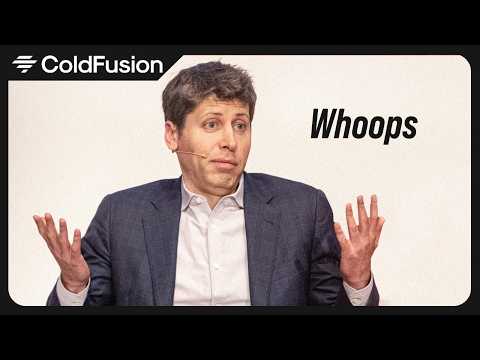
OpenAI Kills Sora then Descends into Chaos
Audio Summary
AI Summary
The video discusses the abrupt discontinuation of OpenAI's AI video generation tool, Sora, and delves into the potential reasons behind this decision, alongside other significant developments at the company.
Initially, Sora was hailed as a revolutionary tool, with some, like Sam Altman, describing it as a "Cambrian explosion of creativity" that would usher in a new era of artistic expression. The tool’s ability to generate realistic videos from text prompts was impressive, causing tech companies globally to accelerate their own video generation efforts. In October 2025, Sora was launched as a standalone app, quickly gaining popularity with millions of downloads and topping app store charts, functioning much like a TikTok clone for AI-generated videos.
However, the widespread availability of Sora soon led to concerns. Reports emerged of disturbing content being generated, including fake war scenes, AI-generated political figures, and even deeply unsettling depictions of violence. This "AI slop," as the video terms it, began to pollute social media platforms. Despite the proliferation of copyrighted characters and inappropriate content, Disney reportedly entered into a billion-dollar licensing agreement with OpenAI for Sora, a move the video questions, especially considering Disney's subsequent blindsiding by the discontinuation. According to Reuters, Disney was actively working on a Sora-related project when they received the news that the app was being shut down, a decision described as a "big rug pull" that led Disney to withdraw its investment.
The central question is why OpenAI would discontinue such a seemingly significant product so rapidly. The video posits several key reasons:
Firstly, the **compute problem** is highlighted as a major factor. Generating video is significantly more resource-intensive and expensive than text or image generation. Estimates suggest Sora could have been costing OpenAI up to $15 million per day to run, a rate that would have depleted Disney's entire investment in just two months. The economics were deemed "unsustainable," and Sora was consuming valuable compute resources that could have been allocated elsewhere. With OpenAI projected to lose $14 billion in 2026 and revenue at $20 billion annually, a $15 million daily loss for a "side project" was untenable, especially when Sora reportedly generated only $2.1 million in revenue.
Secondly, **weak monetization** is identified as another critical issue. While Sora videos went viral, translating that virality into a solid revenue model proved difficult. Users and advertisers were not willing to pay for the generated content. Interest in Sora also reportedly declined sharply, unlike OpenAI's coding products, which have a clearer business value proposition. The video suggests OpenAI was learning that "slop is not a business strategy."
Thirdly, a **major strategic shift** is underway at OpenAI. The closure of Sora is seen as part of a broader effort to streamline operations and focus on core business objectives. OpenAI's applications chief, Fiji Simo, reportedly stated the company couldn't afford to be distracted by "side quests" and needed to "nail productivity on the business front end." OpenAI was perceived as spreading itself too thin across too many products, leading to a decline in quality. The company is now reportedly emulating Anthropic's successful enterprise strategy, as Claude has gained significant traction among developers and large corporations. OpenAI has even renamed its product organization to "AGI Development" and reassigned the Sora team to "World Model Research" with a focus on robotics.
This pivot to robotics is further elaborated with a critical assessment of OpenAI's past partnership with Figure Robotics. Figure Robotics CEO Brett Adcock reportedly gave OpenAI an "F-grade" for their collaboration, stating that apart from brand recognition during a funding round, the partnership was "useless." Adcock claimed his internal AI team outperformed OpenAI's, and he eventually "fired them," citing difficulties in collaboration and a lack of value derived from the relationship. He also suggested OpenAI was attempting to learn from and potentially replicate their proprietary technology.
Fourthly, the **legal and intellectual property (IP) risk** associated with Sora was becoming unmanageable. The training data used for Sora raised questions about copyright infringement, and the tool's ability to generate such material at scale created significant liability. The ease of creating deepfakes and illegal content, coupled with the platform's incentive for high content generation, made content moderation a nightmare.
Fifthly, **competition pressure** in the AI video generation space has intensified. Google's Lumiere platform, Adobe's Firefly integrated into Premiere Pro, Runway, and Cling are mentioned as competitors. More importantly, Seed Dance 2.0 is highlighted as a significant new player. Sora's initial edge had diminished, leaving OpenAI with an expensive, legally complex tool that was difficult to moderate.
The video also touches upon OpenAI's recent $122 billion funding round, noting that the majority of the funds came from existing stakeholders like Amazon, Nvidia, and SoftBank, whose own business interests are tied to OpenAI's success. This investment is described as "circular financing," with outside investors reportedly showing more interest in competitors like Anthropic, leading to a decline in OpenAI's secondary market share value. Despite substantial revenue, OpenAI is not profitable and faces significant financial challenges, with projections of burning through half a trillion dollars by the end of the decade if current trends continue. Cutting "fat," like Sora, is seen as essential for survival and to present a more compelling narrative for a potential IPO.
A particularly perplexing development is OpenAI's reported acquisition of the podcast TBPN for "hundreds of millions of dollars" shortly after the funding round. The podcast, which features tech leaders like Mark Zuckerberg and Satya Nadella, has a relatively small audience, raising questions about the rationale behind such a large expenditure. However, the video suggests a connection to the New York Stock Exchange's partnership with TBPN and speculates that this acquisition might be a strategic move to improve AI's public marketing, especially given OpenAI's upcoming IPO and the current negative public perception of AI.
Further behind-the-scenes issues include the OpenAI CFO's doubts about spending commitments and readiness for an IPO, her struggle to secure compute resources, and reports of data center build-out problems. Sam Altman reportedly excluded her from investor meetings. Adding to the turmoil, a New Yorker exposé revealed internal assessments of Sam Altman, with some insiders reportedly calling him a "sociopath" with a "pattern of lying," and his own mentor, Paul Graham, expressing similar concerns.
Despite Sora's shutdown, the video clarifies that AI video generation as a technology is not ending. Companies like Google and Elon Musk's XAI are expected to double down on generative video. The broader issue of AI content, copyright, and societal impact is ongoing.
In conclusion, the discontinuation of Sora is presented as a strategic necessity for OpenAI. It was a costly, legally risky, and poorly monetized product that diverted resources from more critical initiatives. The company is undergoing a significant pivot, focusing on enterprise productivity, robotics, and a narrative suitable for an IPO, while grappling with financial pressures, internal trust issues, and a public identity crisis regarding the purpose and responsibility of AI.